Vegetarian & Vegan in Japan 2026 – the practical guide for travellers
Contents
If you eat a vegan diet and would like to travel to Japan, you often hear the same half-sentence: “But Japan is a fish country.” True – and not true. Japan in fact maintains one of the oldest living vegan food cultures in the world: shōjin ryōri, the Buddhist temple cuisine, has been purely plant-based for almost 1,500 years. New vegan restaurants open every year in Tokyo, Kyoto and Osaka.
The key points in brief
- Travelling vegan: with good preparation Japan works remarkably well – it only becomes difficult unplanned.
- The dashi problem: almost every classic dish contains hidden fish stock or bonito flakes.
- The decisive sentence: “Katsuobushi to dashi mo dame desu” rules out precisely these invisible ingredients.
- Best addresses: Tokyo, Kyoto and Osaka have the largest scene; in a shukubō on Mount Kōya the kitchen is vegan in any case.
- Settle the ryokan in advance: a vegan kaiseki adaptation needs at least two weeks of lead time.
And yet there is a reason why many vegan travellers set off for Japan with mixed feelings: almost every classic Japanese dish contains fish stock or bonito flakes – ingredients that are invisible to Western eyes. Even the miso soup, even the tempura, even the salad dressing. Anyone who does not know this ends up eating far more fish in Japan than they would wish.
We have lived in Japan for more than ten years and plan journeys for English-speaking guests – including those who arrive with vegan or vegetarian requirements. This article sums up what works, what does not, and how a vegan journey to Japan actually succeeds. Without glossing anything over, but without exaggeration either.
Shōjin ryōri – the ancient vegan cuisine of Japan
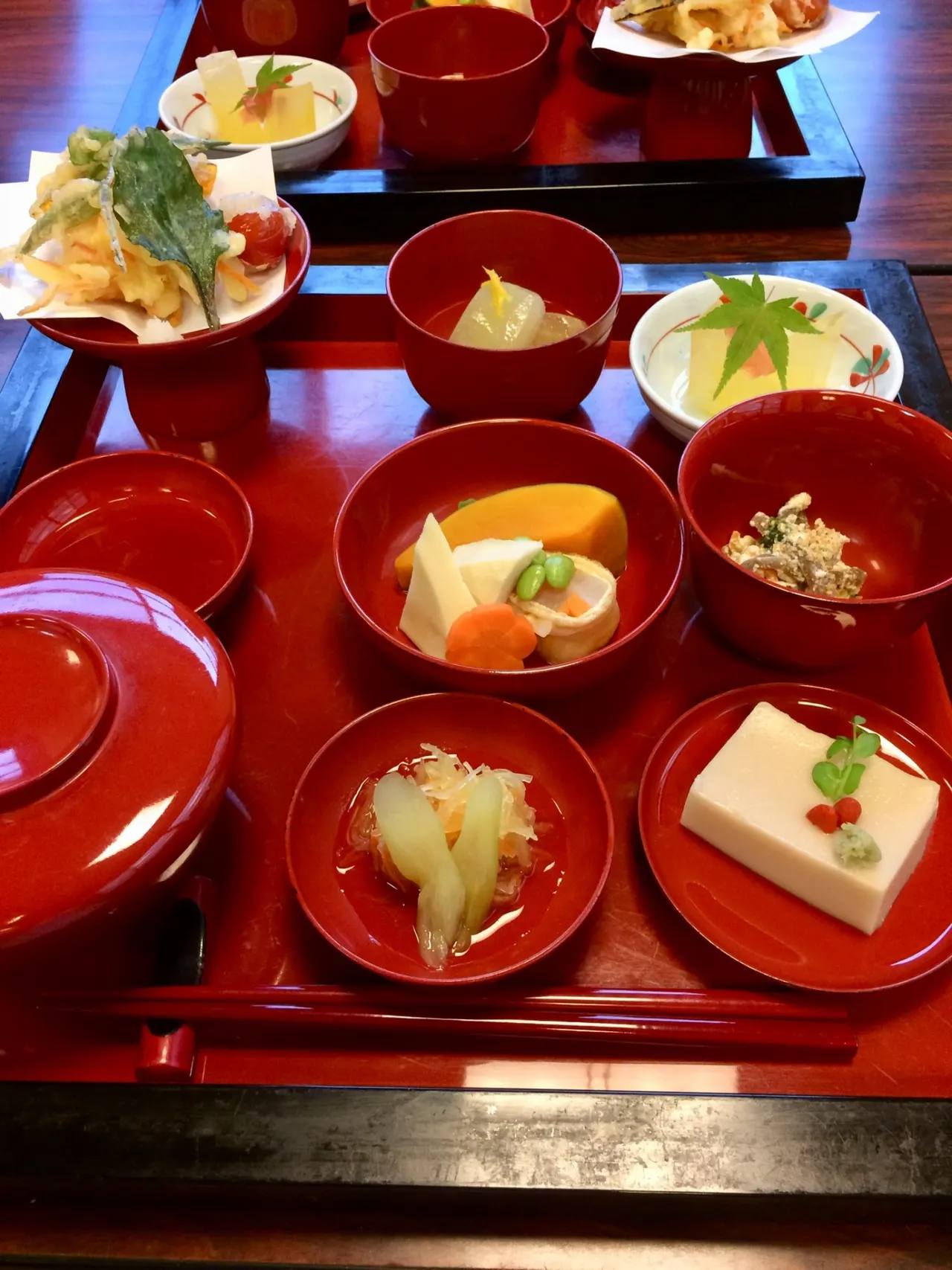
Shōjin ryōri(精進料理) is Japan’s Buddhist monastery cuisine – entirely plant-based since the 6th century, without meat, fish, eggs or dairy. Buddhism brought with it the prohibition on killing animals – and with it this cuisine, whose name means something close to “the cuisine of devotion”. A tradition that surprises many Western travellers.
What at first sounds like renunciation is in truth one of Japan’s most refined food cultures. Tofu is turned into dozens of variations, sesame is ground into creamy sauces, and vegetables of the season are served in several textures. A classic shōjin tray consists of five colours, five flavours and five methods of preparation – a small philosophy on a single platter.
You can experience this cuisine in several places in Japan, most vividly in a temple itself. Three recommendations that we regularly build into our journeys:
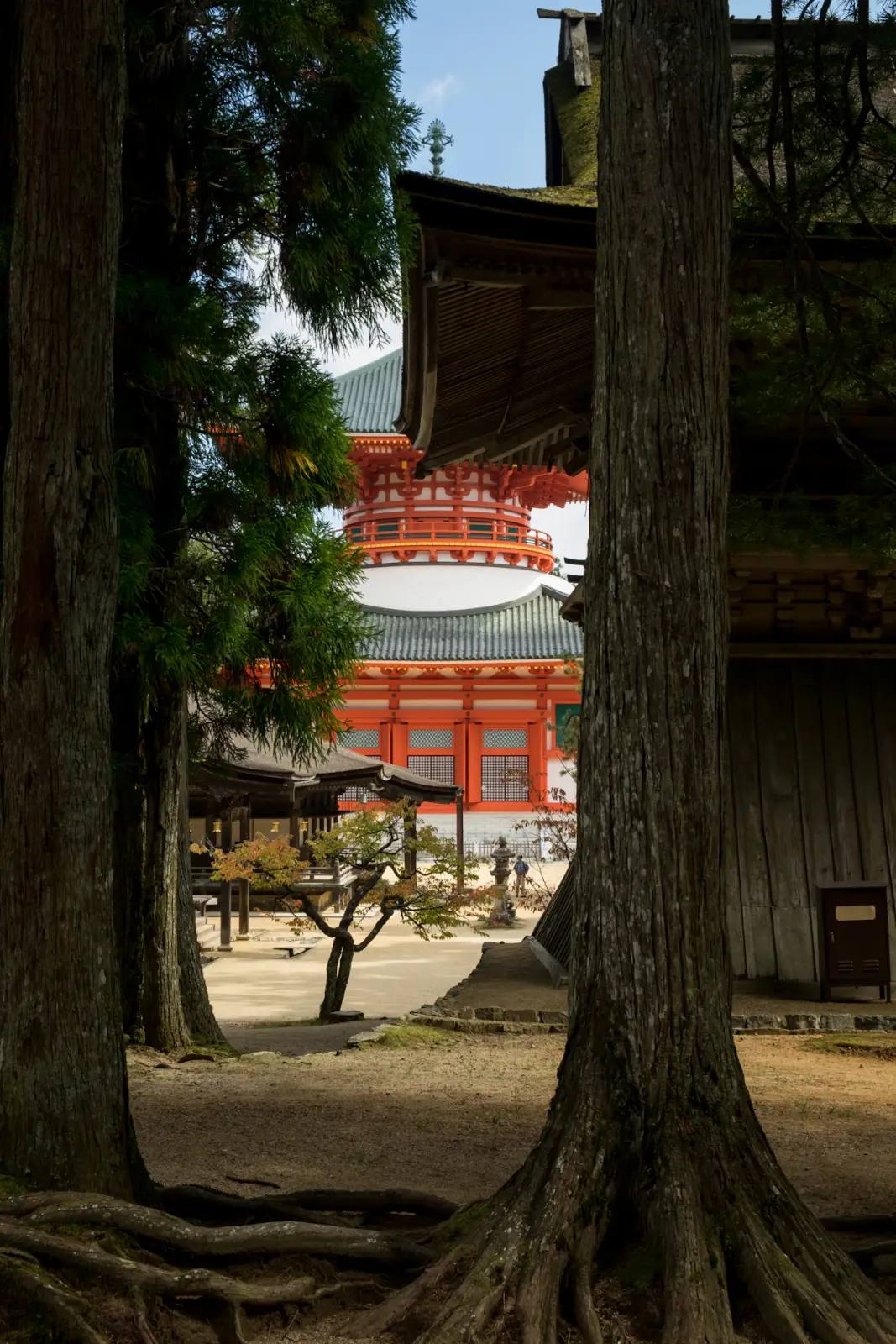
- Mount Kōya (Kōyasan), Wakayama Prefecture. A sacred mountain settlement with 117 temples, 52 of which take in guests. In a so-called shukubō you stay in simple tatami rooms and receive a completely vegan temple meal in the morning and in the evening. For many travellers the high point of the journey through Japan.
- Eihei-ji monastery, Fukui Prefecture. The head temple of Sōtō Zen Buddhism, more remote and quieter than Kōyasan. Overnight stays are possible; the experience is more contemplative.
- Restaurants in Kyoto. If you would rather not spend a night in a monastery, Shigetsu (in the temple garden of Tenryū-ji) or Izusen (in the sub-temples of Daitoku-ji) serve a classic shōjin lunch in impressive surroundings.
The dashi problem – the invisible animal ingredient
If there is one reason why many vegan travellers in Japan unintentionally eat fish despite the best preparation, it is this: dashi (出汁). Dashi is the base stock of the entire Japanese kitchen – and in its classic form it consists of two ingredients: kombu (edible kelp, purely plant-based) and katsuobushi (flakes of smoked, fermented bonito – a fish from the mackerel family, related to tuna but not the same).
The problem: these bonito flakes are in almost every dish you would imagine to be “vegetarian”. The miso soup at your breakfast. The broth of your soba. The sauce for your tempura. Even the harmless-looking wasabi dressing on the salad. To a Japanese eye, “dashi” does not count as “fish” – it is simply the base. For you as a vegan or vegetarian, it is an animal product every time.
So that you have a realistic picture of what “looks vegetarian but is not”, here is an overview of the most common traps:
| Dish | Hidden animal ingredient | Likelihood |
|---|---|---|
| Miso soup | Dashi with bonito flakes | almost always |
| Tempura dipping sauce (tentsuyu) | Dashi, mirin | almost always |
| Soba & udon broth | Dashi, often dried sardines as well | almost always |
| Okonomiyaki | Bonito flakes in the batter & on top, sauce with fish extract | almost always |
| Salad dressing (goma, wafū) | Fish extracts | often |
| Onigiri with “kombu” | Rice often seasoned with bonito stock | medium |
| Vegetable tempura in a restaurant | Egg in the batter, bonito in the dipping sauce | often |
| Curry rice (karē raisu) | Stock often meat- or fish-based | often |
Anyone who has been to Japan before and thought they were eating vegetarian has in all likelihood eaten bonito flakes along the way. This is not ill will on the part of the restaurants – most cooks simply understand “vegetarian” as “without a piece of meat”. If you want to rule out dashi, you have to say so explicitly. Exactly how is the subject of the next section.
Communicating in Japanese – the most important phrases
Two tools will carry you safely through Japan on questions of diet: a few key phrases in Japanese and a printed card. English takes you further here than many expect – but on this particular subject it quickly reaches its limits. The problem is not the language, it is the concept: “vegan” is by now a familiar word, while “without dashi” is by no means taken for granted.
| What you want to say | Japanese (in Latin script) | When to use it |
|---|---|---|
| I am vegan. | Watashi wa vēgan desu. | Opening sentence |
| I cannot eat any animal products at all. | Dōbutsusei shokuhin wa issai taberaremasen. | A clear statement, for safety |
| Bonito flakes and fish stock are not possible either. | Katsuobushi to dashi mo dame desu. | The decisive sentence |
| Eggs and dairy are not possible either. | Tamago to nyūseihin mo dame desu. | Important for strict vegans |
| Is there something I can eat? | Taberareru mono wa arimasu ka? | A polite closing question |
At least as effective as the spoken word is a printed dietary card: a small card in your wallet that sums up your restrictions in Japanese – ideally with a polite form of address and a word of thanks at the end. In the restaurant you hand the card over when ordering; the staff can read it calmly, show it in the kitchen and then tell you what is possible. For our guests we prepare such cards personally.
The internationally established app HappyCow works well in Tokyo, Kyoto and Osaka for finding vegan and vegetarian restaurants. You should not rely on it alone – small places close without notice, opening hours shift, and in more rural regions the choice becomes thin. We recommend booking on the day itself or one day ahead, especially in the evening.
City by city: where you can eat vegan in 2026
The vegan scene in Japan is heavily concentrated in a few cities. In Tokyo, Kyoto and Osaka you will find a growing choice of purely vegan restaurants; in smaller towns and in the countryside you will have to be creative. A short tour with addresses that we recommend ourselves.
- Tokyo – the largest scene in the country. Ain Soph. Journey in Shinjuku is a good place to start (pancakes, burgers, entirely vegan); T’s Tantan right inside Tokyo Station is practical for travellers before or after a shinkansen journey; Saido in Jiyūgaoka serves traditional Japanese dishes in a vegan reading, at a refined level.
- Kyoto – home of shōjin ryōri and therefore good ground. Shigetsu in the temple garden of Tenryū-ji offers the classic temple meal; Mumokuteki Cafe in the Teramachi shopping district offers a relaxed, younger reading with dishes of the day.
- Osaka – in culinary terms a city of meat and seafood, but with islands: Paprika Shokudo Vegan near the castle offers a down-to-earth Japanese menu, and Optimus Cafe in Tennōji is a quiet address for lunchtime.
- Kanazawa, Hiroshima, Fukuoka – a smaller choice, but two or three reliable addresses in each, which we are glad to recommend individually. In rural regions, temple lodgings and a hotel kitchen that accepts special requests are often the safest option.
We adapt specific recommendations and reservations to your travel programme. Restaurant addresses change faster than an article can follow; we check the list again before every journey.
Ryokan and hotel – settling your diet in advance
You will eat vegan in a ryokan if you settle it in advance: many houses adapt the menu on request – but not spontaneously and not everywhere. A night in a traditional ryokan belongs on the journey through Japan for many guests, vegan ones included. Dinner, the classic kaiseki, is however traditionally shaped very strongly by fish and seafood.
What really counts is the lead time. A vegan kaiseki adaptation needs at least two weeks, often rather three to four. The head chef has to order ingredients and rethink the menu – around tofu, yuba, seasonal vegetables, mushrooms and vegan stocks. If you ask on the day of arrival, you will get a makeshift solution at best – and nothing at all at worst. We regularly take on this advance clarification for our guests and know the houses that are genuinely well prepared for it.
A category of their own are the shukubō – temple lodgings, above all on Mount Kōya. There the entire kitchen is vegan from the outset; you have nothing to clarify and nothing to explain. For vegan travellers, a night on Kōyasan is often the most relaxed point of the whole journey.
You can read more about the world of traditional inns, the onsen bath and the kaiseki experience in our complete ryokan guide.
Konbini and supermarket – everyday supplies
You can certainly shop vegan in the Japanese convenience stores – konbini for short – but it does require some attention to the ingredient list (in Japanese, often decipherable with the Google Translate camera). You will find 7-Eleven, FamilyMart and Lawson on almost every corner, open around the clock – they are the backbone of the journey.
Reliably vegan as a rule are: onigiri with umeboshi (pickled plum), inari sushi (rice in a tofu pouch), salted edamame, dried seaweed and many kinds of fruit. Take care with rice balls containing kombu: some are made with bonito stock – only the ingredient list helps here. Be very careful with baked goods: bread in Japan often contains milk, cream or egg without showing it.
In larger supermarkets (Aeon, Seijo Ishii, Bio c’ Bon) the range of vegetarian and vegan products is growing as well, from oat milk to plant-based ready meals. For a longer stay in one city it is worth doing one bigger shop – as a reserve for when a restaurant visit turns out to be unexpectedly difficult.
Allergies and gluten-free – a brief note
If, in addition to a vegan diet, you have allergies – to nuts, soy or gluten – you should be particularly careful. Soy is in a great many Japanese dishes – in soy sauce and miso, which are often used to season soups and sauces, and in tofu. A journey that is vegan and soy-free is possible, but very restricted. Gluten-free is demanding as well, since soy sauce traditionally contains wheat. Special soy sauces made from pure soy (tamari) are an alternative, but have to be asked for explicitly.
The good news: Japan takes allergies in the medical sense very seriously – communicating about them often works better than communicating purely about a way of life. On the menus of many restaurants you will now find an allergen symbol for the most common triggers.
How we plan your vegan journey through Japan
You can do all of this research on your own. Many of our guests have at least tried – and then decided after all to place the preparation in our hands. What we take on specifically when you travel with us:
- Advance clarification with ryokan and restaurants in Japanese. We call before booking, speak directly with the kitchen and confirm what can be adapted and what cannot. A request in Japanese – straight to the kitchen – can usually be settled faster and more precisely than an e-mail in English.
- A selection of houses that can genuinely cook vegan. Some ryokan are excellently prepared for vegan guests, others are simply at a loss. We know the difference.
- A personal dietary card. We produce a printed card in Japanese for you – politely worded, with your personal exceptions and a clear word of thanks.
- Reserving temple stays. A night in a shukubō on Kōyasan is often hard to book from Europe. We take care of the reservation and settle the journey there and the time windows.
- A restaurant list that matches your route. Instead of a generic list you receive addresses that fit your overnight stays and your routes – and which we verify once more before the journey begins.
We are Japan Privat: a Japan-based travel designer for individual journeys through Japan, advising you in English. We live here, we know the houses personally – and for vegan guests we turn a complicated piece of research into a calm start to the journey.
A vegan journey through Japan – planned together
Tell us about your ideas and the way you eat – and we will design a journey from them in which food does not become a daily challenge.
Book a free 30-minute consultationFrequently asked questions
Is Japan a good destination for vegans?
With good preparation: yes. Tokyo, Kyoto and Osaka have a growing scene of purely vegan restaurants, and alongside it stands the ancient tradition of shōjin ryōri in temples and monasteries. It becomes difficult without preparation – because almost every classic Japanese dish contains fish stock (dashi) or bonito flakes (katsuobushi), which are invisible to Western eyes. If you know the right phrases and the right places – or have a specialist at your side – Japan is a remarkably good country to travel in as a vegan.
What is shōjin ryōri?
Shōjin ryōri (精進料理) is Japan’s Buddhist temple cuisine – entirely plant-based for almost 1,500 years. It leaves out meat, fish, eggs and dairy, as well as the five pungent spices (garlic, onion, leek, shallot and chive). The experience is traditionally offered in monasteries such as those on Mount Kōya (Wakayama) or at the Eihei-ji monastery (Fukui), often as part of an overnight stay in a temple (shukubō).
Can I eat vegan in a ryokan?
Yes, but not spontaneously. The classic kaiseki menu of a ryokan almost always contains fish and seafood. Good houses will adapt the menu on request – but they need at least two weeks of lead time and clear communication in Japanese. We regularly take on this advance clarification for our guests. In temple lodgings (shukubō) on Mount Kōya the entire kitchen is vegan in any case.
Which apps help me find vegan restaurants in Japan?
The best-known international app is HappyCow, whose database lists vegan and vegetarian restaurants worldwide. Coverage is good in Tokyo, Kyoto and Osaka. For translating ingredient lists on Japanese packaging, Google Translate with its camera function does excellent work. You should not rely on apps alone – opening hours change and small places close without notice.
How do I explain my vegan diet in Japanese?
The most important sentence is: Watashi wa vēgan desu, dōbutsusei shokuhin wa issai taberaremasen (I am vegan and cannot eat any animal products at all). The decisive addition is: Katsuobushi to dashi mo dame desu (Bonito flakes and fish stock are not possible either). Without this note you will often be served supposedly vegetarian dishes made with fish stock. A printed, multilingual card is often more helpful in a restaurant than any spoken sentence.
About the author

Kentaro Asakura
Founder of Japan Privat · A Japan specialist who guides you in English
Kentaro Asakura was born and raised in Japan. His student years took him first to the UK, where English became second nature to him, and later to Munich, where he met his wife, who is German – together they returned to Japan. With Japan Privat, he has been designing individual journeys for European travellers for more than ten years – in English, with the eyes of a local and a genuine feel for what guests from Europe are looking for.