Ryokan: The Complete Guide to Your Stay in Japan
Contents
If you ask us what the most unforgettable experience of a journey through Japan is, we say without hesitating: a night in a ryokan. Nowhere else in the world do hospitality, architecture, cuisine and stillness merge into such a deeply affecting whole. A ryokan is not a hotel – it is an invitation to become part of a centuries-old culture for a few hours. In this guide we explain everything you should know for your first (or next) ryokan experience.
In brief – what is a ryokan?
A ryokan (旅館) is a traditional Japanese inn with tatami rooms, futon bedding, its own onsen bath and a multi-course kaiseki dinner. Unlike a hotel, it is a complete experience of staying somewhere – many houses have been run by the same family for generations.
Are you planning an individual journey through Japan? This piece is part of our large overview. You will find the complete guide – with the best time to travel, routes, cost and planning – here: Independent Travel in Japan 2026 – the complete guide.
Current situation: the earthquake in Kumamoto of 28 July 2026
All information as of 14 October 2026.
Of the onsen places we recommend here, only Kurokawa lies in Kumamoto Prefecture. Hakone and Kinosaki are several hundred kilometres away, and from the neighbouring prefecture of Ōita, which includes Beppu, only isolated damage has been reported.
Detailed travel advice and sources
On 28 July 2026 at 16:27 local time, an earthquake of magnitude 7.1 struck the south of Kumamoto Prefecture on Kyūshū. In Uki and Hikawa it reached Shindo 7, the highest value on the Japanese intensity scale. The official tally gives, as of 5 October, 38 deaths – including two that may have been caused indirectly by the earthquake – and 43 people seriously injured. 1,288 people are still in emergency shelters, down from almost 10,000 at the peak. Mains water has been available everywhere again since 28 August – more on that below. The number of damaged homes, by contrast, keeps rising: the fire and disaster agency now counts around 70,000, some 25,000 more than on 9 September – not because new damage is occurring, but because the official survey is still working its way through one place after another. Depending on which body you quote, the totals differ widely; the figure we give here is the one from the fire and disaster agency. Our thoughts are with the people there.
For a journey through Japan as a whole, nothing changes. The affected area is the south of Kumamoto – around 900 kilometres from Tokyo and about 500 kilometres from Kyoto. Japan has issued no entry restrictions and no nationwide travel restrictions in connection with the earthquake; outside the south of Kumamoto, travel continues as normal. Official travel advice is something each country issues for its own citizens, so before you book, please look at what your own foreign ministry currently says about Japan – that is what applies to you, not this page.
What currently applies on Kyūshū (as of 14 October; the situation changes daily):
- Kurokawa Onsen itself recorded Shindo 4 and reports no significant damage. According to the village’s most recent statement, dated 29 July, ryokan and shops are working normally; a few individual houses are closed.
- Getting to Kurokawa remains possible – via Fukuoka. The long-distance bus from Fukuoka is operating to schedule as before, and so is the Kumamoto–Fukuoka connection. The trans-Kyūshū bus Kumamoto–Kurokawa–Yufuin–Beppu, which was still cancelled entirely on 29 July and ran only thinned out through August, has been operating in full again since 1 September; Kurokawa is therefore reachable from the direction of Kumamoto as normal once more. Also back since 1 September is the bus line from Kumamoto up to the Aso plateau. The crater itself, however, stays closed: the weather agency lowered the alert level from 3 to 2 on 1 September and the local authorities pulled the cordon back to about one kilometre on 2 September – the plateau is reachable again, the view into the crater is not.
- The interrupted Shinkansen stretch south of Kumamoto has carried through trains again since the first service on 18 September. Two restrictions remain: over about ten kilometres of that stretch the trains still travel at roughly 70 km/h instead of 260, which shifts the times at Kagoshima by a few minutes – southbound you arrive later, northbound the trains depart earlier. And five Sakura and Mizuho services stay cancelled between Kumamoto and Kagoshima.
- The expressway is open along its whole length, and since 13 October no railway line has been interrupted either. The Kyūshū Expressway has carried ordinary traffic along its whole length again since 14 August – the last closed part of it reopened at 6 a.m. One restriction remains: at a damaged bridge south of Kumamoto, the deck of the Fukuoka-bound carriageway is so badly deformed that for about one and a half kilometres both directions share the opposite carriageway. How long that lasts has been quantified since 28 August: the four lanes are not expected back until around the end of 2027. On the South Kyūshū Expressway a further stretch reopened on 18 August; only one short stretch there stays closed: a bridge deck has shifted and left a step of about one and a half metres in the road surface, and according to the operator’s statement of 29 September that stretch is not expected to reopen until around the end of 2028. Anyone who has to get around that gap is routed along ordinary roads, and the toll is adjusted so that leaving the expressway and rejoining it costs no more. For your planning this means Kyūshū can be driven from north to south. The regional trains are running throughout again as well: the line south of Kumamoto has been back in service along its whole length on the normal timetable since 10 October, and a second, separate railway along the west coast has been running along its whole length again since 13 October. This means no railway line remains interrupted by the earthquake.
- On mains water, it is done. On 28 August, one month after the earthquake, supply was restored across the whole disaster area; at the peak around 80,000 connections were without water at the same time. The municipalities had named “by the end of August” as their target and they held it. This is where Japanese recovery can best be judged: a date is rarely given early – but once it is given, it holds. Two qualifications belong to an honest answer: in four districts of Uki the water is still at reduced pressure, and in another town in the south of the prefecture, where only a little over half of households are on the public network, several thousand private wells are damaged and will take years to repair. Neither matters for your journey – for the people there it is the difference between “restored” and “normal”.
How we handle this: For journeys in the coming weeks we look at every Kyūshū section individually. Kurokawa, Yufuin and Beppu have been reachable from the direction of Kumamoto as normal again since 1 September. Kagoshima and Yakushima have been reachable by through Shinkansen again since 18 September; we now factor in a flight only where it fits the schedule better. For Yakushima a second question arises this autumn that has nothing to do with the earthquake: after the heavy rain at the beginning of September the roads up into the mountains were closed. For the road into the best-known valley there is still no date; full repair is expected to take about a year. The other roads up into the mountains, by contrast, have been open again since 16 September, and the compulsory shuttle to the oldest cedar has been running again since 17 September. The island is reachable, but not all of its famous cedar forests are. Because the expressway is open along its whole length, a rental car is an option for the south as well – we will tell you which of the two makes for the calmer few days.
And if something like this falls in the middle of a journey you have already booked? That is exactly the moment we exist for:
- We read the situation where it appears first. Transport operators, the weather agency and the prefecture publish in Japanese – often hours before any of it shows up in English, and some of it never does. We check every day, not only once you ask.
- We talk to your ryokan – in Japanese and directly. Whether a house waives the cancellation fee after a natural event, or moves your booking free of charge, differs from house to house and is rarely written into the booking conditions. We ask on your behalf and tell you honestly what comes of it.
- We rebuild the route instead of deleting days. If one section drops out, we propose an equivalent one – the same idea, a different region – and take care of the new overnight stays and connections while the rooms are still free. That is why we get in touch early and not on the day of travel.
- While you are travelling, we are in the same time zone as you. If a train is cancelled in the evening, the answer does not have to wait for the next morning in Europe.
If you are planning a journey with us, or have already planned one, please talk to us: we will tell you openly what is realistic for your travel dates – including when the honest answer is to move them. Please do not rely on this page alone for your travel arrangements; shortly before you set off, check the official sources.
Sources: Japan Meteorological Agency (JMA), portal on the earthquake, Cabinet Office / fire and disaster agency, situation report of 5 October, Kurokawa Onsen, statement of 29 July, JR Kyūshū, resumption of through Shinkansen service on 18 September and amended timetable (announced 31 August), regional line south of Kumamoto on the normal timetable from 10 October (announced 24 September), Hisatsu Orange Railway, resumption along its whole length on 13 October (6 October), Kyūshū Sankō Bus, timetable situation (1 September), NEXCO West, 17th situation report (13 August): reopening of the Kyūshū Expressway (PDF), Reopening on the South Kyūshū Expressway on 18 August (Car Watch, 17 August), NEXCO West, restoration of the four lanes towards the end of 2027 (28 August, PDF), NEXCO West, reopening of the closed bridge on the South Kyūshū Expressway towards the end of 2028 (29 September) All information as of 14 October 2026.
What is a ryokan?
A ryokan (旅館) is a traditional Japanese inn. Its origins reach back to the Edo period (17th–19th century), when such houses served as rest stops along the old trade roads. Today there are still several thousand ryokan in Japan – from modest family businesses to luxurious estates whose history goes back more than 300 years.
What makes them special: a ryokan is not merely accommodation but a complete experience. Tatami rooms, futon bedding, the house’s own onsen spring (hot thermal baths) and a multi-course kaiseki dinner are all part of the standard. In the better houses every guest is looked after by a personal Nakai-san (room attendant) – a form of hospitality that has no real equivalent in Europe.
Ryokan vs. hotel: the difference
The essential difference: in a Western hotel you sleep in a bed, bathe in your own bathroom and eat à la carte; in a ryokan you sleep on a futon on tatami, wear a yukata inside the house, bathe in a shared or private onsen and are served a multi-course kaiseki menu – dinner and breakfast are included in the price. Many of our guests are unsure at first whether a ryokan suits them. The differences from a Western hotel really are large – but that is precisely where the appeal lies.
| Feature | Western hotel | Japanese ryokan |
|---|---|---|
| Bed | Bed with a mattress | Futon on tatami |
| Floor | Carpet or wood | Tatami – shoes off |
| Clothing indoors | Your own clothes | Yukata (light kimono) |
| Bath | Private bathroom | Shared onsen or private onsen |
| Food | Restaurant à la carte | Kaiseki menu in your room or in the dining hall |
| Service | Reception + room service | A personal Nakai-san, attention to detail |
| Price per night (2 people) | €100–500 | €100–2,500 (including 2 meals) |
Our advice: if you are in Japan for the first time, we recommend 1 to 3 nights in a good ryokan – ideally in an onsen region such as Hakone, Kinosaki or Kurokawa. Kinosaki and Kurokawa have become very popular in recent years and are well visited, above all in the high season – we still recommend them, but advise booking in good time. The remaining nights in Western hotels in Tokyo and Osaka then give a pleasant balance.
Finding the right ryokan
There are thousands of ryokan in Japan – quality and character vary a great deal. We know the houses personally and will recommend the one that suits your wishes.
Ask for a ryokan recommendationThe rooms: tatami, futon and yukata
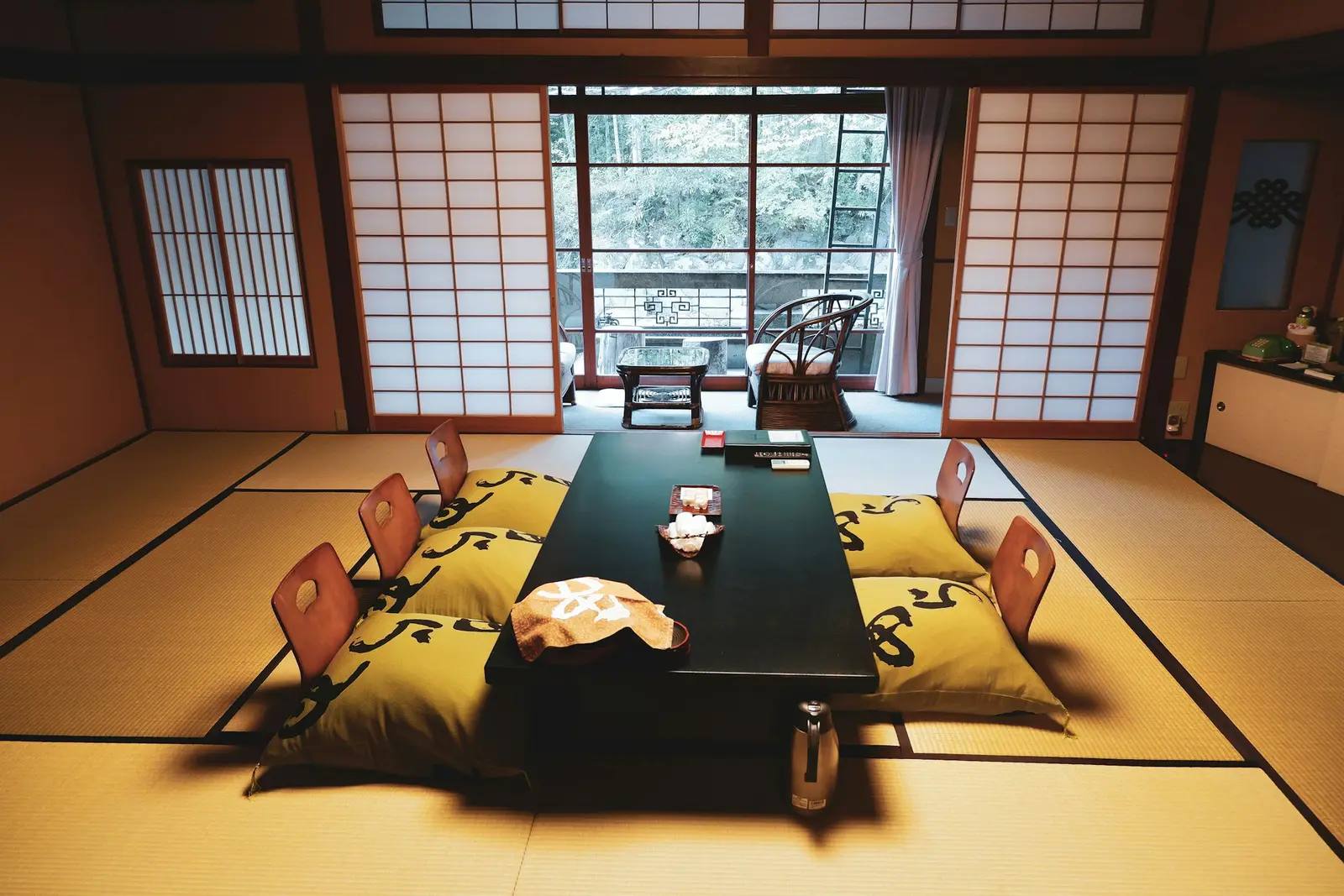
A ryokan room is made up of a few deliberately chosen elements: a tatami floor on which shoes are never worn, a futon that is rolled out in the evening, a yukata as indoor clothing, along with the tokonoma alcove and the shoji paper sliding doors. When you enter a ryokan room for the first time, its plain elegance will surprise you. No opulent furniture, no crowded decoration – instead a deliberately reduced space in which every element has its purpose. In many houses a cup of green tea with a small sweet is waiting to welcome you; which kinds of tea Japan knows, and what matters about them, you can read in our guide to matcha and Japanese tea.
Tatami – more than a floor covering
Tatami are woven rice-straw mats that cover the whole floor of the room. They are soft, smell faintly of straw and shape the atmosphere of the space. Shoes are never worn on tatami – not even the slippers you wear in the corridors of the ryokan. Before entering the room you take those off as well.
Futon – Japanese bedding
The futon is a thick, folded mattress that is rolled out on the tatami in the evening. During the day the room is clear – in the evening, while you are at your kaiseki dinner, your Nakai-san quietly prepares the bed. When you return to the room, everything is ready. The futon is, incidentally, surprisingly comfortable and is considered good for the back.
Yukata – your clothing in the ryokan
On arrival you are given a yukata – a light cotton kimono that you wear throughout your stay. At dinner, in the onsen, in the corridor, at breakfast. The yukata is worn left over right (the other way round is reserved for the deceased). Your Nakai-san or a friendly host will show you how it sits correctly.
Tokonoma and shoji
In a classic ryokan room you will find a tokonoma – a slightly raised alcove with a flower arrangement (ikebana) and a calligraphy scroll. The shoji are the white paper sliding doors that divide the room and let a soft light in. These elements are not decoration but the expression of an aesthetic philosophy that regards emptiness and stillness as beauty.
Kaiseki – dining in a ryokan
Kaiseki ryōri (懐石料理) – Japan’s traditional haute cuisine – is for many guests the highlight of their stay in a ryokan. A kaiseki menu consists of 8 to 15 small courses that present seasonal ingredients of the highest quality. Every course is served on special tableware chosen to match the season. If food is not a side matter for you but a reason to travel, read on in our piece on the culinary journey through Japan – it is about auberges, regional cuisine and how a route can be built out of eating.
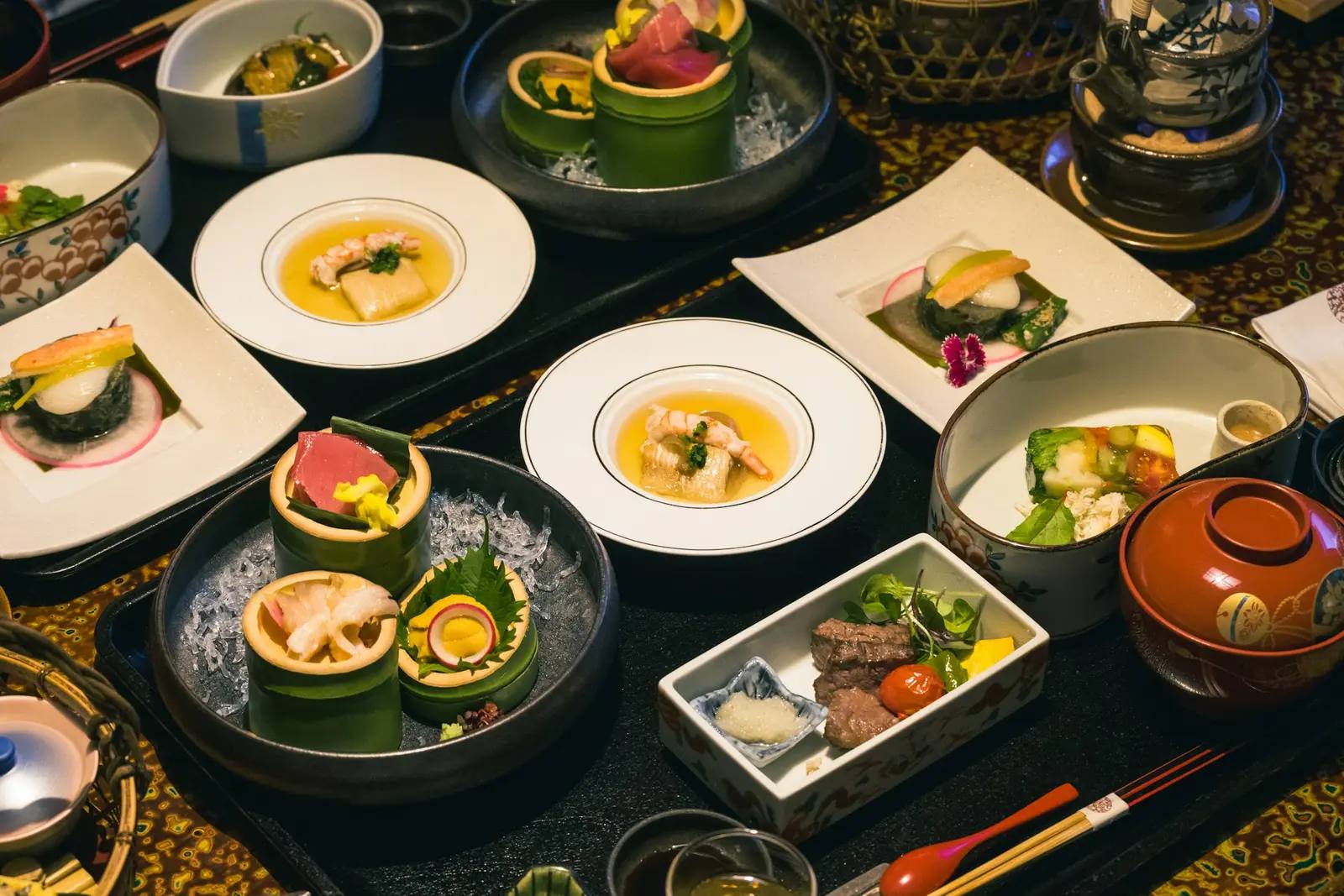
What to expect
| Course | What to expect |
|---|---|
| Sakizuke | Amuse-bouche, often with a piece of seasonal vegetable |
| Hassun | A composition of small seasonal morsels that capture the season on the plate |
| Mukozuke | Sashimi – the freshest fish from the region |
| Takiawase | Braised vegetables with meat or tofu |
| Yakimono | Something grilled – often seasonal fish or wagyu beef |
| Gohan | Rice with miso soup and pickled vegetables |
| Dessert | Fresh fruit or a traditional wagashi |
Our tip: tell us when you book if you have allergies or dietary restrictions (vegetarian, gluten-free, no seafood). Good ryokan adapt the menu as a matter of course – but they need lead time. At the last minute it is rarely possible.
Onsen: etiquette and rules
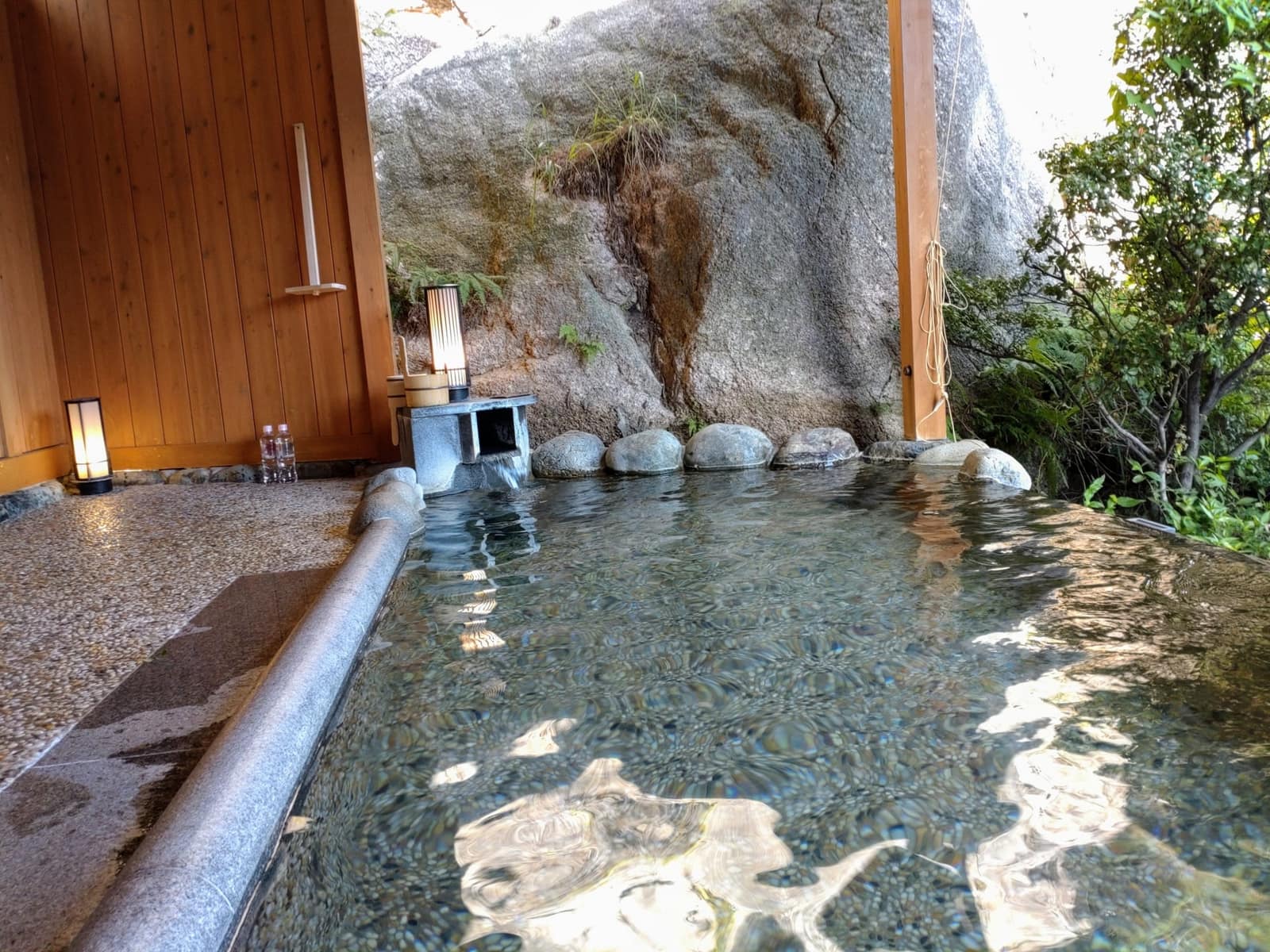
The onsen – the hot thermal bath – is the heart of every ryokan. The water comes from volcanic springs and contains different minerals depending on the region: sulphur, iron, sodium chloride or carbonate. It has been valued for its healing effect for centuries.
The most important rules
- Bathing without clothing: in the onsen you bathe without swimwear. There are cultural and hygienic reasons for this. You are given a small towel – it is for drying yourself and is left at the edge of the bath, not dipped into the water.
- Wash before bathing: in the anteroom there are showers with stools. Here you wash yourself thoroughly with shampoo and soap before you enter the onsen. This is the single most important rule.
- Separated by gender: most onsen are separated into a men’s and a women’s bath (recognisable by blue and red curtains, 男 for men, 女 for women).
- Quiet: onsen are places of relaxation. Quiet conversation is fine, loud laughter or phone calls are not.
- Tie your hair up: if you have long hair, pin it up. Hair should not hang into the water.
- The right length of time: most guests stay in the onsen for 10–15 minutes. The water is 40–43 °C – considerably hotter than baths in Europe. Many Japanese get in several times for short spells instead of staying in for long.
Tattoos in the onsen
One point that occupies many of our guests: tattoos. In Japan tattoos were historically associated with the yakuza, and many public onsen and bathhouses exclude guests with tattoos. This rule is still widespread in traditional ryokan.
The good news: there are now tattoo-friendly ryokan, and the number is growing. In addition:
- Small tattoos: with waterproof skin patches (available in larger pharmacies) you can cover small tattoos.
- Book a private onsen: many ryokan offer a kashikiri-buro (family or private bath). These are reserved exclusively for 30–60 minutes, and there tattoos play no part.
- A room with a private onsen: the most comfortable solution. These rooms have their own onsen bath on the balcony or the terrace.
Our advice: if you have tattoos, let us know. We select ryokan that are either tattoo-friendly or offer private onsen options – so that you do not have to do without anything.
For families: the kashikiri-buro
Are you travelling with children, or would you as a couple like to bathe together? The kashikiri-buro (貸切風呂, literally “exclusively booked bath”) is the answer. It is reserved for 30–60 minutes, and often a modest surcharge applies (2,000–5,000 yen, about €11–27). In many modern ryokan it is already included in the price.
Types of ryokan
Broadly speaking, four categories can be distinguished: luxury ryokan (€800–2,500) with a private onsen in the room, comfort ryokan (€400–800) with excellent cuisine, classic ryokan (€200–400) with an authentic, simpler experience, and minshuku (€100–200) as the family-run, warm-hearted variant. The categories below will help you make your choice:
| Category | Price (2 people, 1 night) | What to expect |
|---|---|---|
| Luxury ryokan | €800–2,500 | Private onsen in the room, kaiseki comparable to Michelin level, historic buildings (100+ years) |
| Comfort ryokan | €400–800 | Excellent cuisine, shared onsen, some rooms with their own bath |
| Classic ryokan | €200–400 | Authentic experience, simpler fittings, solid kaiseki |
| Minshuku | €100–200 | Family-run, simple variant – warm-hearted, but less formal |
The prices are guide values including two meals (dinner and breakfast). In the high season (cherry blossom, autumn leaves, New Year) they can be 30–50% higher.
The best ryokan regions in Japan: from Kyoto to Kyushu
Our favourites are Hakone near Tokyo, Kinosaki Onsen near Kyoto, Kurokawa Onsen in Kyushu, Nyuto Onsen in Tohoku, Ginzan Onsen in Yamagata, and Beppu and Yufuin in Kyushu. Japan has hundreds of onsen places, but a few regions are especially famous for their ryokan – each with a character of its own, which we introduce to you here.
Hakone (near Tokyo)
Only 80 minutes from Tokyo – the most popular onsen region for international guests. With the legendary view of Mount Fuji, the historic Hakone pass and a wide range of ryokan options. Ideal for 1–2 nights as part of a journey to Tokyo.
Kinosaki Onsen (near Kyoto)
A small town with seven public baths, all of which you may visit free of charge as a ryokan guest. The typical thing is to stroll from bath to bath in the evening in a yukata and wooden sandals (geta) – one of the most charming experiences in all of Japan. 2.5 hours from Kyoto.
Kurokawa Onsen (Kyushu)
A secluded mountain valley whose ryokan are all built in the same traditional style (no garish illuminated signs are permitted). Guests receive an “onsen pass” for three public baths. Our favourite for romance and quiet.
Nyuto Onsen (Tohoku)
Deep in the forests of Akita Prefecture. The ryokan here are centuries old, many with white, milky thermal water. In winter picturesquely covered in snow – you never forget the experience of a rotenburo (open-air bath) in the snow.
Ginzan Onsen (Yamagata)
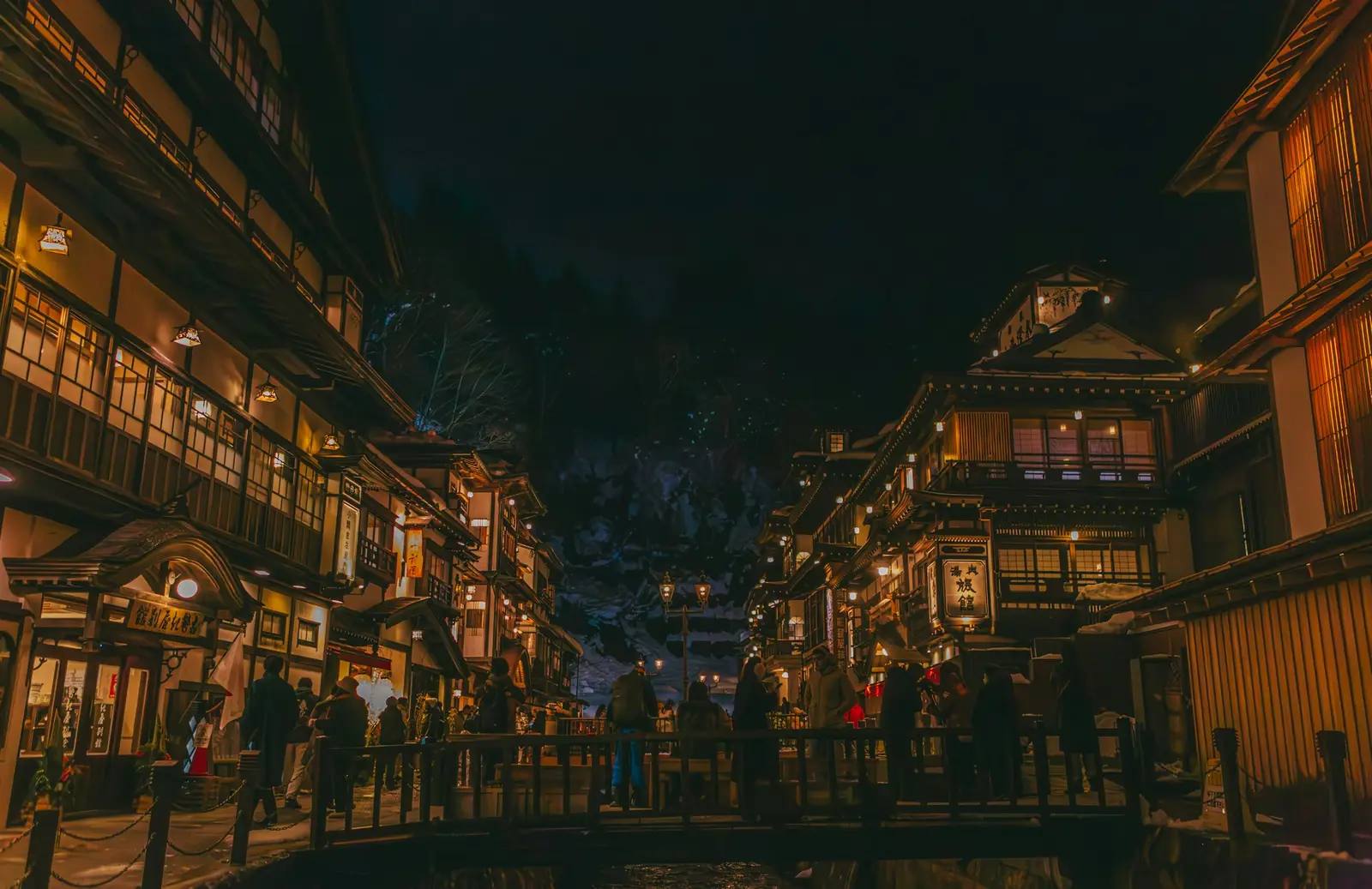
This small thermal town looks as if it came out of a Ghibli film – many fans consider it one of the inspirations for “Spirited Away”. Wooden buildings from the Taishō era (1912–1926), lit by gas lanterns in the evening. Magical above all in winter.
Beppu & Yufuin (Kyushu)
Beppu is Japan’s best-known “steam town” – spread across eight thermal spring districts (Beppu Hattō) and with seven of the ten officially recognised spring types in Japan, an extraordinary variety of waters. Yufuin, only 30 minutes away, is more elegant and quieter. Both offer outstanding ryokan and are easy to reach by train.
Booking a ryokan – our advice
The best ryokan are in demand – some of the top houses are booked out a year in advance. Here are our tips on how to book a ryokan successfully even from Europe:
1. Book early – especially in the high season
For sakura (April) or kōyō (November) you should book 6–9 months beforehand. In the low season 2–3 months of lead time is often enough.
2. Avoiding the language barrier
Many traditional ryokan speak no English. Either you book through platforms such as JapaniCan, Booking.com or Ryokan.or.jp (the official association of Japanese ryokan) – or you use our service, in which we communicate directly in Japanese with the house and pass on your preferences. A general introduction to Japanese hospitality can also be found on the pages of the Japan National Tourism Organization (JNTO).
3. Stating your preferences
Good ryokan adapt the experience:
- Allergies and dietary wishes (vegetarian, gluten-free, without seafood)
- Tattoos – a tattoo-friendly house or a room with a private onsen
- A special occasion (anniversary, honeymoon) – many houses offer small surprises
- Restricted mobility – not all ryokan are accessible, but some are
4. Arrival and departure times
A typical ryokan day: check-in 15:00, check-out 10:00–11:00. Dinner is served between 18:00 and 19:00 – if you arrive later, that can become a problem. Plan accordingly.
Frequently asked questions
What is the difference between a ryokan and a hotel?
A hotel offers beds, a private bathroom and à-la-carte restaurants. A ryokan, by contrast, is a complete experience: you sleep on a futon on tatami, wear a yukata inside the house, bathe in the onsen and are served a multi-course kaiseki menu in the evening. Put briefly: in a hotel you have a room, in a ryokan an experience. Good to know: in a ryokan, dinner and breakfast are usually included in the price, so on those days you save the cost of restaurants. The detailed comparison can be found further up in this article, in the section on ryokan versus hotel.
What is an onsen ryokan?
An onsen ryokan is a traditional Japanese inn with its own hot thermal spring. Bathing in the onsen – often as a rotenburo with a view into nature – is a fixed part of the stay here. Most of them lie in thermal regions such as Hakone, Kinosaki, Kurokawa or Beppu. If you would like to experience Japan’s ryokan culture in its most beautiful form, an onsen ryokan is the right choice.
How many nights in a ryokan should you plan?
On a two-week journey through Japan we recommend 2–3 nights in a ryokan. More becomes too much for many guests – sleeping on tatami, kaiseki every evening and the formal atmosphere are impressive, but intense. A balance with Western hotels in the cities is ideal.
What does a night in a ryokan cost?
A good mid-range ryokan with half board (kaiseki dinner and breakfast) usually costs 25,000–50,000 yen per person per night in 2026 – that is around €130–270. Simpler houses start at about 15,000 yen, while top ryokan with a private rotenburo can cost 80,000 yen and more. Since dinner and breakfast are almost always included, on those days you save the cost of restaurants. You will find a complete breakdown in our article on the cost of a journey to Japan.
Can I stay in a ryokan with children?
Yes – in Japan there are wonderful ryokan that warmly welcome families with children: with adapted children’s menus, private baths (kashikiri-buro) and occasionally family rooms with their own onsen. Simply tell us the ages of your children – we will find the right accommodation, one in which everybody feels at ease.
Is there Wi-Fi in a ryokan?
Most modern ryokan offer Wi-Fi throughout the house. In very traditional houses it is sometimes deliberately available only in the public areas – as a conscious invitation to switch off. If Wi-Fi matters to you, we take that into account when making our selection.
What does “a ryokan with a private onsen” mean?
There are two variants: (1) a ryokan with a bookable kashikiri-buro for couples or families, or (2) a room with its own rotenburo on the balcony or the terrace. The latter is considerably more expensive, but the highlight of highlights – especially on a honeymoon or for guests with tattoos.
Are there ryokan with a Western bed, a private bathroom and enough privacy?
Yes, and there are more of them than most people expect. Many houses offer rooms in the Japanese-Western style (wayōshitsu): a proper bed instead of a futon, plus an en-suite bathroom with WC. The decisive point, though, is a second question that rarely appears in the brochure – how the room is separated from the one next door. In very traditional houses only shōji and fusuma sliding doors divide the rooms, so you hear one another. Newer or renovated ryokan have solid walls. If privacy matters to you, look for solid walls and ask specifically for a kashikiri-buro (a privately bookable bath) or a room with its own rotenburo. These are exactly the details we clarify in advance, in Japanese, directly with the house.
How do you book a ryokan from Europe?
There are three ways: (1) international platforms such as JapaniCan or Rakuten Travel with an English interface, (2) the usual hotel portals such as Booking.com, which list some of the ryokan, or (3) an adviser based in Japan who communicates directly in Japanese with the house and clarifies your wishes in advance – regarding diet, tattoos or a private onsen, for example. Smaller, traditional houses in particular often speak no English, which is why the third way lends itself to a smooth experience. Popular houses should be booked several months in advance; more on this in the section on booking a ryokan above.
Is a stay in a ryokan the right thing for me?
If you are open to a new experience, yes – almost every one of our guests says afterwards: “That was one of the loveliest moments of the journey.” A proper bed and a private bathroom are no obstacle here – see the question above. But if you need completely flexible meal times and a freely planned day, a luxury hotel will suit you better. But at least one night in a ryokan is something we really do recommend to everybody.
Further reading
Our conclusion
A ryokan is not a hotel – it is an experience. A night between tatami and futon, a dinner celebrated like a small ceremony, a morning bath in mineral-rich thermal water before most of the other guests are awake: these are all moments that leave a deep impression and often become the loveliest part of a journey through Japan.
The right ryokan for you depends on many factors: your travel dates, your budget, your preferences. Over the years we have visited countless houses in person and know exactly which house suits which guest. If you are unsure, do talk to us – we recommend nothing that we have not checked ourselves.
We are Japan Privat: a Japan-based travel designer for individual journeys through Japan, advising you in English. From the choice of your ryokan to the complete planning of your journey, we are glad to be there for you.
Finding the perfect ryokan
Whether a luxurious estate with a private onsen or a family-run house in the mountains – we will present a selection that we know personally and can recommend.
Book a free 30-minute consultationAbout the author

Kentaro Asakura
Founder of Japan Privat · A Japan specialist who guides you in English
Kentaro Asakura was born and raised in Japan. His student years took him first to the UK, where English became second nature to him, and later to Munich, where he met his wife, who is German – together they returned to Japan. With Japan Privat, he has been designing individual journeys for European travellers for more than ten years – in English, with the eyes of a local and a genuine feel for what guests from Europe are looking for.