Matcha in Japan: The Tea Ceremony, the Sweets and the Best Tea to Take Home
Contents
- Why matcha becomes a travel subject in 2026
- Green tea, matcha and the quality grades
- Green tea in everyday life: the pot at the table and the bottle for the road
- Experiencing the tea ceremony (sadō)
- Where the tea comes from: Uji, Wazuka and Japan’s tea regions
- Matcha to enjoy: sweets and drinks
- Buying the best matcha and taking it home
- How we build tea into your journey
- The way with Japan Privat
- Frequently asked questions
Hardly any drink tells you as much about Japan as matcha: the quiet art of the tea ceremony, the terraced tea fields around Uji, a parfait in a bamboo cup – and, since 2024, a noticeable shortage that has made green tea sought after around the world. In this guide we take you through the varieties and quality grades, show you where to experience a tea ceremony in English, where to buy genuine Uji matcha and how all of it fits into a calm, well-planned journey through Japan. All prices and times are guide values for 2026, which we check for you before your trip.
The key points in brief
- The heart of tea culture: Uji near Kyoto is regarded as the origin of Japanese matcha – around 20–30 minutes away from Kyoto.
- Everyday life:green tea (“ocha”) is Japan’s most everyday drink – free in restaurants, usually unsweetened from the vending machine, cold as well as hot.
- Two grades: ceremonial for drinking on its own, culinaryfor baking and for lattes – “drink the ceremonial, bake with the culinary”.
- The tea ceremony (sadō): from the inexpensive short form at the Taihoan tea house (from April 2026 around 1,500 yen) to a private ceremony in English.
- Best time: shincha (new tea) matures from late April to mid-May; the tea fields glow at their most beautiful in spring.
- The 2026 shortage:record prices for tencha and often “one tin per person” – yet genuine matcha usually remains well available on the ground.
- Taking it home: tea for your own use is unproblematic in your luggage – all that matters is the duty-free value allowance (€430 for air travellers).
Why matcha becomes a travel subject in 2026
In 2026 matcha is not only a drink but a small piece of world news. The global matcha boom is meeting a shortage that is being felt for the first time in history, and the two together make the journey to the source – to Uji near Kyoto – particularly appealing right now. The Global Japanese Tea Association speaks of the “first matcha shortage in history”, and anyone who stands there in person quickly understands why green tea can carry a whole journey.
The bottleneck does not concern green tea in general, but specifically tencha– the shaded leaf from which matcha is ground. It is only a small part of a Japanese harvest that is shrinking anyway. Two forces are at work at the same time: demand exploding worldwide, and record heat in the Kyoto region. In the spring harvest of 2025, Japan’s output of raw tea fell by around ten per cent nationwide, and in Uji the volume of hand-picked matcha leaf collapsed by about 40 per cent.
This shows in the prices: at the tencha auctions of 2025 average prices climbed to record levels – for hand-picked Uji tencha to more than double the previous year. Since a new tea field needs around five years to reach a full harvest, and the number of tea farms has fallen sharply since 2000, prices are likely to stay high in 2026 as well.
What this means for your journey
The shortage is real, but no cause for worry: the large houses in Uji and Kyoto often apply a limit of “one tin per person” – and that means per item, not per brand. For travellers who simply want to bring good matcha home, that is far more than enough. Only the very top qualities are reserved for regular customers at times.
Sources: Reuters – Japan’s heat-stressed matcha output struggles to meet soaring global demand (4 July 2025), ITO EN Global – Japanese Green Tea Production Process (official), Maison Koko – Matcha Shortage 2026: causes, prices and how to recognise genuine matcha
Green tea, matcha and the quality grades
Matcha is one of several varieties of Japanese green tea – and the only one you drink in its entirety, as a powder. All Japanese green teas are steamed (rather than pan-roasted like Chinese green tea) in order to stop oxidation within seconds and preserve the luminous green. What distinguishes the varieties is above all shading and processing.
The key word is shading: if the bushes are screened from sunlight for days or weeks before the harvest, the amino acid L-theanine is preserved instead of being converted into bitter catechins. The result is more umami (a savoury depth of flavour) and sweetness, less astringency and a deeper green. Sencha grows in full sun, kabusecha is shaded for one to two weeks, gyokuro(the “jade dew”) for 20 to 30 days and more.
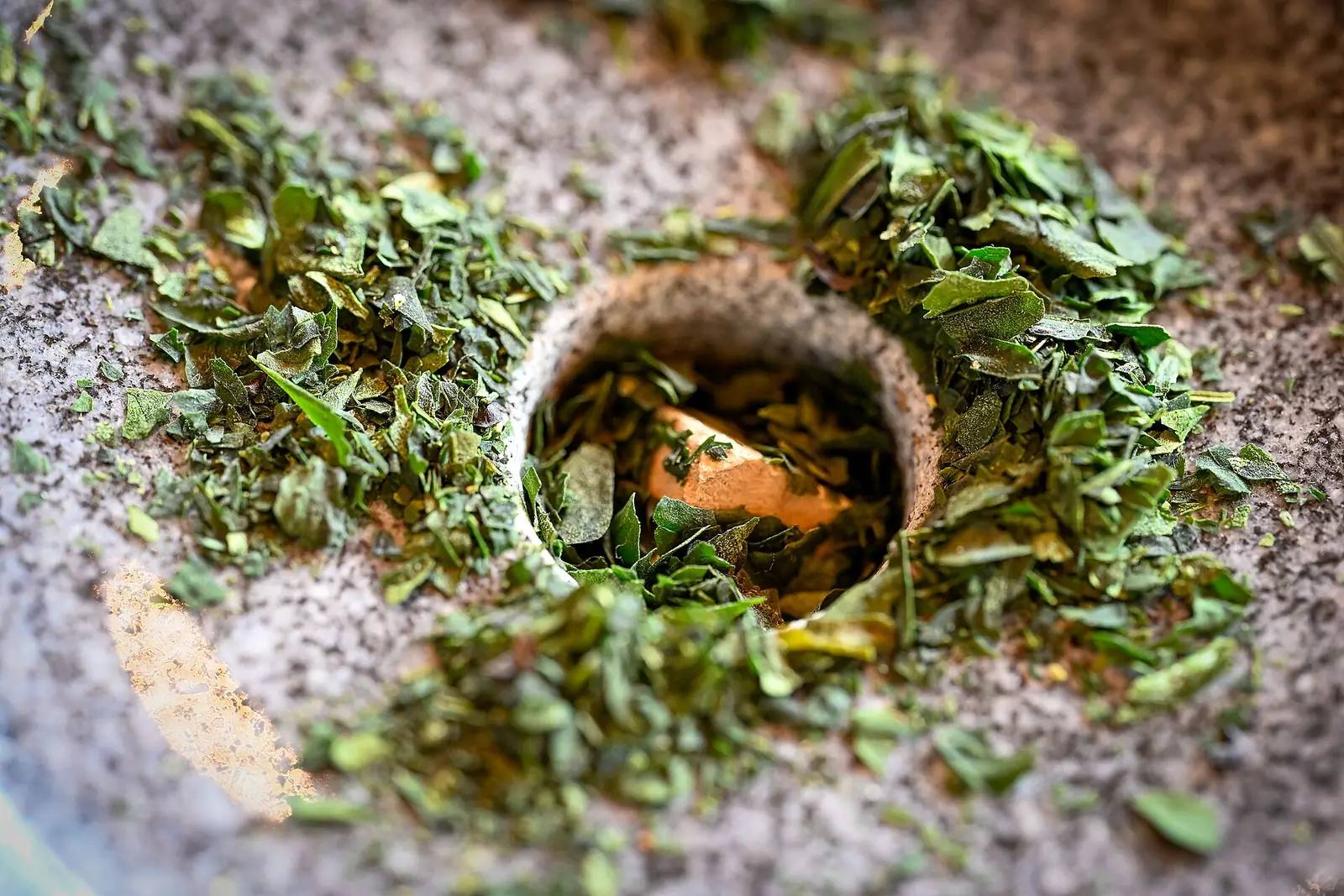
Matcha (抹茶, “ground tea”) is made from tencha: shaded and steamed like gyokuro, but not rolled – dried flat and destemmed instead. Only then do slowly turning granite stone mills (ishi-usu) grind the leaf into an ultra-fine powder of around five to ten microns. Such a mill manages only about 30 to 40 grams per hour – which explains part of the price. Matcha does not dissolve; it is whisked into suspension with the bamboo whisk (chasen) and drunk whole.
Ceremonial or culinary – how to choose
These terms are Western marketing labels with no legal definition – in Japan the distinction is made by use. As a rule of thumb: drink the ceremonial, bake with the culinary. Ceremonial grade comes from the first spring harvest, is velvety-fine and naturally sweet – for pure enjoyment. Culinary grade is stronger and more bitter, ideal for lattes, ice cream and baking, where matcha has to hold its own against milk and sugar.
| Variety | Shading | Character | Infusion |
|---|---|---|---|
| Sencha | none (full sun) | fresh, balanced, mild astringency; more than half of all production | approx. 70–80 °C |
| Kabusecha | approx. 1–2 weeks | the bridge between sencha and gyokuro, more umami | approx. 60–70 °C |
| Gyokuro | approx. 20–30+ days | deep, concentrated umami, hardly any bitterness | approx. 50–60 °C |
| Matcha | approx. 3–4 weeks (from tencha) | stone-ground powder, drunk as a suspension | approx. 70–80 °C (usucha) |
| Hōjicha | none (roasted) | toasty and nutty, very low in caffeine | close to 100 °C |
| Genmaicha | none (with roasted rice) | nutty, inexpensive, low in caffeine | close to 100 °C |
One small rule helps everywhere: the higher the quality, the lower the water temperature. With a high-grade gyokuro you brew cool (around 50 to 60 degrees) so that the umami carries; hōjicha and genmaicha, by contrast, need almost boiling water for the roasted aroma to develop. If you would like to go deeper into Japan’s food culture, our overview of a culinary journey through Japan is worth reading as well.
Green tea in everyday life: the pot at the table and the bottle for the road
In Japan green tea is not a special pleasure reserved for holidays, but the most everyday drink there is. The word “ocha”(お茶) simply means “tea” – and what is meant is almost always green tea. More than half of all Japanese drink it nearly every day: at home, in the office, with meals, and as a natural gesture of hospitality when guests arrive.
The everyday tea par excellence is sencha, the unshaded leaf grown in full sun. In many restaurants green tea – in summer often roasted barley tea (mugicha) as well – stands on the table free of charge like water, or is available to help yourself. In a sushi restaurant it even has a name of its own: agari. It is served free and very hot and is deliberately kept strong and plain – its task is to clear the palate between the pieces, not to compete with the delicate fish. A high-grade, umami-rich gyokuro would be out of place here.
The second, thoroughly modern side is the bottle for the road. In 1985 the tea company Itō En launched the world’s first canned green tea, and in 1990 the world’s first PET bottle followed; the brand is called Oi Ocha (お~いお茶, roughly “Hey, a tea!”) and remains the best-selling of its kind to this day, complete with a Guinness world record. Today you can get chilled – or, in winter, even hot – green tea on practically every corner: from the chilled shelf of the konbini and from the vending machines, of which Japan has more per head than anywhere else in the world. A bottle costs only around 100 to 200 yen (roughly €0.60 to €1.20) – which makes green tea inexpensive and effortless to obtain at any time. Alongside Oi Ocha, the market is shared mainly by Iemon (Suntory), Namacha (Kirin) and Ayataka (Coca-Cola).
The most important difference for travellers: unsweetened
Unlike the often heavily sweetened “green tea” drinks from the European supermarket, Japanese bottled tea is practically always unsweetened: plain, slightly bitter and refreshing. Anyone expecting a sweet soft drink is surprised at first. Our tip: buy two or three different brands from a vending machine and taste the difference – almost incidentally, you develop a feeling for what makes fresh, good green tea.
Experiencing the tea ceremony (sadō)
The tea ceremony – in Japanese sadō or chanoyu, the “way of tea” – is less a performance than a cultivated practice of attentiveness. It goes back to Zen Buddhism: the monk Eisai (1141–1215) brought powdered tea from China to Japan in the 12th century. The way of tea was perfected by the tea master Sen no Rikyū (1522–1591), who reduced the tea room radically in size and preferred plain, handmade vessels.
His legacy is the aesthetic of wabi-sabi – the beauty of simplicity and imperfection – along with four core values: wa (harmony), kei (respect), sei (purity) and jaku (tranquillity). Related to it is the idea of ichi-go ichi-e, “one encounter, one opportunity”: every tea gathering is unique. Within the ceremony a distinction is made between usucha (the thin, frothily whisked everyday tea) and koicha (the thick, syrupy tea of the formal gathering, kneaded rather than whisked and shared from a single bowl).
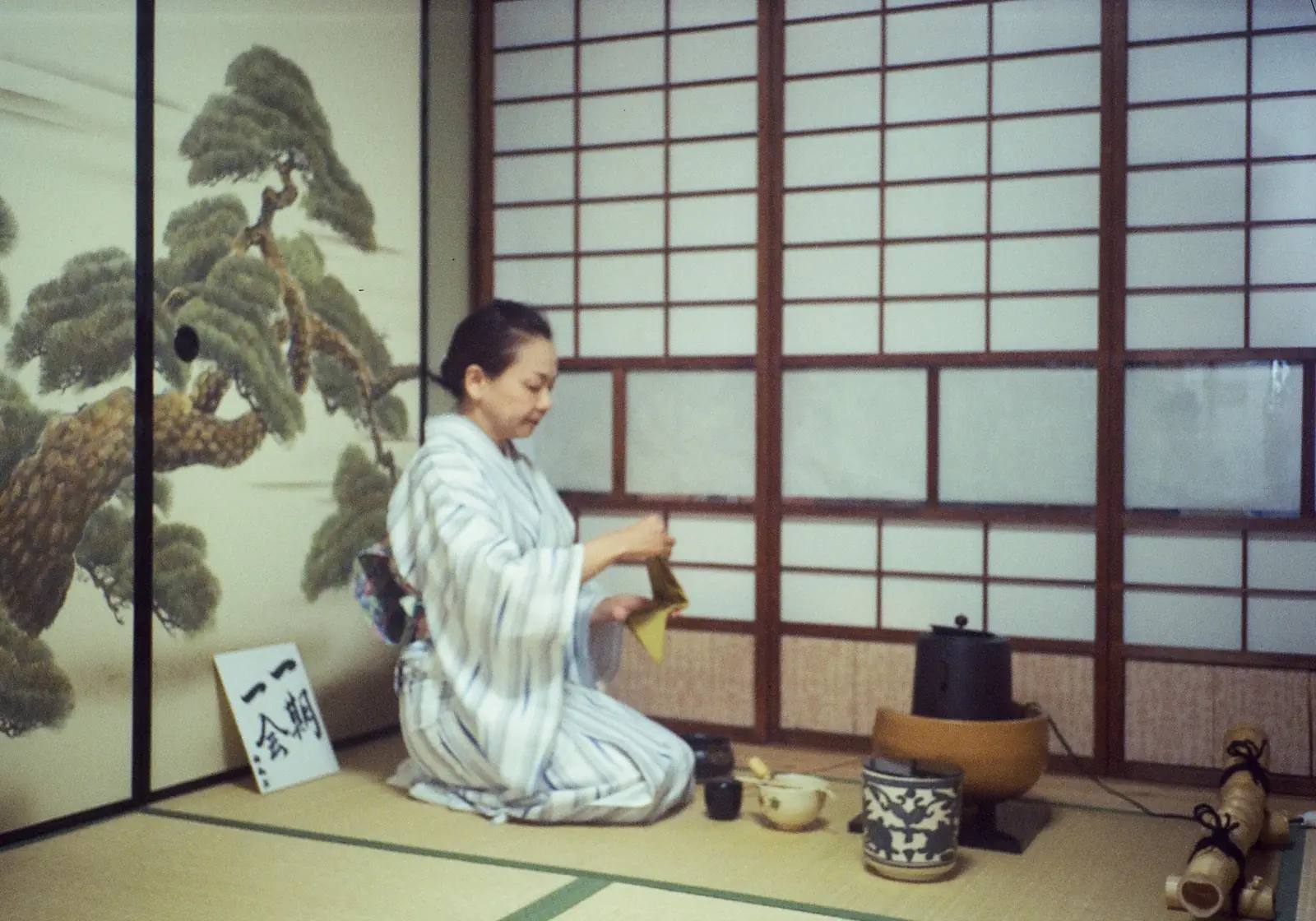
As a guest you do not need to do anything perfectly – the host leads you step by step, and small mistakes are overlooked. Useful to know: take off your shoes (clean socks), eat the sweet you are offered completely first, take the bowl in your left hand and turn it twice clockwise so as not to drink from its beautiful front, then enjoy it in three to five deliberate sips. Avoid strong perfume, take off rings and watches, and take photographs only with permission.
Where you can take part
Uji – Taihoan: the municipal tea house opposite the Byōdō-in is the least expensive authentic option (usucha with a sweet from April 2026 around 1,500 yen, approx. 20–30 min.; a hands-on experience in which you whisk the matcha yourself around 3,600 yen). Leaflets in English, open daily 10:00–16:00.
Kyoto – Camellia: English-language ceremonies in historic town houses (group session 45 min., approx. 3,000–4,000 yen; private from approx. 8,000 yen per person), chairs possible, vegan sweets.
Kyoto – Maikoya: tea ceremony in kimono, approx. 90 min., around 7,000–8,400 yen per person.
If you cannot sit comfortably kneeling on your heels (seiza), you need not miss out on anything: many houses offer the ryūrei style with a table and chairs. An informal gathering (chakai) lasts 45 to 60 minutes; the complete, formal ceremony (chaji) with a kaiseki meal can take up to four hours and is offered to guests from abroad by only a few houses.
Where the tea comes from: Uji, Wazuka and Japan’s tea regions
If you want to experience the origin, you travel to Uji, south of Kyoto – for more than 800 years the home of Japanese matcha and the benchmark for gyokuro and matcha. Getting there is straightforward: on the JR Nara Line from Kyoto main station in around 20 minutes (rapid train) or about 30 minutes (local train), 240 yen one way, covered by the Japan Rail Pass. Alternatively the Keihan Uji Line takes you there in around 30 minutes (approx. 400 yen) – convenient from the Gion district, but not included in the JR Pass.
From the station it is around ten minutes on foot to the Byōdō-in, the UNESCO World Heritage site whose Phoenix Hall of 1053 adorns the face of the Japanese 10-yen coin (admission to the garden and museum 700 yen, viewing the interior of the hall a further 300 yen). The historic approach road Byōdō-in Omotesandō is lined with long-established tea houses; here you also find Tsūen, since 1160 the oldest tea house in Japan, right by the Uji bridge.
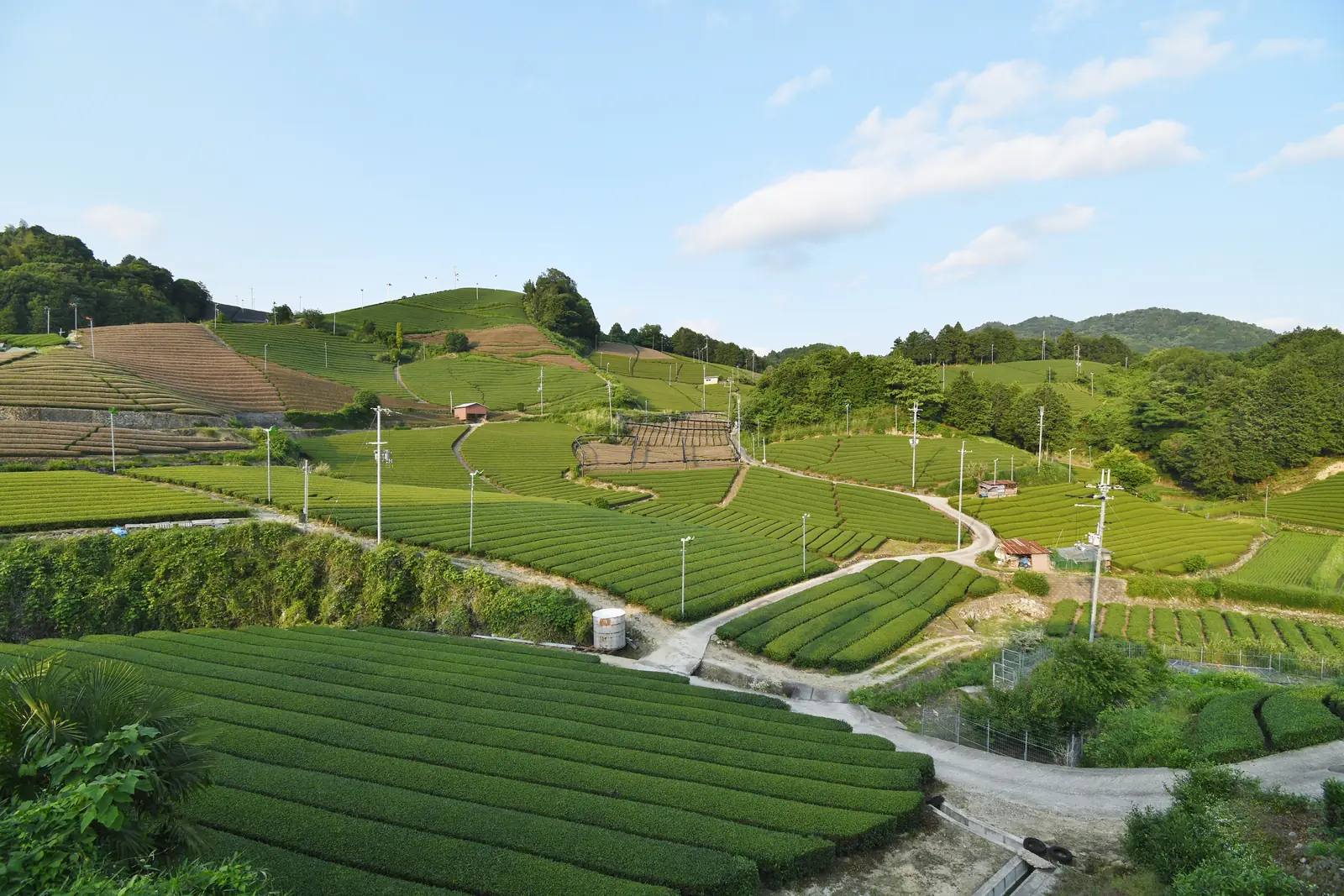
The picturesque terraced tea fields are to be found in the quiet mountain village of Wazuka, around 30 minutes to the east, which produces about half of all Uji tea. The village carries the byname “Chagenkyo” (Teatopia), counts among the most beautiful villages in Japan and has been a Japan Heritage site since 2015. You hire an e-bike (around 1,100 yen per day at the Wazuka-cha Café) and cycle between some 300 plantations, for instance to the iconic Ishitera tea plantation. Please note: the fields are private property – photographing them and walking around them is fine, walking into them is not. Farm visits with an English-speaking guide are offered by Kyoto Obubu Tea Farms and d:matcha, among others. Wazuka fits perfectly into our collection of quiet hidden gems away from the crowds.
Tea grows all over Japan, though – from Kagoshima in the subtropical south to cooler Saitama north of Tokyo. Traditionally, three regions are regarded as “the three great teas of Japan”: Uji, Shizuoka and Sayama. An old saying sums up their strengths: the colour comes from Shizuoka, the fragrance from Uji – and Sayama crowns the taste.
| Region | Prefecture | Known for |
|---|---|---|
| Shizuoka | Shizuoka | Largest growing area; classic sencha and deep-steamed fukamushi, with fields at the foot of Mount Fuji |
| Kagoshima | Kagoshima | Second largest and fastest growing; warm climate, very early first picking, plenty of everyday sencha |
| Uji | Kyoto | Small in volume, but prestige itself: matcha, gyokuro and tencha – our destination |
| Sayama | Saitama | The northernmost of the large growing areas; strong and aromatic thanks to the “Sayama-biire” roasting |
| Yame | Fukuoka | Top-class gyokuro, a regular winner at the national tea competitions |
| Nishio | Aichi | Specialised in tencha – alongside Uji one of the main sources of matcha |
The everyday and bottled tea you drink everywhere mostly comes from the large volume regions of Shizuoka and Kagoshima; the fine matcha and gyokuro specialities come from Uji, Nishio and Yame. The most beautiful time for freshly glowing fields and shincha (new tea) is from late April to mid-May – more on this in our guide to the best time to visit Japan.
Matcha to enjoy: sweets and drinks
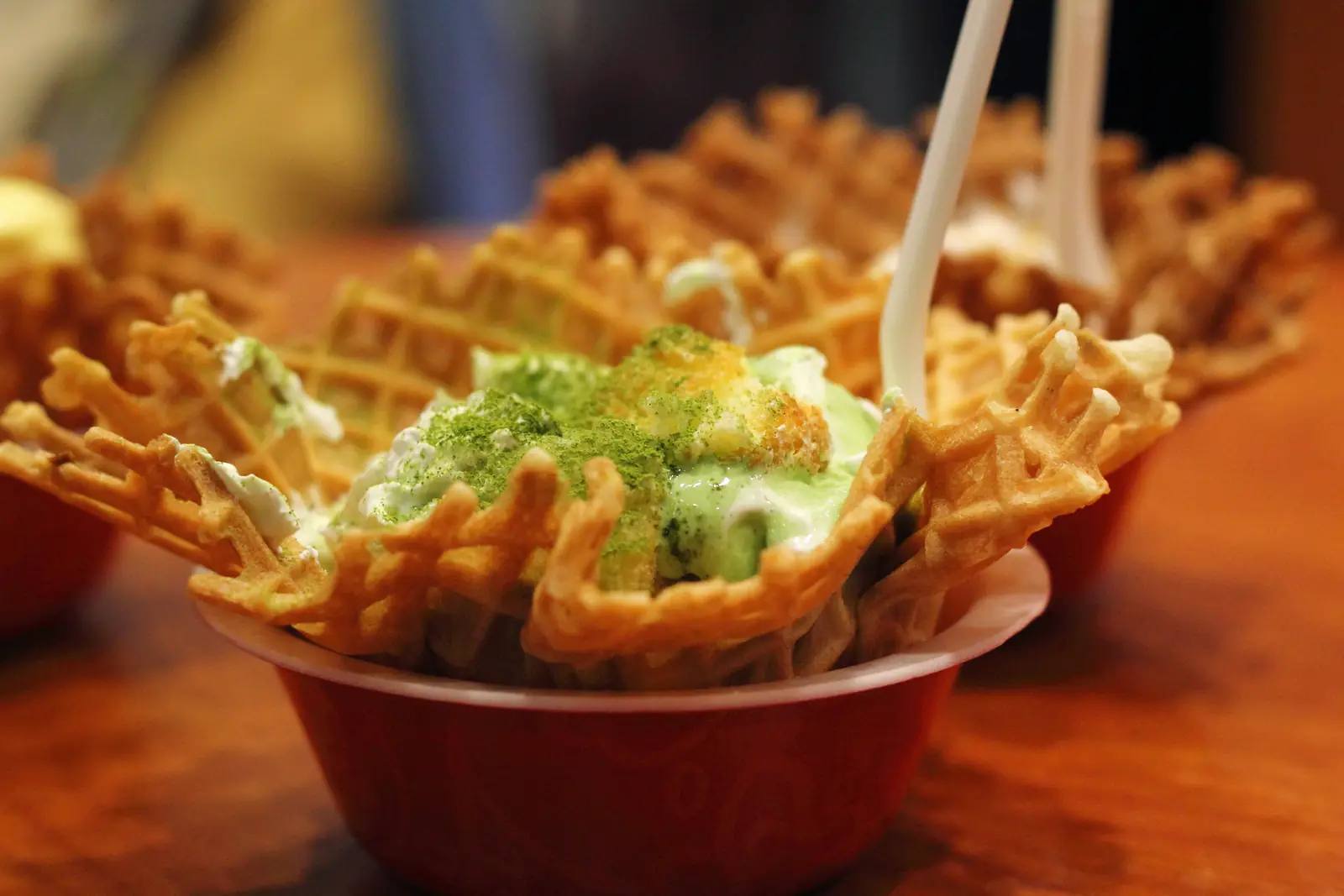
In Japan matcha is enjoyed not only from the tea bowl, but in a whole world of sweets – above all the parfait, a layered dessert in a tall glass with matcha ice cream, jelly, sweet bean paste (anko), soft rice-flour dumplings (shiratama), crunchy elements and cream. It is easy to order and the perfect pause while sightseeing.
- Warabimochi – a translucent, wobbly sweet made from bracken starch, with kinako (soy flour) or matcha and dark sugar syrup
- Dango – rice-flour dumplings on a skewer, often in a matcha version
- Roll cake & tiramisu – the Japanese sponge roll and Western classics in a matcha version
- Matcha soft ice cream – on almost every corner, approx. 200–650 yen
- Seasonal: kakigori (shaved ice with matcha syrup) in summer, zenzai (matcha over sweet red beans) in winter
Among the drinks, a fine distinction is worth making: an iced matcha is hot-whisked matcha concentrate over ice – frothy and strong in umami. Cold brew (mizudashi) is steeped cold and tastes milder, sweeter and lower in caffeine. The classic matcha latte combines matcha with warm or cold milk and can even be found as a ready-made drink in the konbini.
The famous cafés call for a little strategy. Nakamura Tokichi Honten in Uji (founded in 1854) takes no reservations but works with a digital numbering system – at weekends 60 to 90 minutes of waiting is normal. The trick: take a number as soon as you arrive and use the waiting time for the Byōdō-in. Tsujiri and Itohkyuemon likewise have main branches with a numbering system; the fashionable coffee brand % Arabicain Higashiyama has the shortest queues because it works on a takeaway principle. And if you would rather not queue at all: the konbini (7-Eleven, Lawson, FamilyMart) carry excellent matcha snacks for 150 to 400 yen, and in spring even hold their own “Uji matcha fair”.
The finest tea moments, without queuing
We reserve your private tea ceremony, secure seats in the popular cafés and fit Uji into your day so that you enjoy rather than wait. Simply tell us what you would like to experience.
Request a no-obligation consultationBuying the best matcha and taking it home
When buying, the same rule applies as in the kitchen: ceremonial grade for drinking on its own, culinary grade for baking and for milk lattes. More important than the word on the tin is specificity: a named region (Uji, Yame, Nishio), a cultivar (Samidori or Okumidori, for example) and a recent harvest or best-before date are more reliable signals of quality than the unprotected label “ceremonial”.
| Quality | Price (30 g) | What for |
|---|---|---|
| Culinary | approx. 5–20 USD | Baking, smoothies, ice cream, milk lattes |
| Premium / entry-level ceremonial | approx. 25–50 USD | Everyday usucha, strong lattes – works for both |
| Ceremonial (premium) | approx. 60–120 USD | Pure enjoyment, single origin |
| Top-tier koicha | 100+ USD | The thick tea of the formal ceremony |
Recognising fakes
The boom brought imitations with it, often from China and falsely labelled as “Uji matcha”; according to estimates, up to a third of the matcha sold internationally carries a false statement of origin. Four signals help: 1. Colour – luminous jade green, not dull or olive. 2. A specific origin instead of only “from Japan” or “Japanese style”. 3. A recent date. 4. A realistic price– if a “ceremonial” tin (30 g) costs less than about 20 USD in 2026, scepticism is in order. Buy from established houses and you are on the safe side.
Tried and tested addresses: Ippodo (Kyoto, family-run for generations, with an adjoining tea room), Marukyu Koyamaen (founded around 1704, tea house Motoan in Kyoto), Nakamura Tokichi (Uji, 1854 – the yōkan gift boxes are not covered by the quantity limit) and Fukujuen(since 1790, in Uji with a stone-mill experience). In the practice of the shortage you will often meet a sign in 2026 saying “one tin per person” – that applies per item, so you can perfectly well take home one tin each of usucha, sencha and hōjicha.
For home you need three utensils: the bamboo whisk chasen (茶筅), the tea bowl chawan (茶碗) and the bamboo scoop chashaku (茶杓). Matcha does not spoil, but it loses colour and aroma quickly: unopened and stored cool about 6 to 12 months, once opened best within three to four weeks. A tip from experience: if you keep the tin in the fridge, bring it to room temperature before opening it – otherwise condensation forms and the matcha clumps. For import into the EU: tea for private use is unproblematic in your luggage; what counts is the duty-free value allowance of €430 (air travellers) or €300. Unlike coffee, tea is not subject to excise duty and is usually free of customs duty.
How we build tea into your journey
Tea can be woven elegantly into almost any journey through Japan – most simply as a day trip to Uji from Kyoto. Uji is compact and entirely walkable: from the station to the Byōdō-in, along the Omotesandō with its tea houses, a parfait at Nakamura Tokichi and a walk along the Uji river – a relaxed half day to full day.
Because Uji lies on the JR Nara Line between Kyoto and Nara (Uji to Nara only 25 to 30 minutes), the day can be combined well with Nara: the Byōdō-in early in the morning before the tour groups, then on at midday to the Great Buddha and the deer of Nara Park. That makes for a full day – for calm, individual travel we are glad to spread it over two days. Both stops fit seamlessly into our classic two-week route through Japan.
The most beautiful month for tea fields and shincha is May. Traditionally the full harvest in Uji begins at the “88th night” (hachiju-hachiya) around 2 May; the shincha window runs from late April into the third week of May. The air in Uji then smells of freshly steamed tea, and the choice of new tea is at its greatest. From June most shops switch back to regular sencha.
Who is this subject worthwhile for? For travellers who travel to enjoy and for tea lovers who want to go to the source; for those interested in culture and history (the final ten chapters of the “Genji Monogatari”, Japan’s classic novel, are set in Uji); for slow travellers who would like to escape the bustle of Kyoto; and for couples looking for a private tea ceremony as a special moment. Our advice: Uji is worthwhile even if you are not a matcha fanatic – the landscape and the World Heritage site carry the excursion on their own.
The way with Japan Privat
We are Japan Privat: Japan-based specialists who guide you in English and plan individual journeys for discerning guests from Europe. When it comes to tea, that means we take off your hands exactly those points of friction that otherwise make a journey laborious.
- Arranging a private tea ceremony in English – in Uji or Kyoto, in kimono or entirely plain, according to your taste
- Reservations for tea rooms and the popular cafés, so that you do not have to queue
- A farm visit in Wazuka with an English-speaking guide, a tasting across several quality grades and a stone-mill demonstration
- Shopping at the right houses, including advice on grade, origin and transport into the EU
- Timing tuned to the shincha season and to the quiet mornings
Tea is only one building block in this. If you like, we weave it together with a stay in a ryokan – on etiquette and kaiseki you can read more in our ryokan guide – and with the greater whole of your journey, which we describe in detail in our planning guide to independent travel in Japan 2026. Tell us what you have in mind – we listen and plan the rest.
Frequently asked questions about matcha and tea in Japan
Where can I experience a tea ceremony, and what does it cost?
The most authentic and least expensive option is the short form at the municipal Taihoan tea house in Uji – from April 2026 around 1,500 yen for usucha with one sweet. English-language group ceremonies in atmospheric town houses in Kyoto (Camellia or Maikoya, for example) cost around 3,000 to 4,000 yen, and an experience in kimono around 7,000 to 8,400 yen per person. For a special moment we are glad to arrange a private ceremony from around 8,000 yen per person.
What is the difference between ceremonial and culinary matcha?
Ceremonial grade comes from the first spring harvest, is velvety-fine and naturally sweet – intended to be drunk on its own. Culinary grade is stronger and slightly bitter and suits lattes, ice cream and baking. Both terms, however, are unprotected marketing labels with no legal definition.
Where do I buy genuine Uji matcha in Japan?
At established houses such as Ippodo and Marukyu Koyamaen (Kyoto) or Nakamura Tokichi and Fukujuen (Uji). Look for a specific origin (Uji, Yame or Nishio), a named cultivar and a recent date rather than only for the word “ceremonial”. We are glad to accompany you to the right addresses.
How do I get from Kyoto to Uji?
The quickest way is the JR Nara Line from Kyoto main station: around 20 minutes by rapid train, about 30 minutes by local train, 240 yen one way and covered by the Japan Rail Pass. From the station it is about ten minutes on foot to the Byōdō-in and the tea houses.
Do I need to reserve at the popular matcha cafés?
Nakamura Tokichi, Tsujiri and Itohkyuemon take no reservations; they work with a digital numbering system (60–90 minutes of waiting at weekends). Take a number as soon as you arrive and visit the Byōdō-in in the meantime. Where reservations are possible, we are glad to make them for you.
Your journey through Japan around tea and matcha, individually planned
Tell us what interests you – a private tea ceremony, the tea fields of Wazuka or the best matcha café without queuing. We plan your journey in English, directly from Japan.
Plan a journey with tea cultureAbout the author

Kentaro Asakura
Founder of Japan Privat · A Japan specialist who guides you in English
Kentaro Asakura was born and raised in Japan. His student years took him first to the UK, where English became second nature to him, and later to Munich, where he met his wife, who is German – together they returned to Japan. With Japan Privat, he has been designing individual journeys for European travellers for more than ten years – in English, with the eyes of a local and a genuine feel for what guests from Europe are looking for.