Noh Theatre in Japan: When Time Stands Still
Contents
There is a moment – shortly after the flute sounds for the first time and the masked lead actor begins to glide almost imperceptibly across the stage – in which something strange happens: time seems to stretch. What feels agonisingly slow at first develops a quiet pull after a few minutes. And suddenly you sense why Noh theatre has held people under its spell for more than 650 years. Noh is not light fare, and in this article we tell you who a visit is worthwhile for – and who it may not suit. Once it takes hold of you, however, it belongs to the deepest things Japan has to offer in cultural terms.
The key points in brief
- What is Noh? One of the oldest theatre forms still performed in the world – for more than 650 years – with masks, stillness and very slow movements.
- Noh or Kabuki? Noh is older (14th century), meditative and masked; Kabuki is younger, colourful and easier to approach.
- Without Japanese? Yes – Noh lives from sound and movement. Read the plot beforehand; in Tokyo there are English subtitles at your seat.
- Where to experience it? Most easily at the National Noh Theatre in Tokyo, most atmospherically in Kyoto or as a Takigi-Noh by torchlight in Nara.
- Who is it for? For everyone willing to engage with slowness – with small children, or against jet lag, it is rather more difficult.
Are you planning an individual journey to Japan? This article is part of our large overview. You will find the complete guide – with travel seasons, routes, costs and planning – here: Independent Travel in Japan 2026 – the complete guide.
What is Noh theatre?
Noh (能) is a classical Japanese theatre form that took its present shape in the 14th century. Father and son – Kan'ami and above all Zeami Motokiyo – formed a highly stylised stage art out of older dance and entertainer traditions, under the patronage of the shōgun Ashikaga Yoshimitsu. This makes Noh one of the oldest theatre forms still performed anywhere in the world today. UNESCO has declared Nōgaku (Noh together with the comic Kyōgen) part of the intangible cultural heritage of humanity.
In its subject matter, Noh often circles around the supernatural: the spirits of the dead, demons, gods and figures from classical literature such as the Genji Monogatari or the Tales of the Heike. In the most impressive plays, the so-called Mugen-Noh (“dream Noh”), a spirit appears and tells – as if from the other world – of an old love, a guilt or an unfulfilled wish. Above it all lies the aesthetic ideal of Yūgen (幽玄): a deep, mysterious beauty that suggests more than it shows.
This is precisely what makes Noh so different from Western theatre. It does not set out to entertain you, nor to overwhelm you – it invites you to slow down and to enter a mood. Those who engage with it experience a form of concentration that has become rare in modern everyday life.
The elements: mask, stage, sound
Noh arises from the interplay of a few elements, each of them used very deliberately. Once you know them, you see a performance with quite different eyes.
The mask (Nō-men)
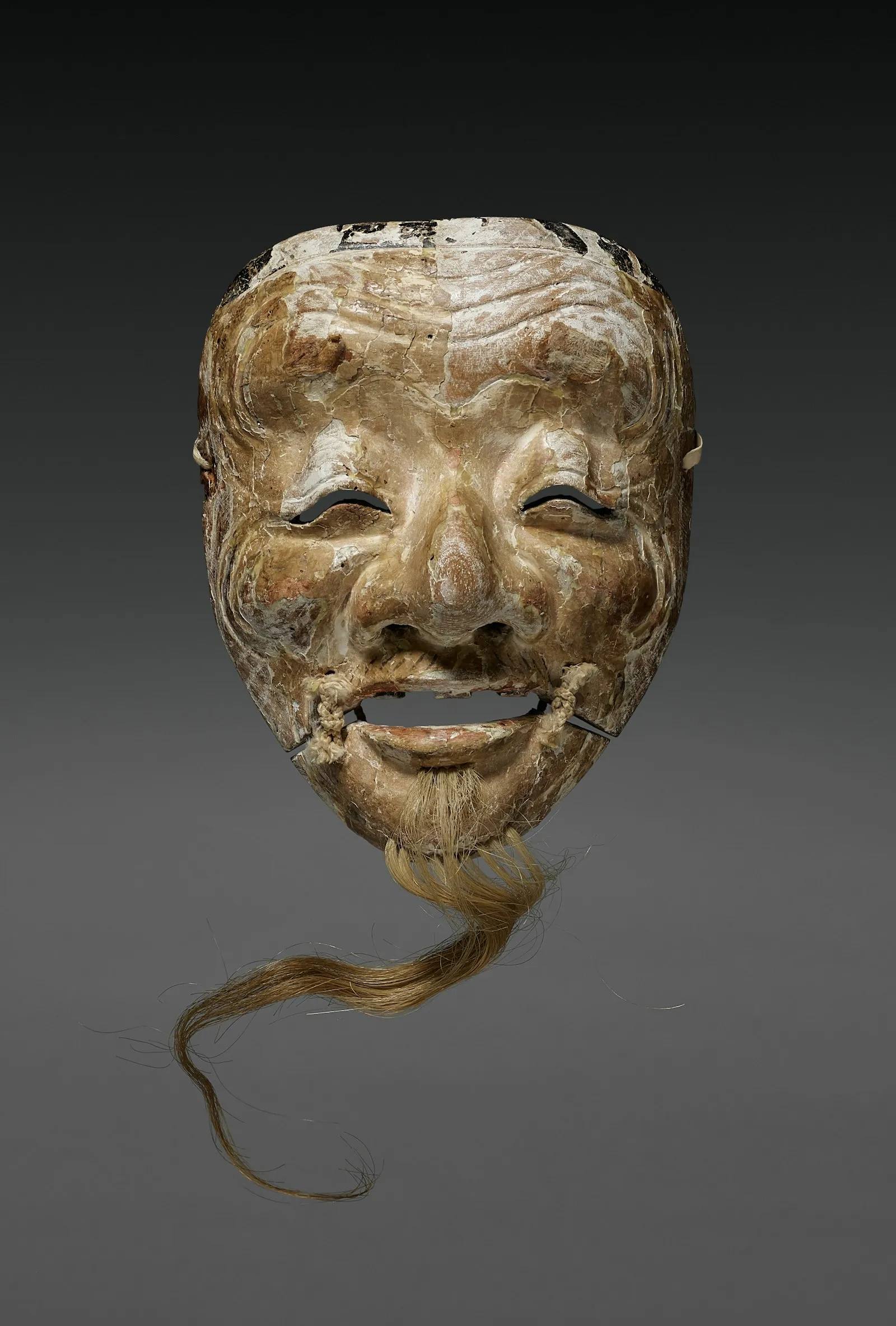
The most famous feature of Noh is the mask (能面, Nō-men or omote). Only the lead actor, the Shite, wears one – usually when he embodies a woman, a spirit, a demon or an old person. Carved from cypress wood, the mask appears rigid at first glance. In fact, however, its expression changes with the slightest tilt of the head: tilted slightly upwards it looks cheerful (teru), lowered slightly it looks sad (kumoru). This quiet transformation without a single change of facial expression is one of the subtlest arts of Japanese theatre.
The stage (Butai)
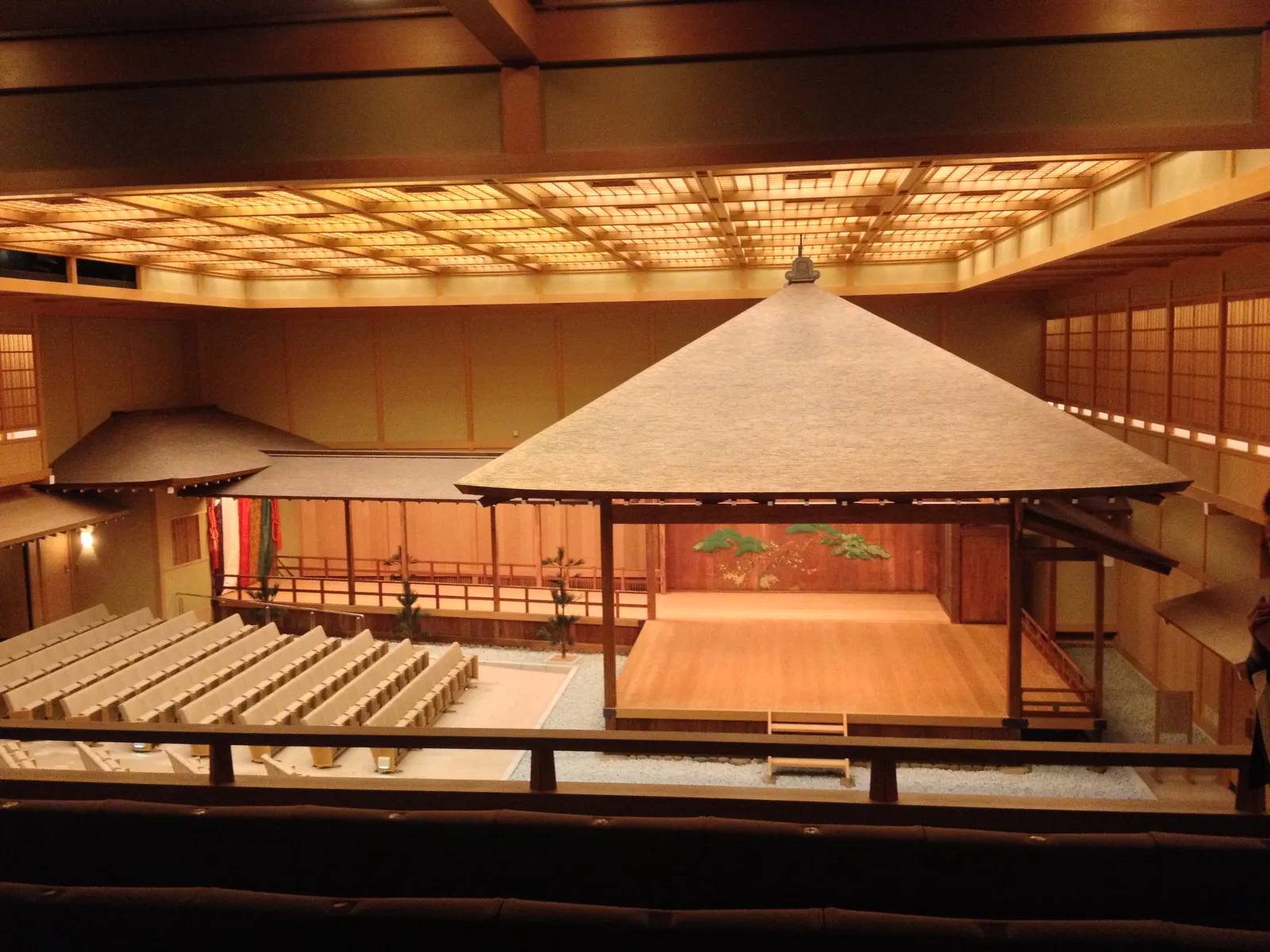
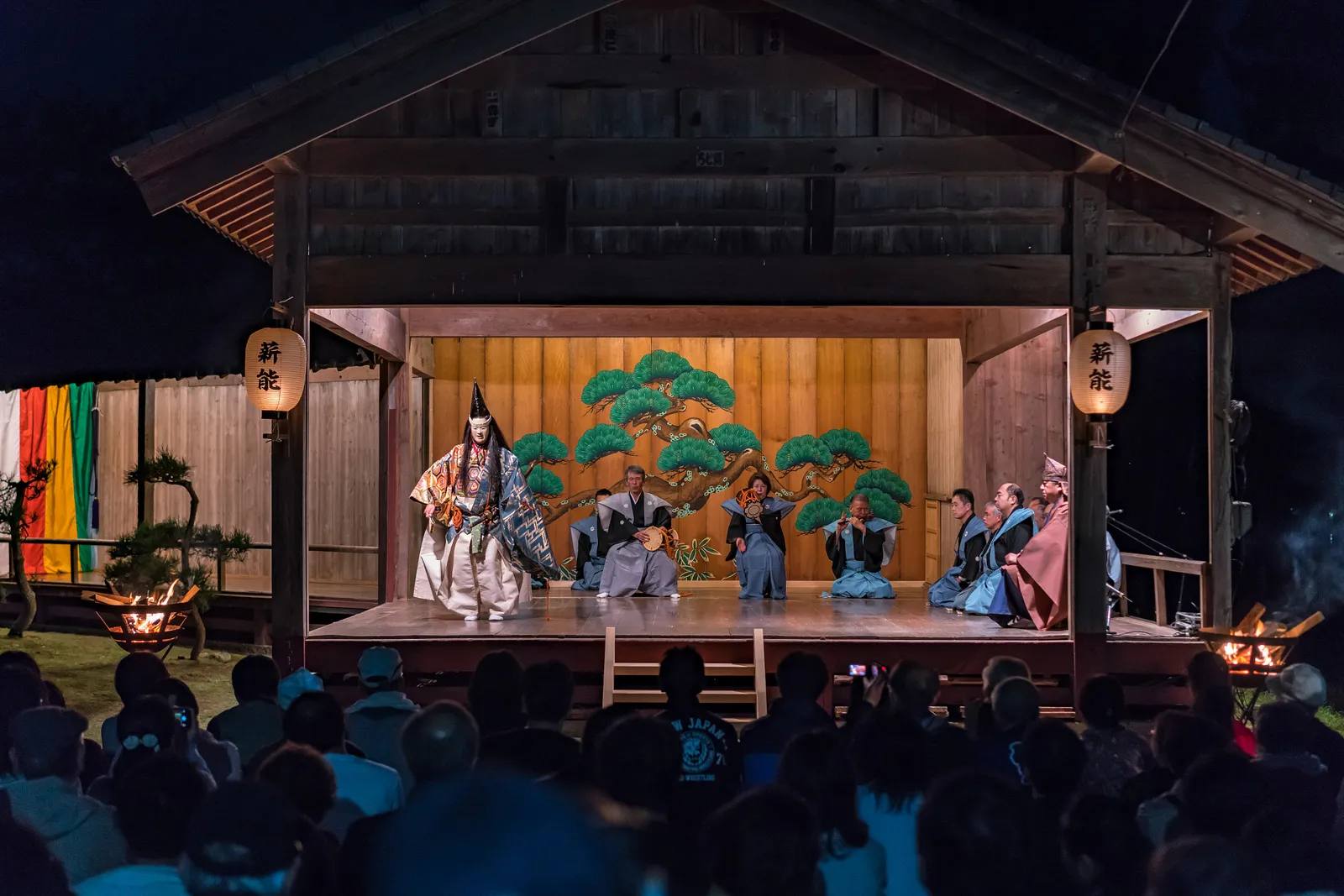
The Noh stage is recognisable at once: a square platform of polished cypress wood, covered by a temple roof of its own – even when it stands inside an enclosed theatre today. Four pillars carry the roof, a sloping bridge (Hashigakari) connects the stage with the dressing room, and on the back wall an old pine tree is always painted, the Yōgō-no-matsu. There are no changing sets and no lighting effects. This radical simplicity is intentional: it leaves the whole space to the imagination of the audience.
Sound and movement
The play is accompanied by a small ensemble, the Hayashi: a bamboo flute (Nōkan) and several drums (Kotsuzumi at the shoulder, Ōtsuzumi at the hip, sometimes the standing drum Taiko). To one side sits a chorus (Jiutai) of about eight singers, who comment on the action. The singing, called Utai, is deep, drawn out, almost incantatory. The movements of the performers are reduced to the utmost: the basic step, Suriashi, is a gliding in which the feet hardly leave the floor. A single slowly raised hand can mean weeping. If you are expecting quick gestures, you will have to think again – here every hint counts.
Noh or Kabuki? The difference
The difference in one sentence: Noh is the older, minimalist and meditative form with masks and very slow movements, Kabuki the younger, colourful and dramatic one with elaborate make-up instead of masks. Many visitors confuse the two – understandably, since both are classical Japanese theatre forms. Yet they could hardly be more different. The following overview will help you decide which is more likely to suit you.
| Aspect | Noh | Kabuki |
|---|---|---|
| Origin | 14th century | 17th century (Edo period) |
| Audience then | nobility and samurai | townspeople |
| Mood | meditative, serious, slow | colourful, dynamic, dramatic |
| Face | masks | elaborate make-up (kumadori) |
| Accessibility | demanding, quiet | entertaining, easier to approach |
| Ideal for | stillness, depth, concentration | spectacle, colour, emotion |
One small but important addition: between the serious Noh plays, short and light-hearted Kyōgen pieces are traditionally performed – spoken comedies without masks, often about servants who outwit their master. They are easy to follow, frequently amusing and form a wonderful contrast. For newcomers they are often the most delightful way in of all.
Is Noh the right thing for you?
Noh suits you if you take pleasure in slow, meditative art and like to look beneath the surface of a culture; if, on the other hand, you are looking above all for variety and spectacle, or are travelling with small children, another form is often the better choice. We are not among those who claim that everyone must love Noh. It is a particular art – and it is not made for every traveller. So that you can reach the right decision for yourself, we tell you openly what matters.
Noh will probably delight you if you take pleasure in slow, meditative art, are interested in classical music or in ritual forms, like to look beneath the surface of a culture and are willing to engage with an unfamiliar pace. Many of our guests who bring exactly this curiosity with them describe the Noh evening afterwards as one of the most memorable moments of their journey.
Something else might suit you better if you are looking above all for variety and spectacle on your journey, are travelling with small children, or are still struggling with jet lag after a long day of flying. In that case we recommend a gentle way in: a single short play instead of a full programme lasting several hours, a light-hearted Kyōgen – or, most beautiful of all, a Takigi-Noh under the open sky (more on that shortly).
And one more reassuring thought: should you nod off briefly during a performance, there is no shame in it. Even Japanese people say with a smile that quietly sinking away is part of Noh – here the border between waking and dreaming is part of the experience.
Where and how to experience Noh
Noh is performed all year round in several cities. Here are the places we recommend to our guests most often:
Tokyo: the National Noh Theatre
The Kokuritsu Nōgakudō (National Noh Theatre) in the Sendagaya district is the first address for visitors. It offers a regular programme and – particularly practical – English subtitles directly at your seat. If you are seeing Noh for the first time and value some help with understanding, this is the ideal place.
Kyoto: houses rich in tradition
Kyoto, the old imperial city, is the spiritual home of many classical arts. Here you will find stages rich in tradition such as the Kongō Noh Theatre and the Kawamura Noh Theatre. A Noh performance fits beautifully into a journey that is devoted anyway to the temples, gardens and tea culture of Kyoto.
Takigi-Noh: theatre by torchlight
If we were allowed to recommend only one single Noh experience to you, it would be the Takigi-Noh (薪能) – a performance in the open air, after darkness has fallen, in the light of blazing torches. Against the backdrop of a shrine or a temple, with the crackling of the fire and the night sky above you, Noh unfolds an almost magical effect. Famous are the Takigi-Noh at the Kōfuku-ji in Nara (usually in May) and the performances at the Heian Shrine in Kyoto (in June). These seasonal dates are much sought after – if you would like to plan for them, you should book early.
Practical tips for your visit
- Tickets & prices: Depending on the house and the seat, tickets cost about 3,000 to 13,000 yen (approx. €16–70). For popular performances and for Takigi-Noh, early reservation is advisable. How experiences of this kind fit into the overall budget of a journey to Japan is something we show in our article The cost of a journey to Japan 2026.
- Duration: A single play lasts 60 to 90 minutes, a classical full programme three to four hours. For a first taste, a shorter performance is often enough.
- Enjoying it without Japanese: Read the plot beforehand – one page is enough. Many houses offer English programme booklets, and the National Theatre in Tokyo even offers subtitles at your seat. Once you know the story, you can give yourself entirely to the sound and the movement.
- Etiquette: Arrive punctually, switch off your phone, and do not take photographs during the performance. Applause comes at the end. Silence during the play is expected and is part of the atmosphere.
- Clothing: There is no particular dress code. Smart casual clothing is entirely appropriate.
Further reading
Frequently asked questions about Noh theatre
Do I need to understand Japanese in order to enjoy Noh?
No. Noh lives more from atmosphere, sound and movement than from the spoken word – even many Japanese do not fully understand the old language. Read the plot of the play beforehand (one page is enough), and you can then give yourself entirely to the experience. The National Noh Theatre in Tokyo also offers English subtitles at your seat.
How long does a Noh performance last?
A single Noh play lasts about 60 to 90 minutes. A classical full programme with several plays and comic Kyōgen interludes can, however, run to three or four hours. For newcomers we recommend a shorter performance or a Takigi-Noh in the evening.
What is the difference between Noh and Kabuki?
Noh is the older, minimalist and meditative form (14th century, carried by the nobility and the samurai), with masks and very slow movements. Kabuki is younger (17th century), colourful, dynamic and more entertaining – with dramatic make-up instead of masks. If you are looking for action and spectacle, you will usually feel at home with Kabuki more quickly; if you are looking for stillness and depth, with Noh.
Where can I see Noh theatre in Japan?
The most important stage is the National Noh Theatre (Kokuritsu Nōgakudō) in Tokyo, with English subtitles. In Kyoto there are several houses rich in tradition, such as the Kongō and the Kawamura Noh Theatre. Particularly atmospheric are the Takigi-Noh – performances in the open air by torchlight, for instance at the Kōfuku-ji in Nara or at the Heian Shrine in Kyoto.
Is Noh also suitable for children or for newcomers to the theatre?
For small children Noh is usually too slow and too quiet. Newcomers to the theatre, on the other hand, can certainly engage with it – best of all through a short play, a light-hearted Kyōgen or a Takigi-Noh as a gentle introduction. What matters is the right expectation: Noh is not a spectacle but an experience that you let work on you.
Our conclusion
Noh is not a form of theatre that you simply “take in” along the way. It asks for a little preparation, some patience and the willingness to enter a time of its own. Those who do are rewarded with a rare experience: a stillness in which a single gesture says more than a hundred words, and in which, for an hour or two, you really do have the feeling that time has stopped.
Whether Noh suits your journey – and if so, in which form: a beginner's piece in Tokyo, a traditional house in Kyoto or a Takigi-Noh under the stars – is best clarified in conversation. We plan the visit so that it fits naturally into your days instead of becoming an obligation.
We are Japan Privat: a Japan-based travel operator for individual journeys through Japan, advising you in English. If you would like to immerse yourself more deeply in the culture of Japan, we will plan your journey together with you – from the right evening at the theatre to the complete route.
Experience Japan more deeply
From the right Noh evening to the whole route – we put together a programme that suits your interests and your pace.
Book a free 30-minute consultationAbout the author

Kentaro Asakura
Founder of Japan Privat · A Japan specialist who guides you in English
Kentaro Asakura was born and raised in Japan. His student years took him first to the UK, where English became second nature to him, and later to Munich, where he met his wife, who is German – together they returned to Japan. With Japan Privat, he has been designing individual journeys for European travellers for more than ten years – in English, with the eyes of a local and a genuine feel for what guests from Europe are looking for.
Image credits
- Cover image (stage of the Yokohama Noh Theatre): photo by yoshi_ban, CC BY-SA 3.0, via Wikimedia Commons (edited).
- Noh on the open-air stage in Sado: photo by Yoshiyuki Ito, CC BY-SA 3.0, via Wikimedia Commons (edited).