Japan with Children: The Family Guide for 2026
Contents
- Is Japan child-friendly? The short answer: yes
- The best time to travel, and from what age Japan works with children
- Transport with children: Shinkansen, stations and luggage
- Accommodation and onsen: family rooms, ryokan and a private bath
- Eating with children: picky eaters and allergies
- Health and hygiene: pharmacies, nappies and emergencies
- Experiences beyond Disney: the right thing for every age
- Pace and planning: fewer places, more nights
- The way with Japan Privat: what we take on for families
- Frequently asked questions
Yes, travelling through Japan with children is one of the most relaxed family adventures there is: very safe, exceptionally clean and full of people ready to help. Much of what worries parents is solved more easily here than at home. This guide takes you through transport, accommodation, food, health and experiences by age, and says openly what needs to be clarified in advance and what a realistic family journey looks like.
The key points in brief
- Japan works remarkably well with children: safe, very clean, helpful, with baby-changing rooms and high chairs almost everywhere.
- Best time to travel: spring and autumn. Avoid high summer (July/August) and Golden Week, because heat, humidity and crowds are hard on children.
- Transport is family-friendly: children under 6 usually travel free on the Shinkansen, pushchairs fit into the space behind the last row of seats, and the Takkyubin luggage service makes changing places easy.
- Two points to clarify in advance: children in nappies are not allowed into the shared onsen, and larger family rooms are booked out early. A private bath and an early booking solve both.
- Experiences beyond Disney: teamLab, Ghibli, the deer of Nara and large aquariums appeal to different ages in different ways.
- Less is more: fewer places, more nights, a buffer for jet lag. This is exactly the planning we take on for families.
Is Japan child-friendly? The short answer: yes
The short answer is yes – and for three reasons that carry everyday life with children: the sense of safety, the well-considered infrastructure for small needs, and a helpfulness you can rely on. We will look at these three in turn.
It begins with safety. In Japan’s large cities, children often travel to school alone by train from primary school age – an everyday sight that says a great deal about the sense of safety in this country. For you as a travelling family it mainly means this: a lost toy or a forgotten bag turns up again surprisingly often, and even in the evening you need not worry in busy neighbourhoods. This basic feeling takes so much off your mind that many parents only notice after a few days how calmly they are travelling.
At least as important for everyday life with children is the infrastructure for small needs. You will find baby-changing and nursing rooms with hot water for making up formula in almost every larger station, in the Isetan and Takashimaya department stores and in most malls. Multi-purpose toilets with a fold-down changing table are standard in larger stations, and public toilets are considered very clean and are often fitted with a washlet – the heated shower toilet that children get used to quickly.
- Changing and nursing: hot water for formula in almost every larger station, in department stores and malls.
- Clean toilets: multi-purpose toilets with a changing table are widespread, public toilets are very clean and often have a washlet.
- In restaurants: high chairs and children’s cutlery are standard in family restaurants.
- Helpfulness: families are often helped without asking – with the buggy on the stairs, in finding the lift, or at the ticket machine.
Our practical tip
The free app Mama Papa Map shows nursing and baby-changing rooms across the country on an up-to-date, community-maintained map – including facilities such as hot water or a microwave. We recommend it warmly to families before departure, because it saves a lot of searching while you are on the move. How to pour these building blocks into a realistic route is explained in our pillar guide to independent travel in Japan.
The best time to travel, and from what age Japan works with children
The most pleasant time for families is spring (March to May) and autumn (October to November). It is better to avoid the humid high summer and the crowded Golden Week at the beginning of May. There is no single right age; every stage of life has its own appeal.
The reason for spring and autumn is the weather: in both windows the temperatures are usually pleasantly mild, the air is dry and the days are bright enough for playgrounds and parks. High summer (July and August) is the real hurdle with children. Temperatures then often climb to 30 to 35 degrees Celsius with high humidity, and small children in particular regulate their body temperature less well than adults. In this period only a rhythm with air-conditioned afternoons works – a museum or an aquarium instead of the midday heat outdoors. If you travel in June, you should also allow for the rainy season – how to work around it well with children is explained in detail in our guide to the rainy season and typhoons.
Just as important as the season are the Japanese holiday peaks, because then the whole country travels at the same time. Three windows stand out and push both crowds and prices up:
- Golden Week (end of April to the beginning of May): Japan’s longest holiday period. Shinkansen seats are booked out early and accommodation is more expensive – particularly stressful with children.
- Obon (mid-August): many Japanese travel to see family, trains and popular places are full, and the summer is at its hottest anyway.
- Cherry blossom weeks (beginning of April): magnificent in terms of scenery, but Kyoto and Tokyo are correspondingly full and expensive. The exact dates shift from year to year with the weather.
Which weeks work out well in 2026 and how the seasons look across the year can be found in our overview of the best time to visit.
As for age, the principle is: Japan adapts, the child does not have to. With a baby, the journey is often logistically easier than expected, because nursing rooms, changing places and formula are available almost everywhere, and a sleeping child in a sling will join you in any temple. With a toddler, the pace is what counts: short distances, plenty of breaks, early evenings – the fascination then lies more in deer, trains and playgrounds than in culture. At school and teenage age, finally, Japan opens up most widely, from teamLab through gaming culture to history and food, and children consciously carry the experiences home with them.
Families who have to travel in high summer, because school holidays in much of Europe fall then, we deliberately plan further north: in Hokkaido and the mountain regions the temperatures are noticeably lower than in Tokyo or Kyoto. That keeps the summer manageable even when the travel period cannot be freely chosen.
Transport with children: Shinkansen, stations and luggage
Transport is where Japan plays to its strengths. Children under 6 usually travel free on the Shinkansen, reserved seats secure places next to each other, and the Takkyubin luggage service takes the suitcases off your hands when you change places.
For fares, a simple orientation applies: children under 6 years of age travel free as long as they do not occupy a reserved seat of their own, and that for up to two free children per paying adult. Children from 6 to 11 years pay about half the fare. If your toddler wants a reserved seat of their own, that seat also costs the child’s fare. In non-reserved carriages a child under 6 may also travel free without sitting on a lap if a seat is free – we clarify the exact distinction before booking.
Pushchairs are permitted everywhere in trains and stations. Families travel most comfortably with a reserved seat in the last row of the carriage, because the official luggage and pushchair space lies behind it. This one space per carriage is quickly booked out during the holidays, so an early reservation is worthwhile. One important note for Tokyo: with a child in a pushchair you belong in the lift, never on the escalator.
The stations themselves are better equipped than many parents expect. According to the Japanese Ministry of Transport (MLIT, as of fiscal year 2024), around 94 percent of heavily used stations with 3,000 passengers a day or more can be reached step-free. In practice, however, the lift is often only at one end of the long platform. If you get off at the other end, you first have to walk the whole length of the platform with the buggy, and changing trains at hubs such as Tokyo or Shinjuku costs noticeably more time as a result. If you plan for that, you will not end up rushing.
- Takkyubin: we send the suitcases from hotel to hotel the evening before, so that families change trains with nothing but a day pack. It is the most effective trick against stress on the platform.
- IC cards (Suica, Pasmo): a rechargeable card saves buying a ticket at every gate; for children from 6 there is a separate children’s IC card at half the fare.
- Taxis and child seats: regular taxis have no child seats. If you need one, you have to order it in advance; for short distances the law is lenient about this, but your child still travels more safely in a reserved seat.
For families we specifically reserve the last row of seats with the pushchair space behind it, and we time the Takkyubin shipment so that the luggage is already waiting at the next hotel on the day you arrive. That way one hand stays free for your child when you change trains. How we set the pace for an entire route is shown by our classic two-week route.
Accommodation and onsen: family rooms, ryokan and a private bath
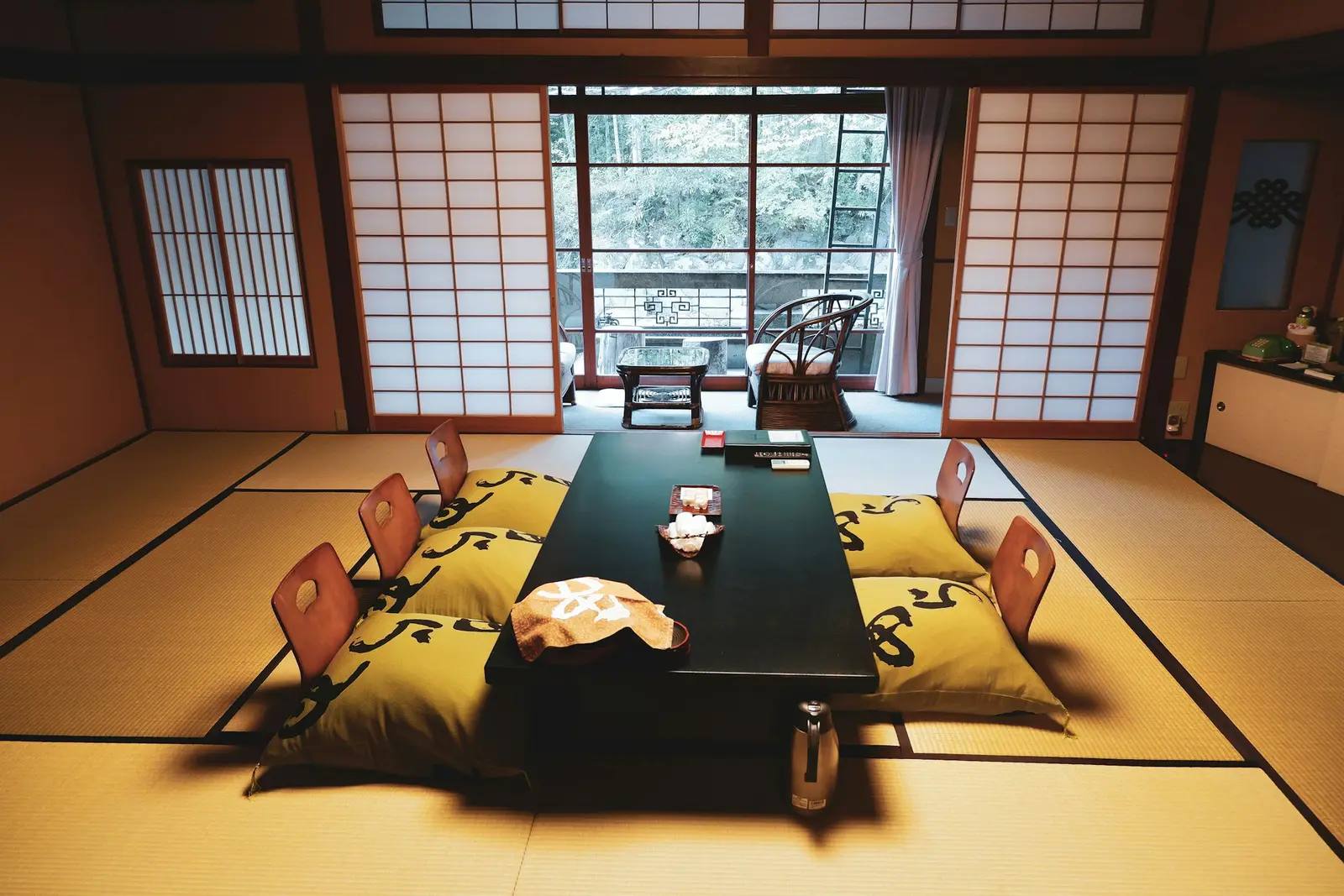
When it comes to accommodation, Japan is more family-friendly than many expect: in many hotels small children sleep in their parents’ bed free of charge, and in a ryokan the whole family lies next to each other on the tatami. Two things are best clarified in advance, namely the maximum number of people per room and the onsen rule for children in nappies. Both are easily solved, with the right room or ryokan and a reserved private bath.
What makes this possible above all is the generous policy on children: at the large chains, sleeping in the parents’ bed free of charge usually applies up to pre-school age, in many places until the end of primary school, and the beds are cut correspondingly wide. What you should mainly watch is the maximum occupancy of the room, because some compact city hotels are limited to three people. For a family of four we then choose a family room or add an extra bed; two separate rooms are only rarely necessary. This works particularly beautifully in a ryokan: there the futons lie directly on the tatami and can be pushed next to each other, so that the whole family sleeps on one surface and no child can fall out of bed. Many houses also offer children’s portions at dinner and items to borrow such as a children’s yukata or a cot – do ask about these things before you arrive, because stocks are limited.
The most delicate question is the onsen, and here a clear rule applies: children who still wear nappies are excluded from the shared bath almost everywhere. This is not harassment but hygiene – nothing may get into the hot spring water. The clean solution is called kashikiri-buro (貸切り風呂), a family bath that you usually reserve exclusively for 30 to 60 minutes. That way you bathe as a family undisturbed, the age of the children plays no role, and the next point resolves itself as well.
Because the often-quoted tattoo issue concerns the parents, not the children. Many public baths still exclude guests with tattoos. For small motifs a waterproof covering patch from the pharmacy helps; for larger ones the way again leads through the private bath. In the vast majority of cases this is the solution – but you should not rely on it blindly: some houses apply their tattoo rule to the booked private bath as well. We therefore obtain confirmation in writing before booking. If you would like to go deeper into building styles, etiquette and tattoo-friendly houses, you will find the details in our ryokan guide.
- Secure a family room early: rooms for four people are rare and are taken months in advance in high season.
- A private bath instead of the shared onsen: the kashikiri-buro gets around the nappy question and the tattoo question in one go.
- Ask about items to borrow in advance: a children’s yukata, a cot and a children’s portion are usually available, but not guaranteed.
In the preparation we firmly reserve the private-bath slot, secure the right family room in a child-friendly house and ask about the items to borrow in writing, so that nothing goes wrong on the day of arrival with a tired child. Which ryokan suits which age we clarify with you beforehand – some traditional houses only accept children from a minimum age.
Planning a family journey with children
We reserve the family room, secure the private-bath slot and choose a ryokan that welcomes children. Let us plan your journey through Japan at the right pace.
Plan a family journeyEating with children: picky eaters and allergies
Even picky children reliably find something in Japan. The cuisine is mild and rice-based, family restaurants and konbini are everywhere, and allergies can be communicated well with a Japanese allergy card.
Most children get used to Japanese food quickly, because it is barely spicy and rarely exotically seasoned. Reliable hits are karaage (fried chicken), onigiri (rice balls), udon noodles in a mild broth, gyoza and the slightly sweet omelette tamagoyaki. At the large curry chains such as CoCo Ichibanya you simply choose the mildest level without any heat for children. If you would like something completely familiar, you will also find pasta, fries and pancakes in every larger city.
Two places make everyday life with children particularly easy. The konbini (Lawson, FamilyMart, 7-Eleven) are open around the clock and stock onigiri, fruit, yoghurt and warm snacks – ideal for in between and for provisions on the Shinkansen. And the family restaurants such as Gusto, Saizeriya and Royal Host are set up for children: they offer illustrated menus you can simply point at, high chairs and changing tables, and you can usually have baby food you have brought with you warmed up there.
One small classic makes eating even easier for families: the okosama lunch (お子様ランチ), the Japanese children’s plate. In family restaurants, department store restaurants and many hotels, children are given a specially arranged plate, usually with moulded rice, a small meat patty, fried prawns or spaghetti, often with a little flag and occasionally a toy. For many children this colourful plate becomes the highlight of the journey, and for parents it is the simplest guarantee that even a picky child ends up full and content.
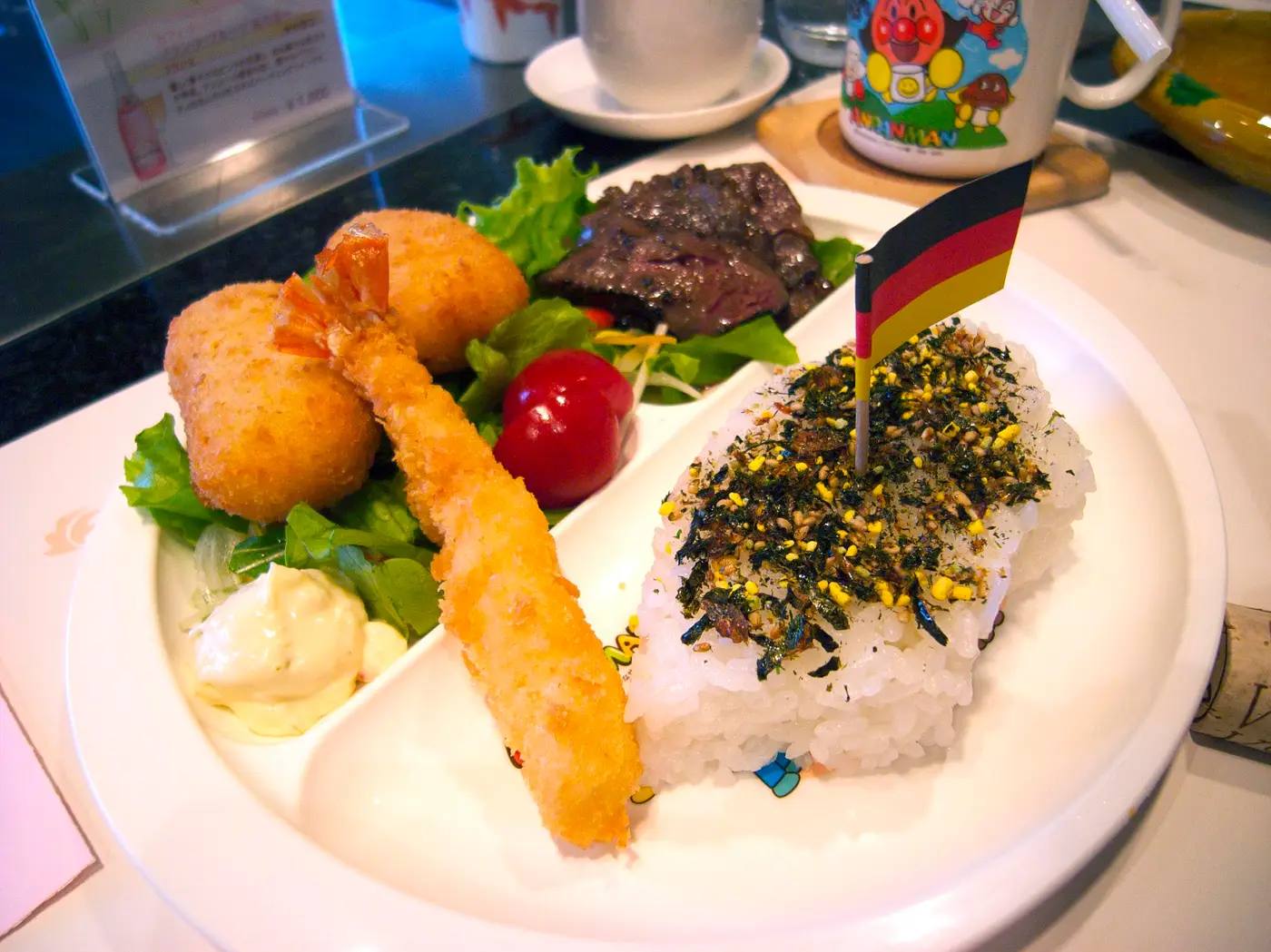
With allergies, an important distinction applies. Packaged konbini and supermarket products are labelled in great detail, whereas restaurants are not obliged to declare allergens. The most effective tool is therefore an allergy card in Japanese that the kitchen staff can read directly. It translates your child’s allergens comprehensibly and, where in doubt, also names the hidden dashi, the fish stock that is in many apparently harmless dishes.
The allergy card: what belongs on it
A good allergy card in Japanese names the specific substances (for example egg, milk, wheat, soy, peanut, crustaceans) and politely asks for the dish to be adapted accordingly. Also watch out for hidden dashi (fish stock) and soy sauce, which are cooked into many side dishes. We put together a detailed allergen list for you before the journey, because labelling requirements can change.
For the finer points of a plant-based diet and dealing with the ever-present dashi, it is worth a look at our guide to vegetarian and vegan in Japan. Before the journey we prepare the right allergy card and note restaurants where families with particular needs can eat in a relaxed way.
Health and hygiene: pharmacies, nappies and emergencies
When it comes to health and hygiene, you can be at ease in Japan. Nappies, formula and baby food are available everywhere, pharmacies stock mild children’s remedies, and an emergency hotline helps in English. The only thing that remains important is good international travel health insurance.
You will find nappies and formula in every larger city. Familiar brands such as Merries, Moony and GooN are on the shelves of the Matsumoto Kiyoshi and Welcia drugstore chains, and the specialist chain Akachan Honpo offers a particularly large selection including formula, baby food and items to borrow. So you do not have to lug a suitcase full of nappies with you – a supply for the first two days is enough, after that you buy locally. We give you a rough orientation on the approximate prices during the planning, as these change continuously.
For medicines, a simple orientation applies: bring your child’s familiar regular medication from home, because Japanese package information is hard to read and specific dosages are difficult to check on the spot. For everyday needs, pharmacies and drugstores stock mild children’s remedies for fever, coughs or an upset stomach. If in doubt, ask the pharmacy staff for advice, and for acute cases a well-developed network of clinics is open to you.
If something does happen, you are not alone. The JNTO Visitor Hotline gives advice around the clock in English and, in an emergency, puts you through to the right place. Check the current telephone number on the official JNTO site before departure, because numbers occasionally change.
- Buying nappies & milk: Matsumoto Kiyoshi and Welcia for quick needs, Akachan Honpo for the large selection including items to borrow.
- Bring regular medication: pack the remedies you are used to from home; Japanese packaging is hard to read.
- Emergency: the JNTO Visitor Hotline (in English, around the clock) – note the number in advance.
- Insurance: take out international travel health insurance with sufficient cover for the whole family.
Travel health insurance: the most important point
Medical treatment in Japan is expensive without insurance, because as a tourist you have no access to the state health insurance system and have to pay up front on the spot. We recommend that every family take out international travel health insurance with sufficiently high cover and repatriation included (without recommending any specific product).
Experiences beyond Disney: the right thing for every age
Japan offers far more than Disney and USJ. The light worlds of teamLab, the Ghibli world, the deer of Nara and huge aquariums delight children in quite different ways, depending on age. The table below sorts the highlights by stage of life.
With teamLab it is worth looking closely at the location. teamLab Planets in Toyosu leads barefoot through warm, knee-deep water and soft floors – a delight for primary school children, but one that quickly becomes overwhelming for the very small in the darkened corridors. If you are coming with a toddler, you are often better served by the dry rooms without a water passage at teamLab Borderless in Azabudai Hills – it is darkened there too, but without the barefoot water stretch. Both houses are popular and booked out early at weekends, so we buy the timed-entry tickets in advance.
The Ghibli world exists in two completely separate versions that are readily confused: the quiet, small Ghibli Museum in Mitaka near Tokyo and the extensive Ghibli Park in Aichi Prefecture. Both are accessible only with an advance reservation, tickets for one explicitly do not apply to the other, and the sought-after weekend slots in particular are often gone minutes after sales open. For small children the compact museum with its short distances is usually the more relaxed choice; the park rewards older fans with more space and attention to detail.
The deer of Nara are not a petting zoo but wild animals with minds of their own. Only the official shika-senbei may be fed to them, sold by licensed stalls for around 200 yen a bundle; any other food, as well as paper and plastic bags, harms the animals. Many deer bow as a learned request, after which you hand over the wafer quickly. When the crackers are gone, show both open palms – the signal for no more food. Small children should only feed them accompanied by an adult, because the deer can jostle when food is visible.
Large aquariums are the most reliable joker for bad weather and heat: air-conditioned, covered and usually suitable for pushchairs. The Kaiyukan in Osaka leads along a continuous spiral ramp without steps, at the end of which the whale shark tank awaits; it is low-barrier and has a baby room with changing facilities, but does not lend out pushchairs itself. The Churaumi on Okinawa is equally low-barrier and lends out pushchairs free of charge subject to availability. Hands-on workshops in museums and aquariums, by contrast, usually start at around six years of age.
With teamLab and the Ghibli world it is the start of ticket sales that decides, not the day you travel. We note the release dates for the timed-entry tickets and reserve within the first hour, because the family-friendly morning and weekend slots go first. Specific prices, opening and feeding times change continuously – we check them against the official sites before every journey.
| Experience | Young child (under 6) | School child (6 to 12) | Teenager |
|---|---|---|---|
| teamLab | Only the dry rooms, otherwise too stimulating | Ideal, the water world is a highlight | Strong, photogenic and immersive |
| Ghibli (museum/park) | Museum works well, short distances | Good, depending on the films they like | Ideal for fans, the park is worth it |
| Nara deer | Only hand in hand, not feeding alone | Ideal, the classic | Good, rather a short stop |
| Aquarium (Kaiyukan/Churaumi) | Ideal, air-conditioned with a buggy | Ideal, plenty to discover | Good, a calmer item on the programme |
| Hands-on workshops | Still too early | Good from about 6 years | Ideal, craft and culture |
| Nature and Hakone | Manageable with a carrier | Good, short walks | Ideal, onsen and landscape |
Pace and planning: fewer places, more nights
The most important advice for families is this: fewer places, more nights. If you are travelling with children, plan generous buffers, write off the first days for jet lag and stay longer at a few bases.
In concrete terms this means for the length of the route: for 7 to 10 days, three to four cities are enough, for example Tokyo, Hakone and Kyoto with a day trip to Nara. Five places in ten days becomes a rush with children, because every change of place with suitcases, finding your way around a station and looking for lifts eats up around half a day. We also set our classic two-week route noticeably more calmly for families and prefer to add one more night per base.
You should deliberately keep the beginning of the journey small. From Europe the time difference to Japan is seven to eight hours, and jet lag noticeably affects children for the first three days or so: waking early at around four in the morning, tiredness in the afternoon. At the start, plan a park, a playground and a midday nap instead of one big item on the programme. Tokyo’s Yoyogi Park, Ueno Park with its zoo, or a quiet playground in the neighbourhood are worth more in these first days than any must-see.
The daily pace is also worth a sober look. With children, 15,000 to 20,000 steps a day are realistic, simply because Japanese stations are large and the distances between them long. Comfortable, worn-in shoes are therefore essential, and a real lunch break back at the hotel is not a luxury but the thing that saves the afternoon.
- One more night per base: long stays beat ticking off many places.
- Keep the first three days calm: a park, a playground and a midday nap instead of big items on the programme.
- One main destination per day: everything else is a bonus, not an obligation.
- Plan a midday break at the hotel: at 15,000 to 20,000 steps a day, it saves the afternoon.
The practical rule for families
Halve the number of places in your first draft and double the nights per stop. What looks like too little is exactly right with children.
The way with Japan Privat: what we take on for families
Exactly those points where families otherwise lose time and nerves are the ones we take off your hands: from the private-bath slot through the right family room to the luggage transport. We plan your journey through Japan individually and at the right family pace.
Three points of friction come up again and again with families, and those are precisely the ones we solve in advance. We reserve the Shinkansen seats so that you sit next to each other, and secure the place in the last row with the pushchair space behind it – the first thing to be booked out at peak times. We choose a ryokan with a kashikiri-buro (a family bath for private reservation) or its own bath in the room, so that the delicate onsen question with children in nappies does not arise in the first place. And we organise the Takkyubin luggage service, which brings the suitcases from hotel to hotel the evening before, so that you change trains with light luggage and free hands.
We set the rhythm of the journey at the right pace from the outset, instead of laboriously defusing it later. In concrete terms this means: three to four bases instead of five in ten days, long stays instead of daily changes of place, air-conditioned afternoons in the hot months and a jet lag buffer for the first three days or so. That leaves room for a playground, a park and a real midday break at the hotel, without the programme suffering for it.
In advance we clarify the small details that can become large along the way:
- The minimum age at some ryokan, which families otherwise only learn about when booking, we check in advance
- Items to borrow such as a cot, a children’s yukata or a high chair we ask about before arrival, so that nothing is missing on the day you arrive
- Allergy communication in restaurants we prepare with a Japanese allergy card, because restaurants are not obliged to label allergens
Much of this connects with topics we cover in detail elsewhere – onsen etiquette in our ryokan guide, for instance, or the hidden dashi in our guide to vegetarian and vegan in Japan. What the whole sequence can look like is shown by our classic two-week route, which we set noticeably more calmly for families. A first, no-obligation conversation will show you what your family journey could concretely look like.
Frequently asked questions about Japan with children
Is Japan really manageable with children, even with a toddler or a baby?
Yes, and often more easily than parents expect. Japan is very safe and clean, helpfulness is the rule, and the infrastructure is family-friendly: high chairs and children’s tableware are available in many restaurants, and clean nursing and baby-changing rooms in almost every larger station and department store. Above all, a calmer pace is worthwhile with a toddler or a baby – and we plan that in from the very beginning.
When is the best time to travel to Japan with children?
Spring (roughly March to May) and autumn (October to November) are the most pleasant seasons with children – mild, dry and beautiful in terms of scenery. High summer, with heat around 30 degrees Celsius and very high humidity, as well as the rainy season, are exhausting for children, and Golden Week at the beginning of May and the Obon period in August bring a full rush of domestic travel. More on this in our articles on the best time to visit and on the rainy season.
Do children travel free on the Shinkansen, and how does it work with a pushchair?
Children under six years of age usually travel free as long as they do not occupy a reserved seat of their own; children from six to eleven pay about half the adult fare. Reserved seats can be booked from one month in advance – for families we recommend the seat in the last row with the standing space behind it, where the pushchair can stand unfolded. These are exactly the seats with luggage and pushchair space that we book for our families in advance.
Are children allowed into the onsen, and what if they still wear nappies or we have tattoos?
Children are in principle allowed into the onsen, but children in nappies are not permitted in the shared pools almost anywhere, for reasons of hygiene. The simple solution is a bookable private or family bath (kashikiri-buro), in which you bathe alone as a family – this also solves the separation by gender for mixed families and the tattoo question, which usually only concerns the parents. For guests with tattoos or families with small children we specifically select houses with a private bath; more on this in our ryokan guide.
What do picky children eat in Japan, and how do we communicate allergies?
Japanese cuisine is mild and not very spicy; reliable favourites are karaage (fried chicken), udon noodles, onigiri and tamagoyaki. Family restaurant chains such as Gusto or Saizeriya offer picture menus, ordering by tablet and children’s seats, and konbini are a good plan B. For allergies we recommend a printed allergy card in Japanese listing the specific triggers – “vegetarian” or “gluten-free” alone is not enough; you will find the background to this in our article on vegan and vegetarian eating.
Can you get nappies, formula and baby food locally?
Yes, without any problem. You will find nappies, formula and a large selection of baby food in drugstores (such as Matsumoto Kiyoshi), in supermarkets and above all in specialist baby stores such as Akachan Honpo. If your child is used to a particular brand, take a supply from home to be safe, as tastes and brands can differ.
Your family journey to Japan, individually planned
Tell us the ages of your children, your travel period and your wishes – we will put together a route at the right pace, take care of family-friendly accommodation, trains and reservations, and advise you in English, directly from Japan.
Plan a family journeyAbout the author

Kentaro Asakura
Founder of Japan Privat · A Japan specialist who guides you in English
Kentaro Asakura was born and raised in Japan. His student years took him first to the UK, where English became second nature to him, and later to Munich, where he met his wife, who is German – together they returned to Japan. With Japan Privat, he has been designing individual journeys for European travellers for more than ten years – in English, with the eyes of a local and a genuine feel for what guests from Europe are looking for.