Rainy season & typhoon season in Japan 2026 – when to travel, when to avoid
Contents
- Rain ≠ the end of your trip
- What is tsuyu – the rainy season?
- The rainy season by region
- What is the typhoon season?
- Current situation: rainy season & typhoons 2026 (as of 19 October)
- Case study: Typhoon No. 6 (Jangmi)
- Advantages and disadvantages
- Hydrangea temples across the country
- Should I avoid the typhoon season?
- Practical tips
- If you would rather travel at another time
- Frequently asked questions
- Our conclusion
When guests from Europe ask us about the best time to travel, a cautious remark often comes with it: “We would rather not go in June – because of the rainy season.” That is understandable. The term sounds like grey days, humidity and ruined plans. In reality tsuyu – the Japanese rainy season – is one of the most underrated times to travel of all. And the typhoon season in late summer is far less frightening than its reputation suggests. In this article we explain honestly what awaits you, which regions are particularly affected, when a journey in June is genuinely worthwhile – and when we would advise against it.
The essentials in brief
- Rainy season (tsuyu): in Okinawa from early May to mid/late June, on the main islands usually from early June to mid-July, in Tōhoku from mid-June to the end of July. Hokkaidō has practically no rainy season.
- Does it rain every day? No. On average it rains on about half of the days, often only for a few hours – in between it often stays cloudy and humid, with individual dry and sunny spells.
- Typhoon season: June to October with a peak in August and September; up to five days of warning time make changes of plan at short notice possible.
- Is June worthwhile? For hydrangeas, quieter temples and lower prices: yes – with the right equipment and realistic expectations.
Are you planning an individual journey through Japan? This article is part of our large overview. You will find the complete guide – with the best time to travel, routes, costs and planning – here: Japan Independent Travel 2026 – the complete guide.
What is tsuyu – the rainy season?
Tsuyu (梅雨, literally “plum rain”) is the annual rainy phase that arises over Japan when warm Pacific and cooler continental air masses meet. It lasts about four to six weeks per region and has been a fixed part of the Japanese calendar for more than a thousand years – plums ripen during this time, rice fields are flooded, and the hydrangeas (ajisai) show themselves in full splendour.
A widespread misunderstanding: tsuyu does not mean continuous rain from start to finish. The reality is far more varied:
- About half of all days are free of rain or have only short showers in the evening.
- Heavy downpours lasting an hour alternate with dry, sometimes sunny spells – even within a single day.
- Humidity is often between 75 and 90 per cent – it feels muggier than the temperatures alone suggest.
- Temperatures during the day usually range between 22 and 28 °C – more pleasant than high summer from the end of July onwards.
So it is less a kind of “weather” than an atmosphere: the trees deep green, the stone lanterns glistening with moisture, the gardens in a quieter light. For many returning guests – and for us as well – it is the aesthetically richest time of the year in Japan.
The Japan Meteorological Agency (JMA) defines tsuyu as the phenomenon of increased rain and cloud from late spring into summer – or as that period itself. During this phase an east–west, stationary rain front (the baiu-zensen) lies over Japan; the rainy season begins in May or June in Okinawa and reaches Tōhoku last of all. That is how the official explanation of the JMA describes it.
The rainy season by region
The rainy season travels from the south-west to the north-east: it begins in early May in Okinawa and only reaches Tōhoku in mid-June – so every region has its own window of about four to six weeks. The reason is geography: Japan is long and drawn out – from Okinawa to Hokkaidō it is around 3,000 kilometres in a straight line. The figures below are long-term averages from the weather agency (1991–2020 normals); every year the actual start shifts by about a week.
| Region | Rainy season (avg.) | Character |
|---|---|---|
| Okinawa & Amami | early May – mid/late June | Begins earliest, often with shorter but more intense downpours |
| Kyūshū & Shikoku | early June – mid-July | Classic tsuyu with high humidity; lush vegetation |
| Kansai (Kyoto, Osaka, Nara) | early June – mid-July | Temples and moss gardens especially beautiful; scattered showers |
| Kantō (Tokyo, Kamakura) | early June – mid/late July | Manageable in the city as well; peak of the hydrangeas in mid-June |
| Tōhoku (northern Honshū) | mid-June – end of July | Shorter and cooler; less muggy, more mountain landscape in mist |
| Hokkaidō | no distinct tsuyu | Isolated rainy days, but no continuous period – an ideal alternative destination |
The practical consequence: a journey to Japan in June does not have to mean tsuyu throughout. If you visit the main island in Kyoto and Tokyo and add a few days in Hokkaidō, you experience almost two weather regimes in one journey – that is one of the beauties of this country.
What is the typhoon season?
In short: the typhoon season officially runs from June to October, with a clear peak in August and September; on the long-term average about three typhoons make landfall on Japan directly and around twelve come close enough to affect the weather; the JMA publishes the expected track up to five days in advance. While tsuyu is an atmospheric, gentle season, typhoons are the other extreme: tropical cyclones in the western Pacific that regularly hit or graze the Japanese islands in late summer.
What you should know as a traveller, in concrete terms:
- Number per year: about three landfalls on the long-term average. Most typhoons pass over Okinawa and southern Kyūshū; a few reach Kantō or Tōhoku.
- Warning time: up to five days – that is how far ahead the JMA publishes the expected track. The Japan Meteorological Agency (JMA) and the weather app from Tenki.jp provide reliable forecasts with a high level of accuracy.
- Duration of a typhoon: as a rule 24 to 48 hours of serious weather per region – before and afterwards the sky is often bright blue.
- Transport: shinkansen lines and flights are suspended early as soon as storm warnings apply. Once the storm has passed, rail services usually resume within a few hours – where lines are damaged, it can take days or weeks.
From our practice
A typhoon during a three-week journey rarely means losing the whole trip; almost always it means rescheduling one or two days. With professional support on the ground this is a matter of hours – not of days.
Current situation: rainy season & typhoons 2026 – 19 October
The situation in two sentences: Typhoon No. 30 has reached the weather agency’s highest intensity category and, according to the agency’s forecast of 19 October, is set to pass around 150 kilometres south-south-west of Yonaguni on the evening of 23 October, with Yonaguni still inside the circle in which its centre will lie with 70 per cent probability; on 23 October the area in which the agency considers storm-force winds possible covers the Yaeyama Islands and Miyako in Japan’s far south-west, the first ferries between the Yaeyama Islands are already cancelled, and ANA is rebooking flights to and from Ishigaki and Miyako from 21 to 23 October free of charge. According to the forecast, the main island of Okinawa and Japan’s main islands remain outside this area up to 24 October, and where the typhoon goes after that is open; on the main islands this week wind and rain matter more – on 21 and 22 October above all in the north and, according to Weathernews, from 24 to 26 October on the Pacific side – and on the Izu Islands a reduced timetable applies until 28 October in any case.
Typhoon No. 30 is forecast to come very close to Okinawa’s southernmost islands
Typhoon No. 30 (international name Champi) has reached the weather agency’s highest intensity category. On the evening of 19 October it lay east of the Philippines, around 1,800 kilometres south-east of Ishigaki. According to the weather agency’s forecast of 9:45 p.m. on 19 October, it keeps this intensity until 21 October, is then downgraded by one step to “very strong”, and moves west-north-west: on the evening of 22 October it lies around 390 kilometres south-south-east of Ishigaki, and on the evening of 23 October around 150 kilometres south-south-west of Yonaguni and around 230 kilometres west-south-west of Ishigaki. The circle in which its centre will then lie with 70 per cent probability includes Yonaguni and reaches almost to Ishigaki. On 23 October the area in which the agency considers storm-force winds – winds of 25 metres per second or more – possible covers the Yaeyama Islands with Ishigaki and Yonaguni, as well as Miyako. On the evening of 24 October the typhoon is forecast to lie, considerably weakened, in the strait between Taiwan and the Chinese mainland; the Yaeyama Islands and Miyako then still lie within the area of possible storm-force winds. According to the forecast, the main island of Okinawa with Naha stays outside this area, and Japan’s main islands far outside; flights from Naha to Ishigaki and Miyako may nevertheless be cancelled. For the Yaeyama Islands the agency considers a storm warning on 23 and 24 October likely, and a high-wave warning likely from as early as 21 October; for Miyako it likewise considers the high-wave warning likely from 21 October, and a storm warning possible from 22 to 24 October. The Japan Weather Association, a private weather service, expects waves of more than six metres around the Yaeyama Islands and Miyako on 22 and 23 October. On the ferries from Ishigaki to the neighbouring islands, the first sailings are already cancelled: no boats run to Uehara port in the west of Iriomote or to Hatoma on 20 and 21 October. Both shipping companies, Yaeyama Kankō Ferry and Anei Kankō, consider it likely that all sailings will be cancelled from the afternoon of 21 October at the latest until 24 October; for 25 October it is still open. ANA is rebooking or refunding flights to and from Ishigaki and Miyako from 12 noon on 21 October until 23 October free of charge, even if they operate (as of 11:30 a.m. on 19 October); by the evening of 19 October JAL had not yet published any such arrangement for these airports, which does not mean that its flights will definitely operate. If you are on the Yaeyama Islands or on Miyako up to 25 October, put any trips to the neighbouring islands on 20 October, as far as the boats are running, be back on Ishigaki from the neighbouring islands by the morning of 21 October – if you are staying in the west of Iriomote or on Hatoma, clarify the way back with your accommodation and the shipping company – and consider a return flight by midday on 21 October. If you only want to fly there between 21 and 25 October, consider postponing the trip until after the typhoon. Where the typhoon goes after 24 October is open. According to Weathernews, most physics-based computer models take it via the area around Taiwan on to the Chinese mainland; several AI models, by contrast, have it turning north-east towards Japan. That is an assessment, not a forecast by the weather agency.
For the boats to the Ogasawara Islands, the shipping company Ogasawara Kaiun has announced no change (as of 19 October). The islands can only be reached by boat from Tokyo, a voyage of around 24 hours. According to the timetable, the boat sails back from Chichijima, the main island of the group, at 3 p.m. on 20 October and reaches Tokyo at 3:40 p.m. on 21 October, calling at Ōshima, the largest of the Izu Islands, where it is helping out under the substitute timetable that the next paragraph is about. On the morning of 20 October Typhoon No. 30 is forecast to lie around 1,400 kilometres south-south-west of the island, moving away from it to the west; the agency sees no increased likelihood of a warning for the Ogasawara Islands up to 24 October. The next boat is due to leave Tokyo on 23 October and reach Chichijima on 24 October; on the evening of 23 October the typhoon is forecast to lie around 2,000 kilometres west of the island. When a boat sails is decided by the shipping company, not by the traveller. That is why we put an island at the beginning of a journey and never on the last days before the return flight – you leave before the storm arrives, not once it is there.
Until 28 October the boats to the Izu Islands still run to a substitute timetable – regardless of the weather. Because of safety shortcomings within the company, the transport authority responsible for the region around Tokyo has prohibited the shipping company Tōkai Kisen from using three of its vessels from 9 to 28 October: one of its two large overnight boats, which is not carrying passengers anyway because of damage to its propulsion, and two of its high-speed boats. To the northern islands as far as Kōzushima, a smaller boat now runs at night. During the day only one high-speed boat a day runs from Tokyo, and on some sailings the boat to the Ogasawara Islands additionally calls at Ōshima. The southern islands as far as Hachijōjima continue to be served by the remaining large overnight boat. If you are planning an Izu island in October, check the substitute timetable before you fix your accommodation and return flight.
After Typhoon No. 25: one line stays closed for months, others are gradually running again
On the peninsula east of Tokyo, restoring the railway is taking far longer than the storm did. Typhoon No. 25 never made landfall there – its centre passed around 100 kilometres off the coast on 21 September – but it left severe damage. Since 5 October the line along the west coast has been suspended only on a short section in Chiba’s southern suburbs, but there for at least around three months, counted from 23 September. From the end of this section to Kisarazu trains have been running again since 5 October, two an hour in each direction, and replacement buses run across the closed section. Expect long waits: according to JR East, the buses can carry only 10 to 20 per cent of what the railway carries. On the remaining northern part of the line up to Chiba around one train in three runs in the mornings and evenings, and seven in ten during the day; south of Kisarazu about half of the trains run, and the express train along this coast is cancelled until the line can be used along its full length again. The line through the interior is running on most of its length; for the last section to the terminus there is no date, and taxis and buses run there as a replacement. Of the two lines to the port town of Chōshi in the north-east, one has been running through again since 4 October; the other has also been running through again since 19 October, with all its express trains. The expressways are the more reliable connection: they have been open again since 23 September; on the prefecture’s other roads just under 50 sections were still closed on the morning of 5 October, according to the transport ministry, most of them because of slopes that had given way.
When the storm is over, not all trains are running again yet. After a typhoon, lines are first checked for fallen trees and landslips, and where something is found, the repair takes days, weeks or – as here – months. In this storm it was mainly the regional lines away from the main axis – the Shinkansen line between Tokyo and Osaka – that were hit. And where a slope has given way once, less is needed the next time it rains. In the days after a storm we therefore do not put a fixed leg on a regional line, and before every journey into an area that can only be reached via such a line we ask the operator.
When the railways announce cancellations – and where it takes longer
Japanese railways suspend services as a precaution during typhoons, and they announce this according to an agreed procedure: under guidelines that the transport ministry drew up with the operators, two days beforehand the notice that a suspension is possible is provided for, and one day beforehand the concrete plan with routes and times. That is a framework, and the operators also use it earlier than required: with Typhoon No. 25, for which the operators in the greater Tokyo area expected effects from the evening of 20 September, the first notice came on the 18th; for a single line the all-day suspension on the 21st was already fixed on the 19th – two days beforehand instead of one – and the times for the other lines followed on the 20th. Anyone who waits only for the concrete plan overlooks the first notice – and that notice already shows which days are in doubt. Even the first concrete announcement is a working basis and not a decision; we do not rebook anything on the first concrete announcement, but look again on the evening before the day concerned. For the main islands there is currently no such notice, and according to the forecast of 19 October little points to one up to 24 October: Typhoon No. 30 stays far south of Kyūshū and the other main islands until then. If the rain along a front becomes heavier – according to Weathernews above all from 24 to 26 October on the Pacific side of western and eastern Japan – individual lines may, however, be affected even if the typhoon does not reach the main islands; according to Weathernews, depending on its track it can strengthen the front from a distance. Independently of this, the stormy weather that, according to Weathernews, moves across the north on 21 and 22 October may affect individual lines on Hokkaidō and in Tōhoku. If one of the weather agency’s next forecasts shows the typhoon heading north towards Kyūshū or the other main islands, that is the moment to read the operators’ first notices.
The next long weekend is 21 to 23 November: 23 November is a public holiday, and on all three days all Nozomi – the fastest trains between Tokyo, Osaka and Fukuoka – run with reserved seats only. Hikari and Kodama still have non-reserved cars. If you want to take the Nozomi from 21 to 23 November, reserve in advance. 3 November is also a public holiday, but is not one of these days; how the public holidays fall in autumn is set out in our article on Japan’s public holidays.
On Yakushima the mossy ravine that Princess Mononoke made famous has been accessible again since 18 October, according to the council for the mountain region – but not on all trails. The road there can be driven again, at some spots only in one direction at a time, and according to KKB the regular bus has also been running again since 18 October. Open are the trail to the Taikoiwa viewpoint rock and back, which leads through the well-known moss forest, and the trail to the Bugyō cedar; individual sections, among them parts of the short loop trail to the Yayoi cedar, remain closed. The mountain roads to the oldest cedar and to the ascent of the island’s highest mountain have been open again since mid-September, and the shuttle bus to the oldest cedar has been running again since 17 September. The damage was caused by Typhoon No. 24, which passed the island at the beginning of September without touching the main islands. A boat often sails again the next day; a road in steep terrain can take weeks or months – that is why, before an island or a mountain leg, we do not ask whether the boat is sailing, but whether the road is open. If you are coming for the pictures of the moss, ask before your hike which trails are currently open.
For the rental car it remains one sentence without exception: water on the road surface means turning back – even when other cars are still driving into it, and even when the spot is not closed off. Underpasses fill up faster than it looks: during the rainfall on 7 September the water in an underpass in the north-east of the country rose from 15 centimetres to two metres in 40 minutes, and one person lost their life. The transport ministry has begun to close particularly vulnerable underpasses as early as the second-highest of the five warning levels.
On the count for the season
For travellers the total for the season is the least important figure. With No. 30, the count this year has reached the mark of thirty typhoons for the first time since 2013 – clearly more than in an average full year; August alone brought ten of them. Three have come ashore on the main islands so far – in the case of No. 8, the weather agency only established the June landfall in its final analysis at the end of September – and No. 25 is not one of them. It therefore does not appear in the landfall statistics – although it left severe damage on the peninsula east of Tokyo and a railway line is interrupted for months. Where a typhoon goes and what it does there decides more about a journey than whether it touches the coast.
Autumn arrives in stages
For Tokyo the weather agency gives highs of 27 and 29 degrees for 20 and 21 October (forecast of 5 p.m. on 19 October); after that it gets cooler: for 22 October it gives 25 degrees, for 23 and 24 October 20 to 21 degrees. In Kyoto and Osaka the high is 29 degrees on 21 October and falls to 23 to 24 degrees from 22 October. Rain is forecast at times in Kyoto and Osaka on 20 October, locally with thunderstorms; on 21 October the probability of rain there is 70 per cent, and 30 per cent in Tokyo. The real clothing problem of autumn in Japan is the change – from one day to the next and within a single day: for 23 October the agency gives 13 degrees in the morning and 23 in the afternoon for Kyoto. In practice that means: rain protection, a long layer for the cool morning and light clothing for the afternoon, and all of it with you on the same day – from 22 to around 24 October with one warmer layer more. The cooler spell does not last long: according to a notice from the weather agency of 19 October, temperatures of a kind that only rarely occur at this time of year are possible again from around 25 October in Kantō and Kōshin, in Tōkai, on the Pacific side of Kinki, on Shikoku and in southern Kyūshū, including Tokyo, Kyoto and Osaka. Even before that, on 21 and 22 October, it may turn stormy in the north according to Weathernews, with very strong winds on the coasts of Hokkaidō, and after that snow may fall in Hokkaidō’s mountains and at high altitudes in northern Tōhoku – important for anyone driving mountain pass roads there to see the autumn leaves.
For Tokyo, Kyoto and Osaka the weather agency expects fewer sunny days than usual over the coming month. Its one-month forecast of 15 October, which runs from 17 October to 16 November, expects this for the Pacific side of eastern Japan and for all of western Japan, with weather that changes every few days; for the Pacific side of eastern Japan, which Tokyo belongs to, it considers more rain than usual the most likely outcome. Temperatures are likely to be above average, markedly so in Tokyo, Kyoto and Osaka in the first half of the period.
After the rain the ground remains the problem. Where a lot of rain has fallen in recent weeks – on the peninsula east of Tokyo, for example – even a little new rain can set slopes in motion. That is the reason why roads are being closed this autumn where the weather looks harmless. In the background an El Niño event continues whose deviation in September was the largest since records began in 1949 and which, according to the weather agency’s report of 9 October, is likely to last into the winter; over Japan, however, the patterns typical of El Niño were not clearly recognisable in September, and for the weather of the coming weeks the agency itself refers to its current forecasts. A warm late summer usually pushes the colouring of the leaves back; when we expect it in 2026 is something we keep up to date in our autumn leaves article.
| Indicator | 2026 | Average (1991–2020) |
|---|---|---|
| Typhoons formed so far (as of 19 October 2026) | 30 | approx. 25 in a full year |
| Of these, formed in August alone | 10 (the third time since 1951, most recently in August 1966) | 5.7 in August |
| Direct landfalls on the main islands (2026 so far) | 3 (No. 6 and No. 8 in June, No. 15 in August) | approx. 3.0 per year |
Sources: the position, strength and forecast of Typhoon No. 30 follow the typhoon information of the Japan Meteorological Agency (edition of 19 October, 9:45 p.m.); distances calculated by us from the coordinates; the likely warnings follow the weather agency’s early notices of possible warnings (19 October, 5 p.m.), the waves of more than six metres the Japan Weather Association (tenki.jp) of 19 October; the ferries the notices of Yaeyama Kankō Ferry (19 October, 5 p.m.) and Anei Kankō (19 October, 12 noon), the free rebooking the notice from ANA (19 October, 11:30 a.m.), the absence of such an arrangement at JAL its page on flight operations in adverse weather (evening of 19 October); the assessment for the period after 24 October Weathernews of 19 October, the rain from 24 to 26 October, the storm in the north on 21 and 22 October and the snow after that a further report from Weathernews of 19 October; the landfalls, including the one by No. 8 established after the fact, the notice of the weather agency of 29 September; the count since 2013 NHK of 15 October. The sailings to the Ogasawara Islands with a call at Ōshima until 28 October follow the notice of the shipping company Ogasawara Kaiun of 2 October, the absence of changes its notices page and the reports of its office on Chichijima (both as of 19 October). On the Izu Islands: the ban on three vessels follows the statement of the shipping company Tōkai Kisen on the procedure (2 October), the substitute timetable its notice on the substitute timetable (5 October), the damage to the overnight boat its notice on the dry-dock period (2 October, 5:30 p.m.), operation under the substitute timetable its service information (19 October), the end on 28 October its answers to frequently asked questions (16 October). The closest approach of Typhoon No. 25 follows the typhoon information of the weather agency (analyses of 21 September). The railway lines in the prefecture east of Tokyo and their operation follow the service information of JR East (19 October, 8:26 p.m.), the resumption of the second line to Chōshi and its express trains on 19 October the same service information, the replacement buses and the duration of the closures its notice on operations in the prefecture (as of 14 October, 5:20 p.m.); the expressways follow the notice from NEXCO East Japan (23 September, 1:10 a.m.), the closed roads and their causes the 17th situation report of the transport ministry (5 October, 9 a.m.; roads as of 6 a.m.). On the schedule for precautionary suspensions: the final guidelines of Japan’s transport ministry and the railway operators; the announcements of 18, 19 and 20 September follow the Shimotsuke Shimbun of 18 September, Traicy of 19 September and Rail Lab of 20 September. The Nozomi with reserved seats only from 21 to 23 November follow JR Central. On Yakushima: the release of the mountain roads and the resumption of the buses follow the Minami-Nippon Shimbun of 16 September and KTS Kagoshima of 17 September, the reopening of the ravine and the road there the council for the mountain region of Yakushima (16 October, 3:45 p.m.), the open and closed trails the administration of Yakushima’s recreation forests (16 October), the regular bus the traffic reports of KKB Kagoshima (as of 18 October). Temperatures, probability of rain and weather in Tokyo, Kyoto and Osaka follow the short-range and weekly forecasts of the weather agency (19 October, 5 p.m.), the temperatures that are possible again the weather agency’s notice on exceptional warmth (19 October, 2:30 p.m.; the page is replaced with each edition), the one-month forecast the one-month forecast of the same agency (15 October, 2:30 p.m.). The underpass and the precautionary closures follow the survey by the Yomiuri Shimbun, the El Niño event and its effect on Japan the El Niño monitoring report of the weather agency (No. 409 of 9 October). The long-term averages follow the JMA typhoon statistics 1991–2020.
Our assessment as an operator on the ground: Autumn is the time in Japan when autumn rain and the last typhoons of the season coincide – and at the same time one of the most agreeable seasons to travel, because the heat is easing. Typhoon No. 25 showed where the risk for a journey really lies: not in whether it makes landfall, but in what it does along the way – and in the weeks after. Three things therefore matter to us. First, we put the long legs on the main axis and not on a regional line – regional lines are harder hit in a storm and often take longer before they run again. Second, after a storm, before an island or a mountain leg, we ask not only about the boat but above all about the road – and, if it goes up into the mountains, about the vehicle that takes you up there. A ferry often sails again the next day, a mountain road can take months, and a route is only open once the bus that goes there is running again. Third, we do not align our replanning with the track of the storm but with when the operators themselves decide – and we already look at the first notice instead of waiting for the concrete plan. Only with islands do we act earlier, because in a storm you may not be able to get off an island.That a typhoon does not touch the coast is not an all-clear, but merely a statement about where its centre is. Because the weather agency publishes the track five days in advance, an affected travel day can in the end almost always be exchanged instead of calling the whole journey into question.
The rainy season of 2026 has ended
On 4 August the Japan Meteorological Agency declared the end of the tsuyu for Hokuriku (Kanazawa) as well as for southern and northern Tōhoku – the last three regions that were still open. The rainy season is therefore over everywhere it exists at all; Hokkaidō does not have one. In the north it held on unusually long this year: in Hokuriku it ended twelve days later than usual and more than a month later than in the previous year. That the tsuyu there reaches into August at all has happened only nine times since records began in 1951. Rainfall was also considerably higher than normal – in Sendai more than twice the average. The reason was a Pacific high that reached only weakly to the north this summer and left the rain front lying over Tōhoku for weeks.
One peculiarity on the side: these dates are at first only provisional values. The weather agency reviews them again in the autumn on the basis of the actual course of the weather and occasionally corrects them by a few days. The end of the tsuyu in Japan is not a switch but a transition of about five days, which the agency subsequently pins down to a single date.
- Rainy season ended – across all of Japan since 4 August
- No rainy season (Hokkaidō only)
Data source: Japan Weather Association (Nihon Kishō Kyōkai / tenki.jp) for the long-term averages; the start and end dates of the tsuyu follow the announcements of the Japan Meteorological Agency (JMA) (provisional values, as of 5 August 2026). The rainy season has ended in Okinawa (29 June), on the Amami Islands (1 July), in Kinki, the Chūgoku region and northern Kyūshū (8 July), in Shikoku (12 July), in southern Kyūshū (13 July), in Tōkai and the Kantō region including Tokyo (20 July) and – as the last of them – in Hokuriku and in southern and northern Tōhoku (4 August). All of Japan is therefore marked orange. The Chūbu region shown here combines Tōkai (ended on 20 July) and Hokuriku (4 August) in a single area; as long as the two had different states, that was the limit of this simplified view – the same restriction applied earlier to Kyūshū. Hokkaidō has no distinct rainy season (grey). Map base: Wikimedia Commons (Public Domain).
| Region | Tsuyu start 2026 | Tsuyu end 2026 |
|---|---|---|
| Amami (southern Ryūkyū) | around 3 May | 1 July |
| Okinawa | around 4 May | 29 June |
| Southern Kyūshū | around 1 June | 13 July |
| Shikoku | around 2 June | 12 July |
| Northern Kyūshū | around 4 June | 8 July |
| Chūgoku (western Honshū) | around 4 June | 8 July |
| Kinki (Kansai with Kyoto, Osaka, Nara) | around 4 June | 8 July |
| Tōkai (Nagoya region) | around 7 June | 20 July |
| Kantō-Kōshin (Tokyo, Yokohama, Mt Fuji) | around 7 June | 20 July |
| Hokuriku (Kanazawa region) | around 20 June | 4 August |
| Southern Tōhoku | around 20 June | 4 August |
| Northern Tōhoku | around 21 June | 4 August |
| Hokkaidō | no official rainy season | – |
Sources: all dates in the table follow the announcement of the Japan Meteorological Agency (provisional values, as of 4 August 2026) ; the assessment of the end on 4 August – the gaps to the long-term average and to the previous year, the rainfall totals and the cause – follows Weathernews, the Japan Weather Association and the Mainichi Shimbun of the same day.
What this means for your journey
- After the rainy season the heat is what counts – but not everywhere to the same degree. No sooner was the rainy season over than the kokusho-bi began – the term the Japan Meteorological Agency has used officially since this year for days from 40 °C, alongside manatsu-bi (from 30 °C) and mōsho-bi (from 35 °C). In August 2026 the west lay in settled high summer: plenty of sun, high humidity, widely above 35 °C. In Kumamoto more than 40 °C was measured in early August, more than ever before in that prefecture. In the east it was at times considerably milder – in Tokyo it repeatedly stayed below 30 °C, though it was cloudier. For the classic route Tokyo–Hakone–Kyoto–Hiroshima this means in high summer: the further west you come, the more severe the heat becomes. Where it is hot, our guests are out early in the morning and in the late afternoon; the midday hours are spent somewhere cool – in a museum, in a tea house or in the basement of a department store, where the depachika hides a fine-food world of its own.
- In high summer the north is the most pleasant corner of the country. In Hokuriku (Kanazawa) and in Tōhoku summer officially began only on 4 August in 2026, and it is noticeably milder there than in the west. If you have planned Kanazawa, the Japanese Alps or Tōhoku for August, you hold the better cards. After the long, wet rainy season we continue to plan mountain routes there with an eye on the official warnings.
- After the rainy season the hydrangeas are over, Hokkaidō remains the way out. The ajisai season on the main islands ends in July; after that it can only be experienced at higher altitudes and further north. If you would like to avoid the summer heat altogether, combine the main island with two to four days in Hokkaidō – this recommendation applies in 2026 as it does every year.
The rainy season in Tokyo 2026
In Tokyo the rainy season has been over since 20 July; after that the summer heat set the rhythm of the day. It had begun on 7 June, roughly on the long-term average. Anyone who experiences the city during this phase gets humid days, short and at times heavy showers and dry, sunny hours in between – and about one to two weeks after the start, the famous ajisai temples in Kamakura and in the city reach their peak.
The rainy season in Okinawa 2026
On Okinawa the rainy season has been over since 29 June, on the Amami Islands since 1 July; after that, stable high summer prevailed there. It begins earliest here – in 2026 already in early May – and is more tropical than on the main islands: humid and warm, with heavy but mostly short showers. The end usually falls between mid and late June, in good time before the settled heat of high summer. If you travel here in summer, it is best to follow the typhoon situation; we keep the current state of it up to date further up in this article. Whether Okinawa is worth adding to your trip at all, and where it belongs in your route, is covered in our guide Okinawa on your Japan itinerary.
Case study: Typhoon No. 6 – how a typhoon really unfolded in 2026
Typhoon No. 6 (Jangmi) was the first storm of the season to reach Japan in early June 2026 – and even so it was usually over after half a day to a day in each region. This concrete example from this year shows well what a typhoon means for a journey in practice. Formed on 27 May east of the Philippines, it approached Okinawa on 1 June, passed Kyūshū and Shikoku on 2 June and made landfall on the main islands near Wakayama on the Kii Peninsula in the early morning of 3 June (shortly before 05:00). That was the fourth-earliest landfall since the statistics began in 1951 and the first June landfall in 14 years – on the long-term average three typhoons make landfall on Japan directly each year. It then moved along the Pacific coast over Tōkai to Kantō and turned into an ordinary low east of Tokyo on the evening of that same 3 June (at around 21:00).
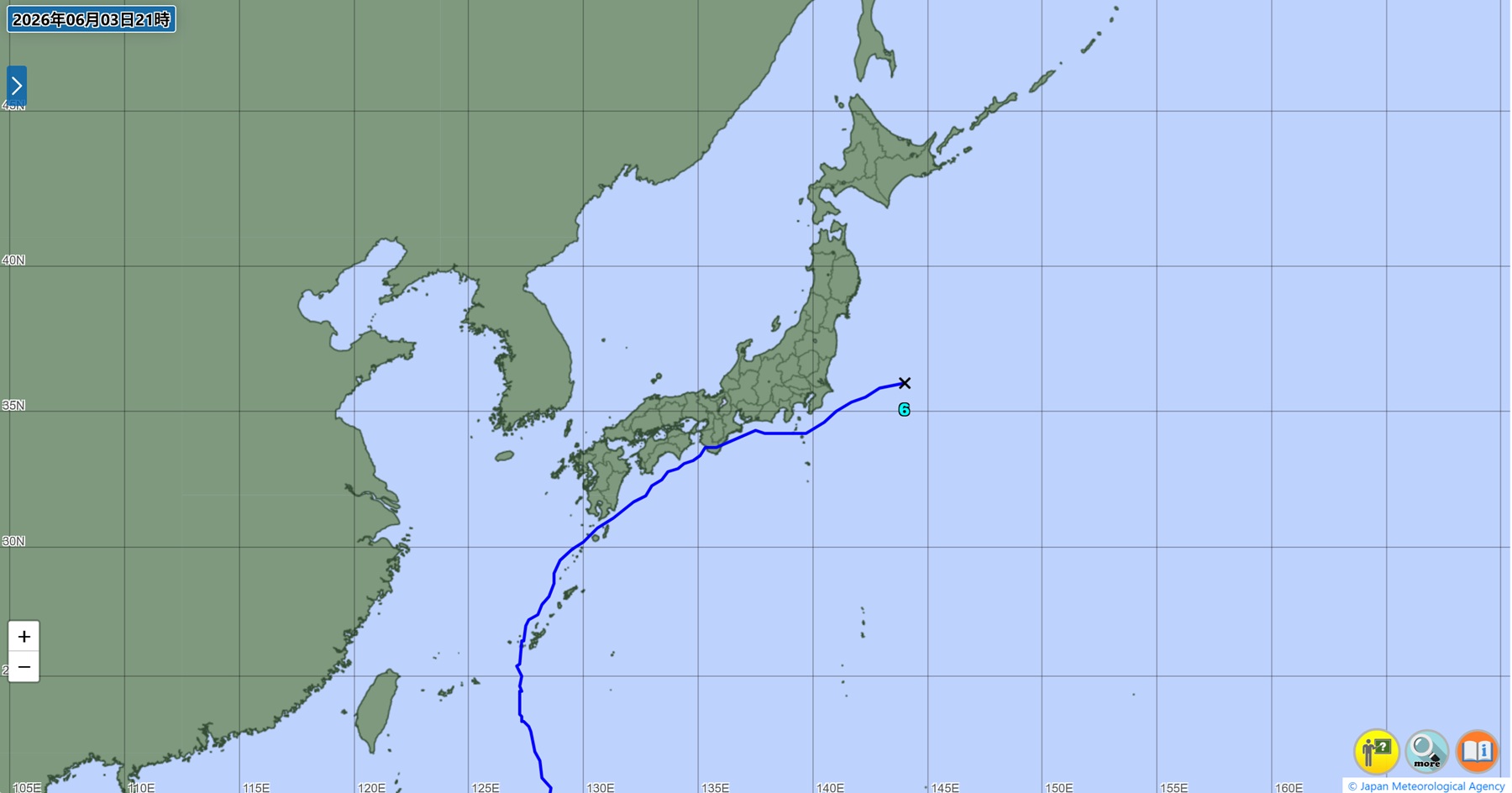 As of 3 June 2026, 21:0027 May · formation1 June · Okinawa3 June, shortly before 05:00 · landfall Wakayama3 June, evening · extratropical
Strength at its peak
- Central pressure min. approx. 975 hPa
- Max. wind approx. 30 m/s (10-min mean)
- Storm field (from 25 m/s): radius up to approx. 190 km
- Strong-wind field (from 15 m/s): up to approx. 650 km
The sequence of events
| Time | Region | What happened |
|---|---|---|
| 27 May | east of the Philippines | Formation as Typhoon No. 6 (Jangmi) |
| 1 June | Okinawa | closest approach; ferries and flights cancelled, the monorail in Naha suspended for the whole day |
| 2 June | Amami, southern Kyūshū, Shikoku | moves east along the south coast; locally torrential rain, storm gusts |
| 3 June, shortly before 05:00 | Kinki – Wakayama (Kii Peninsula) | landfall on the main islands – fourth-earliest landfall since the statistics began in 1951; heavy rain and storm, afterwards moving on towards Tōkai |
| 3 June | Tōkai, Kantō (Tokyo) | peak of rain and wind in the morning, during the commute; by the evening the rain was already moving away |
| 3 June, 21:00 | east of Kantō | transition into an extratropical low – the storm moves away |
How strong it was – and how long it lasted
What is decisive for the assessment: in each individual region the severe weather itself lasted usually only half a day to a day. The storm moved on briskly and the heavy weather went with it. The values now measured do show, however, that it was quite serious on the Pacific coast – with rainfall totals that in places came close to records:
- Rainfall (measured): in Mie Prefecture (Tōkai) around 535 mm fell in Owase within 24 hours, on the Kii Peninsula locally 320–380 mm, in Kōchi Prefecture more than 400 mm. In Tokyo 173 mm fell within twelve hours – in each case the highest June figures since records began.
- Records: in Mie Prefecture alone, ten out of twenty measuring stations set a new June rainfall record; inland in Kansai (among others Nara, Yao, Kōbe) the highest June wind in the history of measurement was reached.
- Wind (measured): peak gusts of about 35 m/s (around 125 km/h) on the Izu Islands, widely 25–29 m/s along the coast.
- Consequences: in Tokushima, Wakayama and Mie “linear rainbands” (senjō kōsuitai) formed; for the Kozagawa river in Wakayama the highest warning level 5 applied for the first time.
Honestly said: this is not weather in which you are out and about light-heartedly. But it was also limited to a few hours per place – and foreseeable a good day in advance.
Effects on transport
Air travel was affected most: for 3 June the two large airlines (JAL and ANA) together cancelled around 600 flights – almost 80,000 travellers had to rearrange their plans, including at the hubs Haneda and Narita. On the shinkansen there was temporarily restricted operation above all on the Tōkaidō and the Yamagata lines; in local transport around Tokyo individual lines and express trains were cancelled. After the storm had passed, rail services usually returned to normal within a few hours – the shinkansen is comparatively robust against wind and rain.
What travellers can learn from this
- Lead time: the weather agency warned about the course as early as 31 May – that is, around two to three days before the storm reached Honshū. Enough time to move individual travel days.
- Speed: in each region the severe weather was over after half a day to a day. In Tokyo the peak was on the morning of 3 June; by the evening it was already clearing.
- Rapid weakening: although Jangmi made landfall near Wakayama in the early morning of 3 June, it weakened quickly afterwards and turned into an ordinary low east of Kantō the very same evening (3 June, at around 21:00).
- To be taken seriously nevertheless: together with the rain front it brought a great deal of rain to the Pacific coast. Anyone travelling on exactly those one or two days needed flexibility – and the warning time is precisely enough for that: rearrange one or two days instead of the whole journey.
Sources: Japan Meteorological Agency (JMA), information on Typhoon No. 6; Japan Weather Association (tenki.jp), report on the landfall near Wakayama of 3 June 2026 as well as further Japanese media reports, as of 4 June 2026; the time of landfall follows the final analysis of the weather agency of 29 September 2026 (previously given provisionally as around 04:30). The rainfall and wind figures are measured preliminary AMeDAS values from 3 June; the finally checked values are published by the JMA afterwards.
Advantages and disadvantages of a journey during the rainy season
The result first: a journey in June is worthwhile above all because of the peak hydrangea season, the smaller crowds and the lower prices; the disadvantages are the humidity, occasional showers and viewpoints more often hidden in cloud. We do not want to paint you a one-sided picture. A journey in June has clear advantages – and equally clear downsides. Both side by side:
| Advantages | Disadvantages |
|---|---|
| Peak hydrangea season – temples and gardens at their best | Humid air, above all in Kansai and Kyūshū |
| Fewer tourists – the cherry blossom and autumn leaf crowds are over | Occasional showers can shift the plan for a day |
| Lower prices – ryokan and hotels less expensive in the low season | Viewpoints (Fuji, the Alps) more often hidden in cloud |
| Deep green – moss and forest gardens at their best | Hiking paths more slippery, some mountain routes only open from July |
| Quiet moods – temple courtyards in the rain are an experience in themselves | Laundry dries more slowly; clothing is prone to mildew |
Our honest conclusion on this section: anyone who depends on bright blue skies and a perfect view of Fuji should avoid the rainy season. Anyone who can give themselves over to atmosphere, plants and quieter temples gains more in June than they lose in sunshine.
A journey in June to the hydrangea temples
We plan your route so that you catch the peak of the ajisai bloom in each region – and have day-to-day weather guidance on the ground.
Request a no-obligation consultationThe ajisai wonder – hydrangea temples across the country
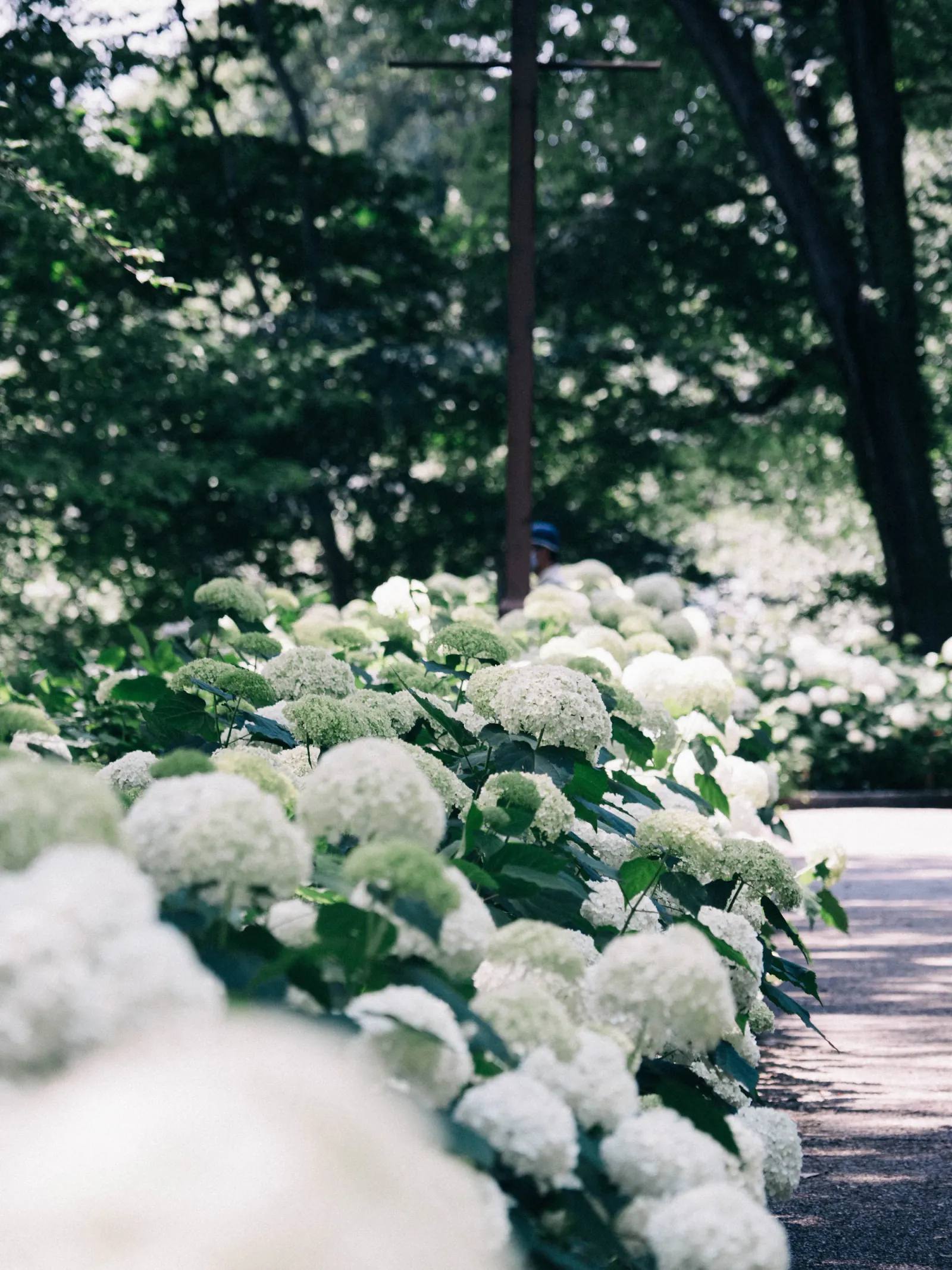
If the rainy season in Japan has a secret leading actress, it is the ajisai – the Japanese hydrangea. More than a dozen temples and shrines across the country have been known for centuries as ajisai-dera (“hydrangea temples”). Some tend hundreds of plants, others several thousand – and the peak of the bloom falls exactly within the tsuyu.
Here is a selection of the loveliest places, arranged by travel region. The flowering period shifts by about a week each year – the dates given are averages.

Kamakura – the classics near Tokyo
A good hour by train from Tokyo: Kamakura is the ajisai place of Japan, and you notice that in the visitor numbers as well. If you come early – before 9 in the morning – you will experience these temples in their quiet beauty all the same.
- Meigetsu-in (明月院) – the very embodiment of the “ajisai-dera”. The famous “Meigetsu blue” hydrangeas (around 2,500 plants) flower in mid-June in a uniform, almost surreal shade of blue. The stone steps up to the temple entrance are among the most photographed images of Japan.
- Hase-dera (長谷寺) – on a rise with a view of the sea. About 2,500 hydrangeas in shades of pink, violet and blue line a walking path around the temple; admission is regulated with time slots – arriving early is worthwhile.
- Jōchi-ji (浄智寺) – less well known, noticeably quieter, situated between Meigetsu-in and Engaku-ji. An overgrown bamboo grove with hydrangeas along its edge – atmosphere rather than spectacle.
Kyoto & Uji – hydrangeas in the old capital
- Mimuroto-ji (三室戸寺) near Uji – with around 10,000 hydrangeas, one of the largest collections in Japan. In June there is illumination in the evening; the famous heart-shaped hydrangeas are at the southern end of the garden. Peak bloom mid to late June.
- Fujinomori-jinja (藤森神社) – a Shintō shrine in the south of Kyoto with about 3,500 hydrangeas in two separate gardens. Less touristy than Mimuroto-ji, ideal for travellers who are in Kyoto anyway.
- Yoshimine-dera (善峯寺) – a mountain temple west of Kyoto. Hydrangeas grow on a slope spread along the whole temple path; a magnificent view over the Kyoto basin in clear weather.
Nara – the original hydrangea temple
If you combine Nara with Kyoto, you should plan in Yata-dera (矢田寺) – historically the origin of the Japanese ajisai-dera tradition. About 8,000 hydrangeas in 60 varieties, considerably quieter than the temples of Kyoto and Kamakura. A meditative experience rather than a spectacle – exactly what the rainy season actually promises.
Greater Tokyo – the ones close to the city
- Takahata Fudōson (高幡不動尊) – about an hour from Shinjuku on the Keiō line. Around 7,000 hydrangeas on a temple hill; considerably fewer visitors than in Kamakura, and instead the intimate character of a neighbourhood temple.
- The Hakone mountain railway line – if you are travelling to Hakone anyway, early summer is a good choice: between mid-June and early July the winding narrow-gauge railway runs through whole corridors of hydrangeas. In places it deliberately slows down for them.
North and south – if you would rather avoid the crowds
On Hokkaidō the hydrangeas flower later (July to early August) and in a cooler climate – the island is generally a good alternative destination when the main islands lie under tsuyu. In Kyūshū it is above all Senkō-ji near Kurume (Fukuoka Prefecture), with around 7,000 hydrangeas on its slopes, that is worth a detour; in the Chūgoku region the hydrangea path at the Kibitsu shrine in Okayama is rewarding – both of them away from the crowded Kansai classics. If you are generally looking for such quiet places far from the great streams of tourists, you will find further ideas in our Japan hidden gems.
A practical note on the peak bloom
The peak hydrangea season shifts by about a week each year, depending on the weather. Reliable real-time information is given by the temple websites (often with a daily bloom status in per cent) and by the app Tenki.jp. For our guests we are glad to take on this day-to-day research.
Should I avoid the typhoon season?
Our short answer: not across the board. Anyone planning a tightly timed round trip takes a certain risk in August and September; anyone who travels flexibly and builds in buffer time can travel well during the typhoon season – especially in the northern regions. We are asked this question often – and the answer depends more on the way you travel than on the calendar. Late summer does after all have its lovely sides as well: festivals, fireworks and the Obon period. Which ones these are, you can read in our article on summer in Japan.
If you are planning a round trip with a fixed route – for example Tokyo → Hakone → Kyoto → Hiroshima → Miyajima in fourteen clearly timed days – a typhoon in August or September can indeed lead to frustration. Cancellations of high-speed trains, closed sights and rebooking a ryokan at short notice cost nerves, above all without someone to mediate on the ground.
If you travel flexibly – few fixed dates, a willingness to stay two days longer in one place, good indoor alternatives (museums, onsen, meals out) – then August and September are not an exclusion period either. We have had guests who “sat out” a typhoon in a rural ryokan in Tōhoku and later described those two quiet days as the emotional high point of the journey.
A clear recommendation from us:
- First-time travellers on a first visit and with a fixed plan: better May, June (early to mid), October or November.
- Experienced Japan travellers who are willing to be flexible: August and September work – above all in the more northerly regions (Tōhoku, Hokkaidō).
- Families with small children: better to avoid the typhoon weeks, if only because of the heat and the humidity. How a journey to Japan with children can be planned in a relaxed way is shown in our family guide.
Practical tips for tsuyu and the typhoon season
What you should pack
- A folding umbrella rather than a rain jacket. In the humidity of June you will sweat under a rain jacket faster than the rain can make you wet. A good folding umbrella (available at any Japanese station for 500–1,500 ¥ if needed) is the better choice.
- Breathable clothing. Linen, thin cotton and quick-drying functional fabrics are more pleasant than tight synthetics.
- A second pair of shoes. Even waterproof shoes often need to air overnight. A change of shoes is worth its weight in gold.
- A laundry bag. Damp clothing has to be carried back to the hotel – a waterproof bag in your day pack is the simplest solution.
- A small towel. People in Japan carry a small towel with them at all times – for hands, forehead, glasses. Indispensable in summer and in the rainy season.
Apps and information
- Tenki.jp or Weathernews – the most reliable weather apps in Japan, with hour-by-hour rain radar forecasts. Both have English versions.
- Japan Meteorological Agency (JMA) – the official weather agency. For typhoon tracks and warning levels the most reliable source (available in English as well).
- NHK World – an English-language TV app with current weather updates, above all in the event of a typhoon.
When a typhoon is coming
- Three days before: review your travel plans, identify alternative indoor activities at your destination.
- 24 hours before: have food and water for half a day at the hotel (convenience stores are often bought out the day before).
- On the day of the typhoon: stay in the hotel or ryokan. A day in an onsen with a good book is a profoundly Japanese experience.
- The day after: on the main lines rail services usually run again within a few hours – in our experience most guests travel on the same day. Where lines are damaged, it can take days or weeks.
- In a cloudburst: stay up on the surface. In Japanese cities the water usually does not come from the river but from within – the drainage system can no longer take the volume (naisui hanran). What is dangerous then are the low places: underpasses, sunken stretches of road, basements and underground car parks. How deep the water stands in an underpass cannot be judged from the outside – if you are travelling by rental car, it is better to wait that one hour out on higher ground.
- Do not put a stage of your journey on the announced day of resumption. When an interrupted railway line names a date for resuming service, that is an intention subject to the weather. In the summer of 2026 one such date was pushed back, and on another line services were suspended again after it had already started running. So put a stage of your journey on the day after. And for sections that hang on a single feeder connection, check in advance whether there is any replacement service at all: on branch lines in the mountains and on island connections there often is none.
If you are travelling by rental car
Since 1 September 2026 a speed limit of 30 km/h instead of the previous 60 has applied on Japanese minor and residential roads without a centre line. Around 870,000 kilometres of road are affected, that is almost everything away from the main roads. Unlike in many other countries, this is as a rule not signposted there: in Japan no sign does not mean “no limit”, it means precisely this one. Anyone exceeding it by 30 km/h or more does not pay an on-the-spot fine but is prosecuted under criminal law and as a rule may not drive for 30 days.
A summer journey with support on the ground
If typhoons occur, we organise your rebookings, alternative connections and the forwarding of your luggage – in real time, in English.
Plan an individual summer journeyIf you would rather travel at another time
If, after this article, you come to the conclusion that neither tsuyu nor the typhoon season is your idea of Japan – that is entirely understandable. There are three windows that we particularly recommend to first-time visitors:
- Early to mid-May – after the cherry blossom, before the rainy season. Fresh temples, mild weather, lower prices than in the sakura high season.
- Mid-October to mid-November – the beginning of the autumn leaves in Tōhoku and the Japanese Alps; calm weather, clear air. Everything about it in our guide to the autumn leaves in Japan.
- Late March to early April – the classic sakura high season, with all its advantages (beauty) and disadvantages (crowds, prices). When and where the bloom is expected in 2027 and how early you should book is set out in our guide to the cherry blossom in Japan 2027.
A detailed breakdown of all the seasons can be found in our separate article Best Time to Visit Japan 2026: The Ultimate Guide.
Frequently asked questions
When is the rainy season in Japan in 2026?
The rainy season (tsuyu) begins in Okinawa in early May and reaches the main islands in early June. On Kyūshū, Shikoku and most of Honshū it lasts roughly from early June to mid-July, in Tōhoku (northern Honshū) from mid-June to the end of July. Hokkaidō has no distinct rainy season. The Japan Meteorological Agency (JMA) announces the actual start and end dates region by region every year; they shift by a few days up to a week from one year to the next. The dates on which each region came out of the rainy season in 2026 – the last of them Hokuriku and Tōhoku on 4 August – are listed in the section “Current situation: rainy season & typhoons 2026”.
Does it really rain every day during tsuyu?
No. The rainy season is a mixture of grey, humid days, short heavy showers and individual sunny hours. On average it rains on about half of the days, often only for a few hours – a whole day of plans is rarely made impossible.
When is the typhoon season in Japan?
Officially from June to October, with a clear peak in August and September. On the long-term average about three typhoons make landfall on Japan directly; around twelve come close enough to affect the weather noticeably. The Japan Meteorological Agency (JMA) publishes the expected track up to five days in advance – changes of route at short notice are therefore quite possible.
How many typhoons are there in Japan in 2026?
That varies from year to year. More important for travellers than the total number is how many typhoons actually reach Japan: on the long-term average there are about three direct landfalls per year, while others graze the coasts. How many typhoons have formed so far in 2026, and how many of them have reached Japan, is set out in the section “Current situation: rainy season & typhoons 2026”.
How long does a typhoon last in Japan?
In any one region the severe weather itself usually lasts only half a day to a day – the storm moves on quickly, and both before and after it the sky is often bright blue. A typhoon normally passes over a single region within 24 to 48 hours. Because the Japan Meteorological Agency (JMA) publishes the expected track up to five days in advance, an affected travel day can almost always be rearranged.
Are the hydrangea temples overcrowded?
The best-known temples such as Meigetsu-in in Kamakura or Mimuroto-ji in Uji have their high season from mid to late June – early in the morning or in the late afternoon it stays more relaxed even there. If you would rather avoid the crowds, you will find far quieter conditions at Yata-dera (Nara) or at smaller temples.
Is a journey to Japan in June worthwhile at all?
For travellers who love hydrangeas and appreciate quieter sights and lower prices, June is one of the loveliest times to travel – provided you come with the right expectations and the right equipment. Anyone who depends on bright blue skies should choose May or October instead.
Further reading & planning your journey
- → Japan Independent Travel 2026 – the complete guide
- → Ryokan in Japan: tradition, onsen and how to book one
- → What does a journey to Japan cost? The honest cost guide
- → Japan in two weeks: the golden route
- → Best Time to Visit Japan 2026: The Ultimate Guide
- → Why a Japan specialist? – what planning on the ground brings
Our conclusion
Tsuyu and the typhoon season are not travel taboos but times of year with a character of their own. The rainy season gives you hydrangeas in full splendour, quieter temples and lower prices – the price for that is a few showers and a humidity that can be handled well with the right equipment. The typhoon season is more demanding, but it is not a reason to stay away – above all not for guests who travel flexibly, or for routes in the northern regions of Japan.
Our advice is always the same: build your journey around what you are looking for, not around what you want to avoid. If you are looking for ajisai, moss gardens in the rain and quiet temples, June is your month. If you want the blue view of Fuji and flawless days for walking, May or October are better. Both are legitimate. Both are Japan.
We are Japan Privat: a Japan-based tour operator for individual journeys through Japan, advising you in English. If you are wondering whether the rainy season is the right thing for you – or how a summer journey can be cushioned against the risk of typhoons – do get in touch with us; there is no obligation.
Thirty minutes for a first conversation – free and without obligation
Tell us what you hope for from your journey through Japan. We listen, we ask questions – and together we decide whether June, July or another time of year suits you.
Request a consultationAbout the author

Kentaro Asakura
Founder of Japan Privat · A Japan specialist who guides you in English
Kentaro Asakura was born and raised in Japan. His student years took him first to the UK, where English became second nature to him, and later to Munich, where he met his wife, who is German – together they returned to Japan. With Japan Privat, he has been designing individual journeys for European travellers for more than ten years – in English, with the eyes of a local and a genuine feel for what guests from Europe are looking for.