Autumn Leaves in Japan 2026 – Where, When and How to Experience Kōyō
Contents
- The high point of autumn
- What is kōyō? The autumn leaf front
- Current status 2026
- Autumn leaves by region
- Kyoto – the capital of the autumn leaves
- Tōhoku & Nikkō – the early autumn
- Tokyo and its surroundings
- Quiet places away from the crowds
- Yoru-momiji – the evening illumination
- Practical tips
- How we plan your autumn journey
- Frequently asked questions
- Our conclusion
When you think of the most beautiful time to travel in Japan, the cherry blossom probably comes to mind first. But ask Japanese people themselves: many name not the delicate pink of spring, but the blazing red and gold of autumn. Kōyō – the autumn leaves – is the second great high point of the Japanese calendar of nature, and for some the more beautiful one. Maple leaves glow in deep crimson, ginkgo avenues shine in pure gold, and for a few weeks whole temple gardens seem to stand in flames. The decisive difference from the cherry blossom: the autumn leaves are easier to plan for, because they move from north to south over more than two months. In this article you will learn where, when and how to experience kōyō in 2026 at its best.
The key points in brief
- When? The autumn leaves travel from north to south – from late September on Hokkaidō, mid-October to early November in Tōhoku and in the mountains around Nikkō, mid to late November in Kyoto and Tokyo, in places into early December.
- Where? Kyoto is regarded as the capital of the autumn leaves (Tōfuku-ji, Eikan-dō, Arashiyama); if you travel earlier, you will find leaves that are just as beautiful and often quieter in Tōhoku and around Nikkō as early as October.
- Forecast for 2026? Nihon Kishō expects a normal date in eleven of fourteen cities. In its forecast of 14 October, the Japan Weather Association expects a later peak than usual in many places, above all in the lowlands of eastern and western Japan; Weathernews expects it somewhat later in many places at the sites that are usually in colour after mid-October. The weather agency expects higher temperatures than usual until mid-November. In mid-October the leaves are at their peak in many places in the mountains, while on Hokkaidō they are already fading in many places; in the cities from Tokyo to Kyoto it is still green. For Kyoto the second half of November remains the best choice.
- Crowded? At the famous places, yes – but the long season of more than two months leaves room for many quieter alternatives.
Are you planning an individual journey through Japan? This article is part of our large overview. You will find the complete guide – with travel season, routes, costs and planning – here: Independent Travel in Japan 2026 – the complete guide.
What is kōyō? The autumn leaf front
Kōyō (紅葉) is the word for the autumn colouring of the leaves. Two trees shape the picture: the Japanese maple momiji (紅葉/もみじ), whose small leaves glow in bright red to orange, and the ginkgo ichō (銀杏), which turns whole avenues pure gold. Beeches, larches and many other species are added to them – a very different play of colour depending on altitude and region.
Much like the cherry blossom in spring, the autumn leaves also travel across the country as a “front” (kōyō-zensen) – only in the opposite direction. While the cherry blossom moves from south to north, the autumn leaves move:
- From north to south: They begin in late September on Hokkaidō and reach the south only in late November to early December. By then the first snow has already fallen in the north – the transition into the Japanese winter is seamless.
- From top to bottom: In the mountains the leaves turn weeks earlier than in the valleys and cities of the same region – a difference in altitude of a few hundred metres can amount to two or three weeks.
- Over more than two months: This long span is your great advantage – unlike with the cherry blossom, there are always autumn leaves at their best somewhere in Japan.
The colouring needs the right weather: warm, sunny days and cool nights make the colours especially intense. That is precisely why the peak season shifts every year – a warm autumn can push the leaves back by one to two weeks.
Current status: autumn leaves 2026 – 19 October
The current picture first: in the mountains the leaves are at their peak in many places; on Hokkaidō the colours are already fading in many places, and at the highest elevations the leaves have fallen. In the cities from Tokyo to Kyoto it is still green; after a few cooler days from 22 October, the weather agency considers exceptional warmth possible again from around 25 October. For Kyoto the second half of November remains the right choice. The Japan Weather Association presented its second forecast on 14 October. It expects the peak mostly at the usual time or later: in the lowlands of eastern and western Japan later than usual in many places, because it is expected to stay warmer into November. In mountains in the north, by contrast, the colouring has set in earlier than usual in places. The weather agency’s one-month outlook of 15 October, too, expects above-average temperatures until mid-November.
What can already be seen – and what is only calculated
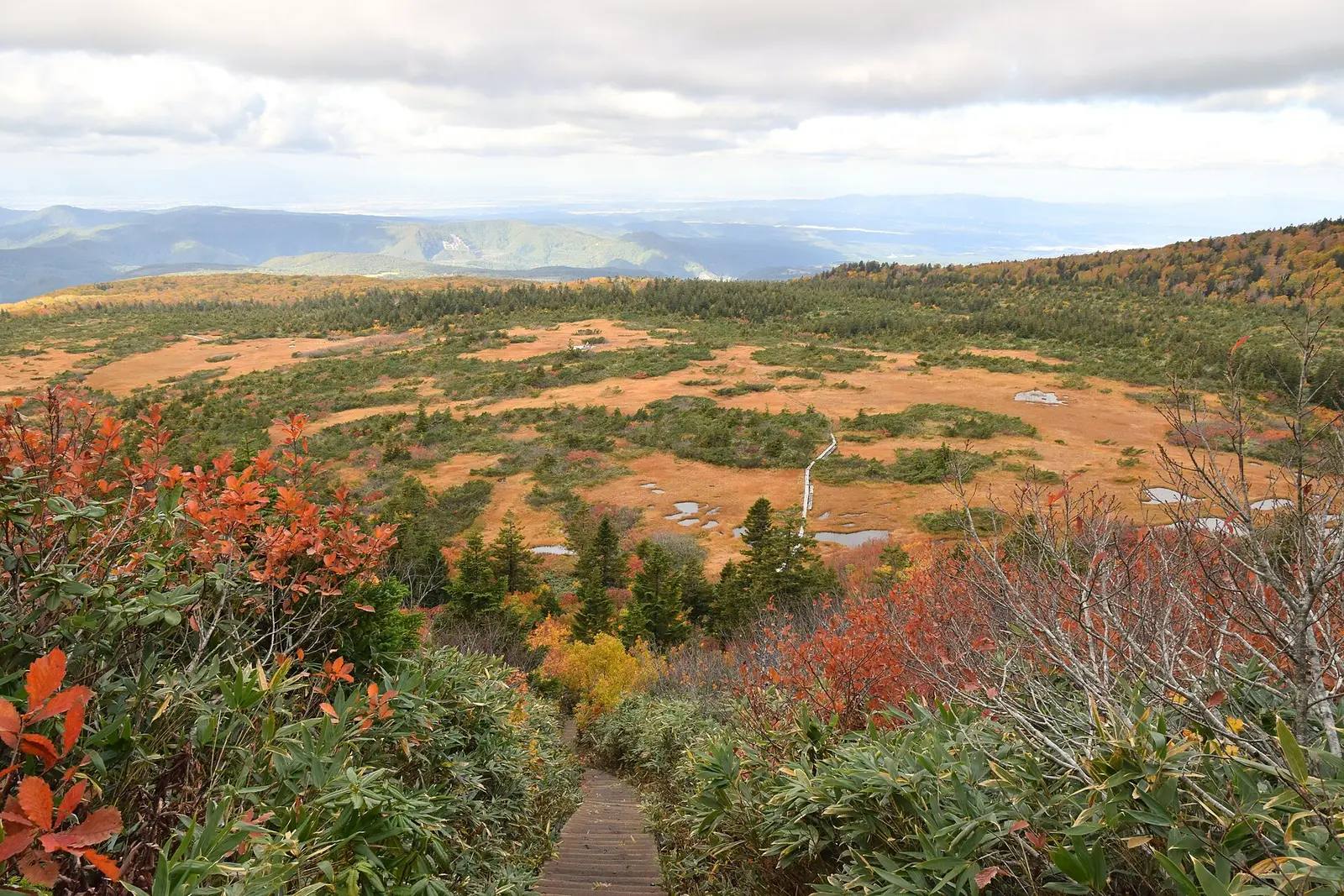
Reported colouring and forecast dates are readily mixed up in travel reports; telling them apart is the heart of this section. So far the colouring has reached its peak in the mountains and on Hokkaidō. On Hokkaidō, according to tenki.jp on 19 October, the colours are already fading in many places, for example in Jōzankei near Sapporo and at Lake Akan; at the highest elevations of the Daisetsuzan mountains and in the Sōunkyō valley the leaves have already fallen. In Tōhoku, higher elevations such as Zaō and parts of Hachimantai are at their peak; on the panoramic road across Hachimantai and on Hakkōda the colours are already fading. At the Oirase gorge the colouring has begun; according to Weathernews, the leaves there were about half coloured on 18 October. In the Northern Alps the leaves have fallen on the high plateau of Tateyama, while further down the mountain the colouring has begun; in the Kamikōchi valley they are at their peak. In Shirakawa-gō the colouring has begun. Near Nikkō the leaves are at their peak at the high elevations of Oku-Nikkō, around Lake Yuno and on the Senjōgahara plateau; at Lake Chūzenji and on the Irohazaka road the colouring has begun – on the Irohazaka road the leaves were about half coloured on 17 October, according to Weathernews. In the cities it is still green: tenki.jp reports Arashiyama, Eikan-dō and Kiyomizu-dera in Kyoto as well as the ginkgo avenue at Meiji-Jingū-Gaien in Tokyo and Mt. Takao near Tokyo as “green leaves” on 19 October. Every date for the peak in Kyoto, Tokyo or the valleys of Tōhoku is therefore to this day a forecast, that is, a calculation drawn from the temperature outlook, and not an observation.
Why the forecasts give different dates for Kyoto
For Kyoto there are three dates, and they lie four weeks apart: the Japan Weather Association gives 13 November for Arashiyama as the beginning of the peak, Weathernews 20 to 26 November for the city’s well-known temples, and Nihon Kishō 11 December. All three services left their date for Kyoto unchanged in their respective second forecasts; since then, Weathernews has moved the dates for Kyoto on its pages for individual places back by one day. This is not a contradiction but a difference in what is being measured – and for your planning it is the most important paragraph on this page.
- Nihon Kishō forecasts for a single reference tree at the weather station the day on which that tree has fully turned – by the same standard the weather agency uses for its observations. For Kyoto that date falls on 5 December in the long-term mean.
- Weathernews forecasts the destinations themselves: from the day on which about 70 per cent of a site has coloured until the leaves begin to fall. The averages are drawn from the years 2004 to 2025.
- The Japan Weather Association likewise forecasts destinations, with Arashiyama representing Kyoto. From what degree of colouring it considers the peak to begin is not stated on its forecast page.
For travel planning it is the two forecasts for the destinations that count. If you go by the station value and put Kyoto on 11 December, you will stand in the famous gardens in front of largely bare branches. You do not have to choose between the other two: together they outline a window that opens around 13 November and has its focus in the second half of November. Seen the other way round, the difference explains why you find dates for the same city online that lie weeks apart: they are different questions, and all of them are answered correctly.
Where the 2026 season runs later – and where it does not
The delay varies from region to region. The Japan Weather Association sees the north as a whole within the usual range: because the first half of September and the beginning of October were cool, the colouring in mountain areas such as Sōunkyō and at the Oirase gorge set in earlier than usual; in southern Tōhoku, by contrast, it expects a delay in places. For eastern and western Japan it expects “normal or later”, in the lowlands later in many places. Nihon Kishō classes eleven of fourteen cities as normal, among them Tokyo (28 November) and Kyoto (11 December, six days after the mean); by the service’s classification Nagano, Sapporo and Kōchi count as late, by seven to nine days. Weathernews expects mostly a normal peak at the places that are usually in colour by mid-October, and in many places a somewhat delayed one at the later places.
The forecasts for well-known destinations
The overview below sets side by side, for well-known destinations, the dates of the two services that forecast the places themselves. Both mark the beginning of the peak, not its end – from there, one to two weeks usually remain.
| Place | Japan Weather Association (forecast of 14 October) | Weathernews (page for the place, as of 19 October) |
|---|---|---|
| Oirase gorge (Aomori) | 15 October | 23 October |
| Nikkō, Irohazaka road | 23 October | 23 October |
| Shirakawa-gō | 31 October | 1 November |
| Kyoto, Arashiyama | 13 November | 25 November |
| Kōrankei gorge (near Nagoya) | 16 November | 24 November |
| Takachiho gorge (Kyūshū) | 16 November | 26 November |
| Miyajima | 18 November | 19 November |
| Mt. Takao (near Tokyo) | 19 November | 23 November |
The Weathernews dates are later at almost all places, at the Oirase gorge by eight days; the Japan Weather Association’s date there has already passed, and so far only the start of the colouring has been reported. Whether the gap comes down to the standard used cannot be said: Weathernews has the peak begin at about 70 per cent colouring, while the Japan Weather Association does not state its standard. Weathernews keeps adjusting the dates on its pages for individual places: for Kyoto and Mt. Takao they are now one day later, for the Oirase gorge and Shirakawa-gō two to three days earlier. For Kyoto, the service also names individual temples: Tenryū-ji in Arashiyama from 20 November, and thus earlier than the Arashiyama valley as a whole, Tōfuku-ji from the 24th, Eikan-dō from the 25th and Kiyomizu-dera from 26 November.
How strong the colours will be is something Weathernews estimates by region in its second forecast of 8 October – information that forecasts rarely include otherwise. From Hokkaidō, after a comparatively sunny September, there are reports of colours more vivid than for several years. In Tōhoku and in Kantō, where September was short on sun, individual places report weaker colouring. From Hokuriku and Tōkai to Chūgoku and Shikoku the service expects better colours than last year, and weaker ones overall only in Kyūshū, where the summer was hot and dry. Independently of the colours, Weathernews pointed out on 8 October that in Kyūshū individual roads remain closed after the earthquake in July.
How to estimate the shift for yourself
Leaves do not turn according to the calendar, but according to temperature. In Japan the rule of thumb is: the colouring sets in when the minimum temperature falls below about 8 °C, and it accelerates below 5 °C. From that point it takes around three weeks until a place really looks its best. Then there is altitude: for every 100 metres of elevation the temperature falls by about 0.6 °C – which is why the highlands turn earlier than the city below them. With these three figures you can check any forecast for yourself. Take Mt. Takao near Tokyo: the mountain lies around 500 metres above the city of Hachiōji, which is a difference of about 3 °C. If Hachiōji falls to 11 °C at night, the summit has reached 8 °C – and about three weeks later it stands in full colour.
These figures are a value drawn from experience, not a measurement. They refer to the Japanese fan maple (iroha-momiji) and vary from tree to tree and from place to place. For the finer points, three further things matter, which Japanese meteorologists like to name together: enough sun, enough water and a clear difference between day and night. If the nights stay above 10 °C, the red turns dull; if they fall below 0 °C, the leaves turn brown instead of red. That is precisely why a warm autumn can push the peak season back by one to two weeks.
Why this autumn stays warm – the weather agency’s outlooks
The weather agency’s three-month forecast of 18 September considers above-average temperatures across the whole of Japan the most likely outcome for October to December (50 per cent). For October and November this applies from Hokkaidō to Kyūshū; in December, “normal” and “warmer than normal” are equally likely for the north. For the autumn leaves this means: the nights will fall permanently below 8 °C later, and the three weeks that the leaves still need afterwards will begin correspondingly later.
The one-month outlook of 15 October confirms this for the period up to 16 November. In the east including Tokyo and in the west including Kyoto the meteorologists consider higher temperatures than usual likely at 70 per cent, in the north at 60 per cent; for the first week up to 23 October the figure in the east and the west is 80 per cent, in the north 70. On 19 October the agency issued a new notice of exceptional warmth: for about five days from 25 October, temperatures that occur only rarely at this time of year are possible from Kantō and Kōshin through Tōkai and the Pacific side of Kinki to Shikoku and southern Kyūshū, so in Tokyo and Kyoto as well. The agency issues this notice as soon as the probability reaches 30 per cent; it does not apply to Hokkaidō and Tōhoku, where the leaves are now in colour. From the one-month outlook, a second statement is important for the colours: on the Pacific side of eastern Japan and throughout western Japan the agency expects fewer sunny days than usual – and enough sun is one of the three conditions for a strong red. The weekly forecast of 19 October shows the daytime highs in Tokyo and Kyoto falling, after 29 degrees on 21 October, to 20–25 degrees in the days that follow. The next three-month forecast appears on 20 October, the next one-month outlook on 22 October.
Behind this warm autumn lies a pattern, not a coincidence. An El Niño event has been under way since the spring of 2026, in September stronger than ever since the series began in 1949, and the weather agency expects it to continue into the winter. For Japan, however, El Niño does not automatically mean “warm” – the patterns typical of it were not clearly discernible over Japan in the recent past. The path is more indirect: global warming and El Niño together raise the temperature of the entire atmosphere in the tropics, so that warm air settles over Japan more readily.
What this means for your planning
- Kyoto: the second half of November – backed by both forecasts for the destinations. The Japan Weather Association and Weathernews put the beginning of the peak between 13 and 26 November. If you arrive around 15 November and stay two weeks, you will cover this window. You should still not rule out the beginning of December.
- For colour in October: head for the mountains now, and lower down in the second half of the month. You will currently find the peak at Zaō in Tōhoku, in Kamikōchi and at the high elevations of Oku-Nikkō, among other places; on Hokkaidō the colours are already fading in many places. Next come the Irohazaka road near Nikkō (according to both services) and the Oirase gorge (according to Weathernews), each around 23 October, followed by Shirakawa-gō around the turn of the month (according to both services); at all three places the colouring has already begun.
- Accommodation does not wait for the forecast. The houses in Kyoto are often already fully booked for the second half of November long before the last forecasts appear. So the order is: book first, fine-tune afterwards.
- A forecast is not a date. Weathernews presents its third forecast in late October, Nihon Kishō its third in early November. For Kyoto the direction is set, the exact day is not. Individual rainy days are part of the planning, especially if you are counting on the evening illuminations: until mid-November the weather agency expects fewer sunny days than usual in western Japan including Kyoto, and on the Pacific side of eastern Japan including Tokyo also more rain.
- Keep an eye on Typhoon No. 30 and this week’s weather (as of 19 October). The typhoon has reached the weather agency’s highest intensity category. According to the agency’s forecast, on the evening of 23 October it lies about 150 kilometres south-south-west of Yonaguni, with Yonaguni still inside the circle in which its centre is then expected; the area in which the agency considers storm-force winds possible then covers the Yaeyama Islands and Miyako, but not the main island of Okinawa and not Japan’s main islands. On 24 October it is forecast to lie, weakened, between Taiwan and the Chinese mainland. Where it goes after that is open: according to Weathernews, most conventional computer models take it via the area around Taiwan to the mainland, while several AI models have it turn north-east towards Japan. Depending on its track, it may also intensify a rain front south of Honshū; Weathernews considers heavy rain possible on the Pacific side of western and eastern Japan from 24 to 26 October – these days are less suited to trips into the mountains. Even before that, according to Weathernews, it may turn stormy in the north on 21 and 22 October, and after that snow may fall in Hokkaidō’s mountains and at high elevations in northern Tōhoku; if you are driving mountain pass roads there to see the leaves, check the road conditions beforehand. We keep the current status in our article on the rainy season and the typhoon season.
- For now, plan on the Yōrō valley in Chiba only by car and from the south. The small railway line into the valley was damaged at 26 points on its rear section by Typhoon No. 25 on 21 September; the railway expects it to take from half a year to more than a year until the whole line is running again. The replacement service runs only on weekdays and much less often, and not as far as the valley, because the road there from the north is closed. By car, too, the valley cannot currently be reached from the direction of Ichihara in the north. For one of the two closed roads the city gives November as its target, for the other no date yet. From the south, via the town of Ōtaki, you can get to the Awamata waterfall; according to the city, the Kannon bridge and Yōrō-Keikoku station have also been reachable this way since 14 October. Many inns and restaurants in the valley are open, and according to the city of Ichihara the autumn leaves can be seen from mid-November as usual; they usually reach their peak there in late November to early December. From 23 November, the Kannon bridge, the Awamata waterfall and the Kengai-kyō rock face are illuminated in the evenings.
Sources for this section: Forecasts – the second kōyō forecast from the Japan Weather Association of 14 October 2026 (its date for Arashiyama from the first forecast of 1 October following tenki.jp of 10 October 2026), the second kōyō forecast from Nihon Kishō of 1 October 2026 (reference tree; the date for Kyoto from the first forecast following the press release of 2 September 2026), the second kōyō forecast from Weathernews of 8 October 2026 with the press release of the same day (condition of the leaves), the definition of the peak following the first Weathernews forecast of 3 September 2026, and the dates for individual places following the Weathernews pages for individual places (as of 19 October). Observations – the colouring status on tenki.jp of 19 October 2026 (15:00) and the Weathernews pages for individual places (17 and 18 October). Temperatures – the three-month forecast of 18 September, the one-month outlook of 15 October, the weekly forecast of the weather agency of 19 October (17:00) and the next dates following the seasonal forecasts of the weather agency, the weather agency’s notice of exceptional warmth (version of 19 October 2026; the page is replaced with each issue), and El Niño following the El Niño report of the weather agency of 9 October 2026. Typhoon No. 30 – the typhoon information of the weather agency (19 October, 21:45), Weathernews of 19 October 2026 (computer models) and a further Weathernews report of the same day (rain from 24 to 26 October, storm and snow in the north). Yōrō valley – the press release of the Kominato Railway of 8 October 2026 and its timetable for the replacement service from 19 October, the notices of the city of Ichihara on access and illumination (as of 14 October 2026) and its notice on the Yōrō valley of 14 October 2026. Rules of thumb – 8 °C, three weeks and 0.6 °C per 100 metres of altitude following tenki.jp, and the acceleration below 5 °C and the restriction to the fan maple following Weathernews.
How we maintain this section
This section grows with the season – just as we handle it in our article on the rainy season and the typhoon season, which we have been updating weekly since May. The date in the heading shows you at any time how old the information is.
- 20 October: the weather agency’s next three-month forecast, which also re-examines the outlook for the winter.
- 22 October: the weather agency’s next one-month outlook.
- Late October: the third forecast from Weathernews.
- Early November: the third forecast from Nihon Kishō. There is no date yet for a third forecast from the Japan Weather Association.
- Ongoing: the reports of the actual colouring from the regions – place by place, observations take the place of calculations.
At this point we always say what a date rests on: an observation or a forecast. For the day-to-day state of the colouring during your journey, the apps tenki.jp and Weathernews are the most reliable sources.
Autumn leaves by region
The autumn leaves travel from north to south: they begin on Hokkaidō in late September, reach Tōhoku and the mountains around Nikkō in October, and Kyoto, Tokyo and Kyūshū only from mid-November to early December. The overview below shows the typical windows of the peak season. The dates are averages of the past years; expect a shift of one to two weeks depending on the weather.
| Region | Peak season (avg.) | Well-known places |
|---|---|---|
| Hokkaidō | Late Sept. – mid-Oct. | Daisetsuzan, Jōzankei, Lake Tōya |
| Tōhoku (northern Honshū) | Mid-Oct. – early Nov. | Oirase Gorge, Zaō, Urabandai, Chūson-ji |
| Nikkō & Hakone | Mountains around Nikkō: mid-Oct. – early Nov.; town of Nikkō and Hakone: early – mid-Nov. | Irohazaka, Lake Chūzenji (mountains); Tōshō-gū (town of Nikkō); Lake Ashi (Hakone) |
| Kyoto & Kansai | Mid-Nov. – early Dec. | Tōfuku-ji, Eikan-dō, Arashiyama, Rurikō-in |
| Tokyo | Late Nov. – early Dec. | Meiji-Jingū-Gaien, Rikugi-en, Mt. Takao |
| Kyūshū | Late Nov. – early Dec. | Yabakei Gorge, Takachiho |
The practical consequence: If you travel early in the season (October), Tōhoku and Nikkō belong on your list. If you travel in the classic month of November, Kyoto is the heart of the season. If you would like to combine both, travel from north to south – and you will see the autumn leaves twice, as it were.
Kyoto – the capital of the autumn leaves
In Kyoto the peak of the autumn leaves usually falls in the second half of November – no other city brings autumn leaves and culture together so densely. Hundreds of temples and gardens, centuries-old maple trees, carefully composed views – here the contemplation of autumn leaves was refined into an art form over centuries.
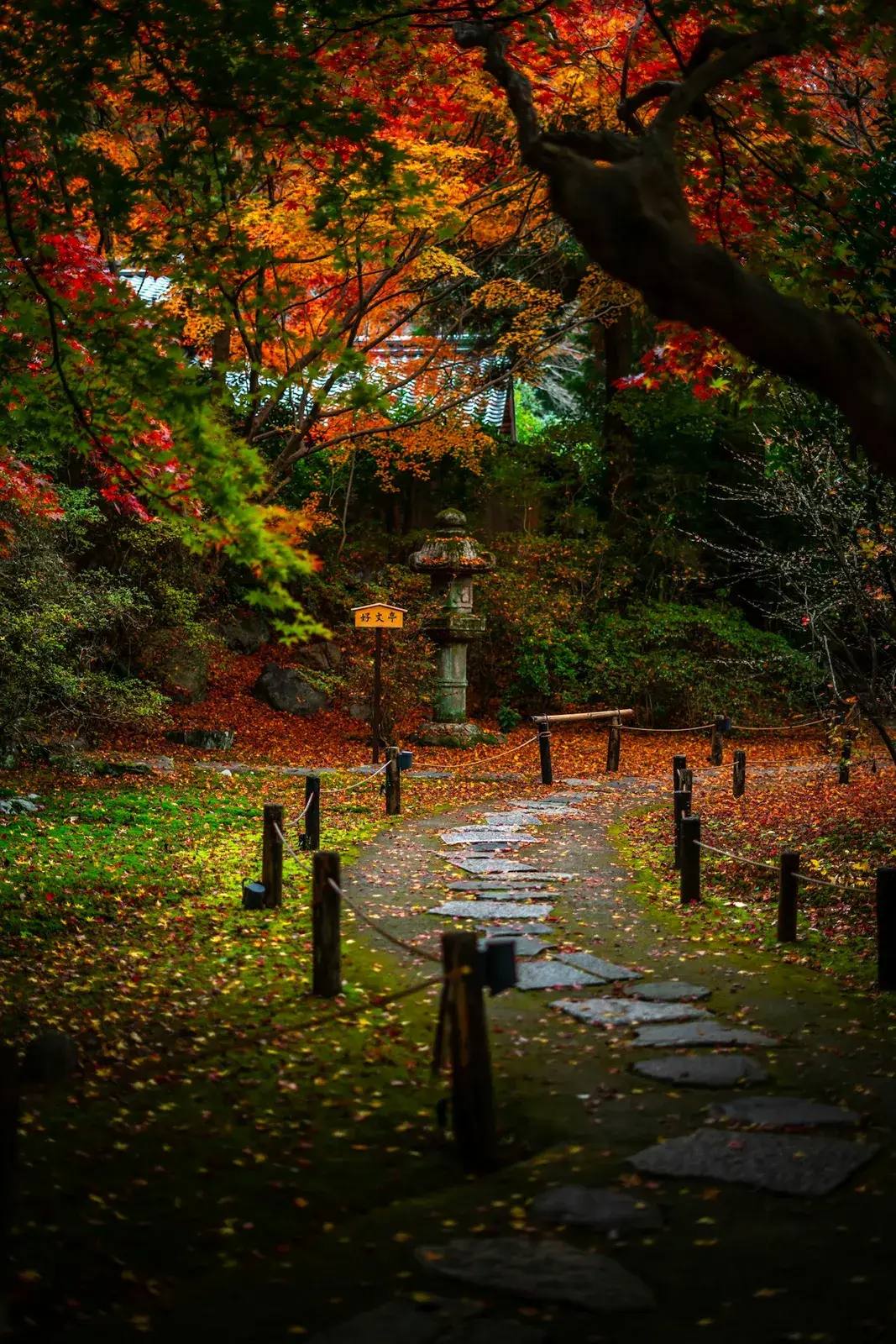
- Tōfuku-ji (東福寺) – From the Tsūtenkyō, a wooden bridge, you look out over a whole sea of red maple. One of the most famous and therefore also one of the most crowded places in Kyoto – arriving early is worth it.
- Eikan-dō (永観堂) – Known since ancient times as “Momiji no Eikandō” (the Eikandō of the maple). Magnificent by day, and almost otherworldly in the evening with the illumination.
- Arashiyama (嵐山) – The west of Kyoto: the Togetsukyō bridge over the river, the garden of Tenryū-ji and the picturesque Sagano Romantic Railway through the autumn hills.
- Rurikō-in (瑠璃光院) – Famous for the reflection of the leaves on the polished black tables. Open only for a limited period and requiring a reservation – a highlight for connoisseurs.
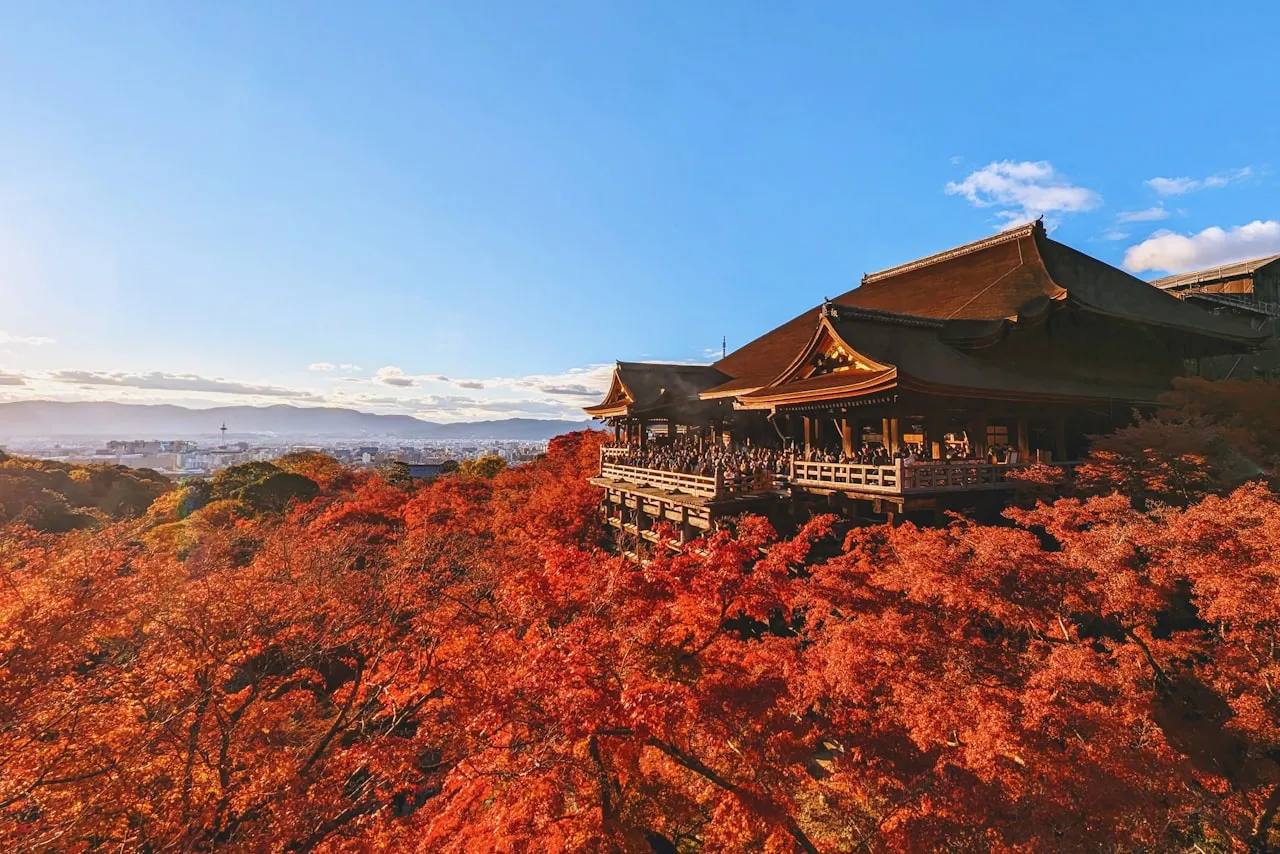
- Kiyomizu-dera (清水寺) – The famous temple terrace above a slope of red maple, also illuminated in the evening during the season.
Our tip from practice: spread Kyoto wisely across the day. The great names such as Tōfuku-ji in the early morning, smaller temples around midday, an evening illumination to close. That way you avoid the largest crowds.
Experiencing Kyoto at the height of the autumn leaf season
We lay out your route so that you meet the height of the colouring in each region, we reserve the sought-after evening illuminations and we guide you past the great names to the quiet places.
Request a consultation without obligationTōhoku & Nikkō – the early autumn
If you would like to see the autumn leaves as early as October – or wish to avoid the crowds of Kyoto – travel to the north and into the mountains. Here the leaves turn three to four weeks earlier than in the old capital, and the landscapes are wider, quieter, more untouched.
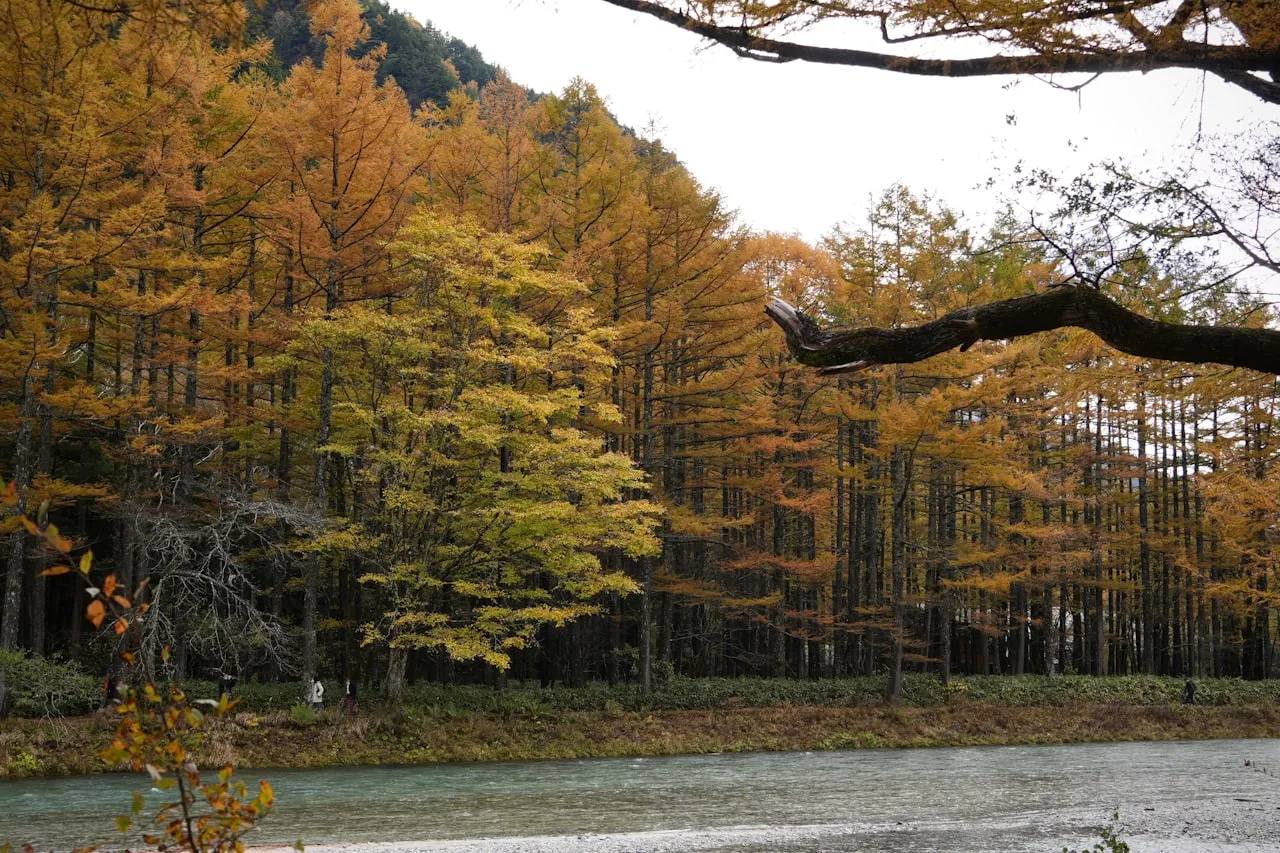
- Oirase Gorge (奥入瀬渓流) – A walking trail along a mountain stream in Aomori, lined with waterfalls and fiery red leaves. One of the most beautiful autumn walks in Japan.
- Chūson-ji (中尊寺) in Hiraizumi – The UNESCO World Heritage temple with its famous golden hall, embedded in autumn forests.
- Zaō and Urabandai – Mountain regions with crater lakes and the five coloured ponds (Goshiki-numa), in which the leaves are reflected.
- Nikkō (日光) – Easy to reach from Tokyo: the winding Irohazaka road, Lake Chūzenji and the Kegon waterfall, together with the magnificent shrines and temples. The higher areas colour first: along the Irohazaka road, at Lake Chūzenji and at the Kegon waterfall the peak season usually runs from mid-October to early November, at the shrines and temples in the town, a good 600 metres lower, only from early to mid-November.
Tokyo and its surroundings
If your journey ends in Tokyo, that fits well: the capital reaches its autumn peak only in late November to early December – often the last blaze of colour of the season.
- Meiji-Jingū-Gaien (明治神宮外苑) – Probably the most famous ginkgo avenue in Japan: a golden tunnel of more than a hundred trees, in the middle of the city.
- Rikugi-en (六義園) – A classical landscape garden from the Edo period, with an evening illumination of the maples.
- Mt. Takao (高尾山) – A popular day trip: reachable from Shinjuku in a good hour, with walking trails through colourful leaves and a view as far as Mt. Fuji.
- Hakone – Onsen and autumn leaves at Lake Ashi, a classic detour between Tokyo and Kyoto.
Quiet places away from the crowds
At the famous places it does get crowded during the peak season – that is worth knowing before you plan. But Japan is large, and there are quieter alternatives everywhere. Which regions really are still quiet in 2026 – and which supposed insider tips have long since ceased to be – we have gathered in a separate article on the hidden gems of Japan away from the tourist trails , together with current figures on where the crowds are shifting to:
- In Kyoto: smaller temples such as Enkō-ji, Jōjakkō-ji or Jissō-in offer the same play of colour with a fraction of the visitors.
- In the mountains: the Kōrankei gorge near Nagoya or the valley of Yōrō in Chiba are regional classics, yet barely known abroad. The Yōrō valley, however, has been unreachable by train since the typhoon of 21 September, and the roads there are partly closed as well (more on this in the current status).
- Using the time of day: If you get up early, you will have even the most famous places almost to yourself for an hour. The finest pictures are taken in the soft morning light in any case.
Yoru-momiji – the evening illumination
A Japanese speciality is yoru-momiji (夜もみじ), the autumn leaves at night. During the season many temples and gardens open their gates in the evening and illuminate the leaves – the deep red against the black night sky, reflected in still ponds, has a beauty entirely of its own, almost solemn.
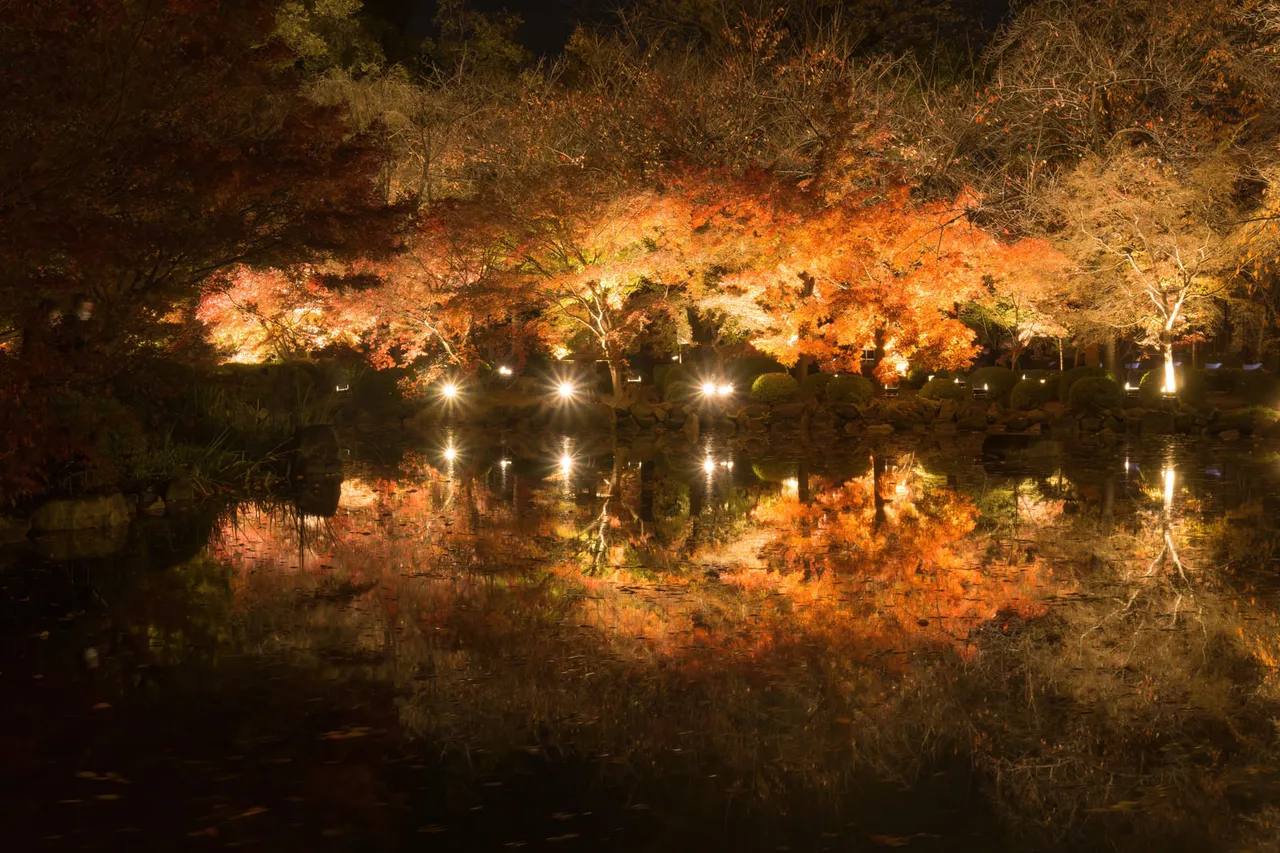
In Kyoto, Eikan-dō, Kiyomizu-dera, Tōfuku-ji and the Rurikō-in, among others, are known for their evening openings; in Tokyo, the Rikugi-en. One important note: the dates change every year, some places are freely accessible, others require a reservation with a fixed time slot – and the tickets are often gone early. If you would like to experience a particular illumination, you should plan in good time.
Practical tips for your autumn journey
Book accommodation early
The peak of the autumn leaf season is as sought-after in Kyoto as the cherry blossom. Good ryokan and hotels are then fully booked months in advance. If you would like to be in Kyoto in November, you should secure your accommodation as early as possible – it is the single most important decision of the whole planning.
Avoiding the crowds
- Get up early – the first hours after opening are the quietest.
- Choose weekdays rather than weekends for the great names.
- Use public transport; car parks at the temples are a bottleneck during the season.
Clothing
In Kyoto and Tokyo November is mild during the day, but noticeably cool in the morning and in the evening – layers are ideal. In the north (Tōhoku) and in the mountains (Nikkō, for example) you will need warm clothing as early as October.
Cherry blossom or autumn leaves
A question that reaches us often. In short: the cherry blossom is delicate, short and very much in demand – a narrow window of often only one week. The autumn leaves are more intense in colour, last longer and are easier to plan for, and the weather is usually stable and clear. If you value flexibility and strong colours, you are often better served in autumn. If you nevertheless decide on the pink window: how narrow it really is, and how to meet it, we show in our guide to the cherry blossom in Japan 2027. A detailed comparison of all the seasons can be found in our article on the best time to visit Japan.
Meeting the autumn colours – with the right planning
We watch the colouring on the ground, secure your accommodation in good time and match the route to the peak season of each region – so that you experience the leaves at their best.
Plan an individual autumn journeyHow we plan your autumn journey
With the autumn leaves in particular, the right timing decides everything – and that is precisely what is hard to get right from a distance. As a travel operator based in Japan that advises you in English, this is where we come in:
- Watching the colouring: We follow the forecasts and the day-to-day situation on the ground and adjust the order of your stops if needed.
- Securing accommodation in good time: We reserve the sought-after houses for the peak season early – before they are fully booked.
- Booking the evening illuminations: Including those where the reservation is only possible in Japanese and with a fixed time slot.
- A route from north to south: If you bring more time with you, you experience two stages of the season – we combine the early north with the late Kyoto.
You can read more about when a specialist is worthwhile in our article Why a Japan specialist? – 5 advantages over booking online.
Frequently asked questions
When is the best time for autumn leaves in Japan?
That depends greatly on the region. On Hokkaidō the autumn leaves begin as early as late September. In Tōhoku and in the mountains above Nikkō (Irohazaka, Lake Chūzenji) they follow from mid-October to early November, at the shrines and temples in the town of Nikkō in early to mid-November, and in Kyoto and Tokyo they usually reach their peak from mid to late November, in places into early December. If you would like to see the classic temple foliage in Kyoto, it is best to plan for the second half of November – the exact peak shifts by one to two weeks every year.
Where do you see the most beautiful autumn leaves in Japan?
Kyoto is regarded as the capital of the autumn leaves – temples such as Tōfuku-ji and Eikan-dō and the Arashiyama district are world-famous. If you travel earlier in the season, you will already find autumn leaves in October that are just as impressive and often quieter – in Tōhoku (Oirase Gorge, Zaō) and around Nikkō (Irohazaka, Lake Chūzenji). In Tokyo the ginkgo avenues glow in late November, for example at the Meiji-Jingū-Gaien.
Are the autumn leaves in Japan as crowded as the cherry blossom?
At the most famous places in Kyoto it can become very crowded during the peak season – comparable to the cherry blossom. Unlike the cherry blossom, however, the autumn leaves move from north to south over more than two months, so there are many alternatives: earlier regions such as Tōhoku, less well-known temples or the early morning hours remain considerably more relaxed.
What is the difference between cherry blossom and autumn leaves as a travel season?
The cherry blossom (late March to April) is short, delicate and very much in demand – a window of often only one week per region. The autumn leaves (October to early December) last longer, are more intense in colour and easier to plan for, because they extend over many weeks and many regions. The weather in autumn is usually stable and clear as well. Which season is the more beautiful remains a matter of taste – both have their own appeal.
Can autumn leaf illuminations be booked in advance?
Many temples in Kyoto offer special evening openings with illumination (yoru-momiji) during the autumn season. Some are freely accessible, others – the Rurikō-in, for example – require a reservation with a fixed time slot, and the tickets are allocated early. The exact dates and booking arrangements change every year; planning ahead is worthwhile.
Further reading
Our conclusion
The autumn leaves are Japan’s second great high point – for many the more beautiful one. They give you strong colours, clear and stable weather and, thanks to their long journey from north to south, a predictability that the cherry blossom does not offer. The price for that is crowded temples at the most famous places – but with the right choice of timing, early bookings and a few quiet alternatives, that can be absorbed well.
Our advice remains the same as ever: build your journey around what you are looking for. If you are looking for glowing colours, clear autumn days and the whole depth of Japanese garden art, November is your month – and October in the north is its quieter sister. We will help you to get the timing right.
We are Japan Privat: a travel operator for individual journeys through Japan, based in Japan and advising you in English. If you would like to experience kōyō in 2026, do get in touch with us without obligation.
A 30-minute first conversation – free and without obligation
Tell us which colours and which places you dream of. We listen, we ask questions – and together we decide when and where you will experience the autumn leaves at their most beautiful.
Request a consultationAbout the author

Kentaro Asakura
Founder of Japan Privat · A Japan specialist who guides you in English
Kentaro Asakura was born and raised in Japan. His student years took him first to the UK, where English became second nature to him, and later to Munich, where he met his wife, who is German – together they returned to Japan. With Japan Privat, he has been designing individual journeys for European travellers for more than ten years – in English, with the eyes of a local and a genuine feel for what guests from Europe are looking for.