Japan in Winter 2026/27: Snow Monkeys, Onsen in the Snow and Honest Trip Planning
Contents
- Why Japan in winter is worthwhile – and for whom it is not
- Climate and regions: the snow belt and the Pacific side
- The snow monkeys of Jigokudani (Nagano)
- Skiing and powder snow (Japow): Niseko, Hakuba and others
- Onsen in the snow: rotenburo and yukimi-buro
- Winter illuminations and the Sapporo Snow Festival (Yuki Matsuri)
- New Year’s Eve and New Year (Ōshōgatsu): well planned
- Winter cuisine: nabe, kani and hot sake
- December, January or February – the months compared
- Packing, transport and your tailor-made winter journey
- Frequently asked questions
Japan in winter is the country’s quietest and perhaps most honest season – and at the same time its most underrated. While metre-deep powder snow piles up on the Sea of Japan side, Tokyo and Kyoto often lie under a clear, cold sky with the best view of Mt. Fuji of the whole year. It is the season of steaming onsen in the snow, of the snow monkeys of Jigokudani, of the Sapporo Snow Festival and of warming nabe pots – but also of short days and New Year closures, about which most guidebooks stay silent. As a tour operator living in Japan and guiding you in English, we tell you openly for whom winter is worthwhile – and for whom it is not. And we show how snow, culture and onsen become an individual, tailor-made journey, entirely without the constraints of a group.
The key points in brief
- Best time to travel: December brings the illuminations and the clearest view of Mt. Fuji, January the most reliable powder snow, February the great snow festivals – the peak of the season.
- Snow falls only in the snow belt: Many people assume that the whole of Japan lies under snow in winter – in fact Tokyo, Kyoto and Osaka usually stay free of it. For real snow you travel deliberately to Hokkaidō, Nagano, Niigata or Tōhoku.
- Cold and short days: In Sapporo the temperature stays below freezing all day (daily mean around −3 °C), and it gets dark as early as around 4:45 pm. Warm clothing in layers is essential.
- New Year (Ōshōgatsu): From 29 December to 3 January many shops, restaurants and museums are closed and the shinkansen is booked out early – we recommend arriving from 4 or 5 January onwards.
- Onsen in the snow: The steaming outdoor bath (rotenburo) while snow is falling is the quiet centre of the winter – with clear guidance on tattoo rules and private baths (kashikiri).
- Low-season advantage: Outside the New Year week, winter (above all January and February) is quieter and less expensive. Hokkaidō and the ski regions are the exception – there it is high season.
- Lead time: For tailor-made winter journeys we recommend six to nine months of lead time; top ryokan and ski accommodation in Niseko or Hakuba often even earlier.
Why Japan in winter is worthwhile – and for whom it is not
The Japanese winter (December to February) is low season for large parts of the country – and that is precisely where its greatest appeal lies: fewer crowds at the well-known places, noticeably lower flight and hotel prices, and the clearest view of Mt. Fuji of the whole year. That more and more travellers are discovering this is reflected in demand: the major German tour operator DERTOUR reported an increase of around 107 % in its Japan bookings for the winter of 2025/26 (guide value). We notice this growth here on the ground as well.
There are two exceptions to the low prices that you should plan for firmly: the New Year week (roughly 29 December to 3 January), when prices and crowds rise and much is closed, and Hokkaidō and the ski regions, where winter is high season. Everywhere else the guide value for 2026/27 is: from around 5 January into February it becomes considerably quieter and less expensive. The dry, clear winter air on the Pacific side – Tokyo, Kyoto – also provides the most reliable view of Mt. Fuji in December and January, on around 20 to 25 days per month.
| Winter is particularly worthwhile for … | Less suitable if you … |
|---|---|
| onsen and culture travellers looking for steaming outdoor baths in the snow and empty temples | expect gardens in lush bloom or deep green – in winter they lie dormant |
| snow and ski fans who want the famous powder snow (“Japow”) in Hokkaidō or Nagano | need long, mild days – in January it already gets dark around 5 pm |
| city travellers seeking calm, who would like to experience Tokyo and Kyoto without the crush and at low-season prices | expect reliable snow in Kyoto – there it snows only rarely, and then lightly |
Our advice as a tour operator on the ground: winter is not a “worse” time to travel, but a different one. Placed correctly, it suits people who prefer warmth in a ryokan, snow in the mountains and quiet cities to a crowded high season. How the months compare over the course of the year is something we set out in our overview of the best time to visit Japan. And because snow, culture and onsen are hard to press into a ski package, we prefer to plan an individual journey through Japan at your own pace – rather than a group tour running to a fixed beat.
Sources: Japan Highlights – Mt. Fuji Visibility by Month (accessed July 2026), Agate Travel – Cheapest Month to Visit Japan (accessed July 2026), japan-guide.com – Visiting Japan during New Year (accessed July 2026)
Climate and regions: the snow belt and the Pacific side
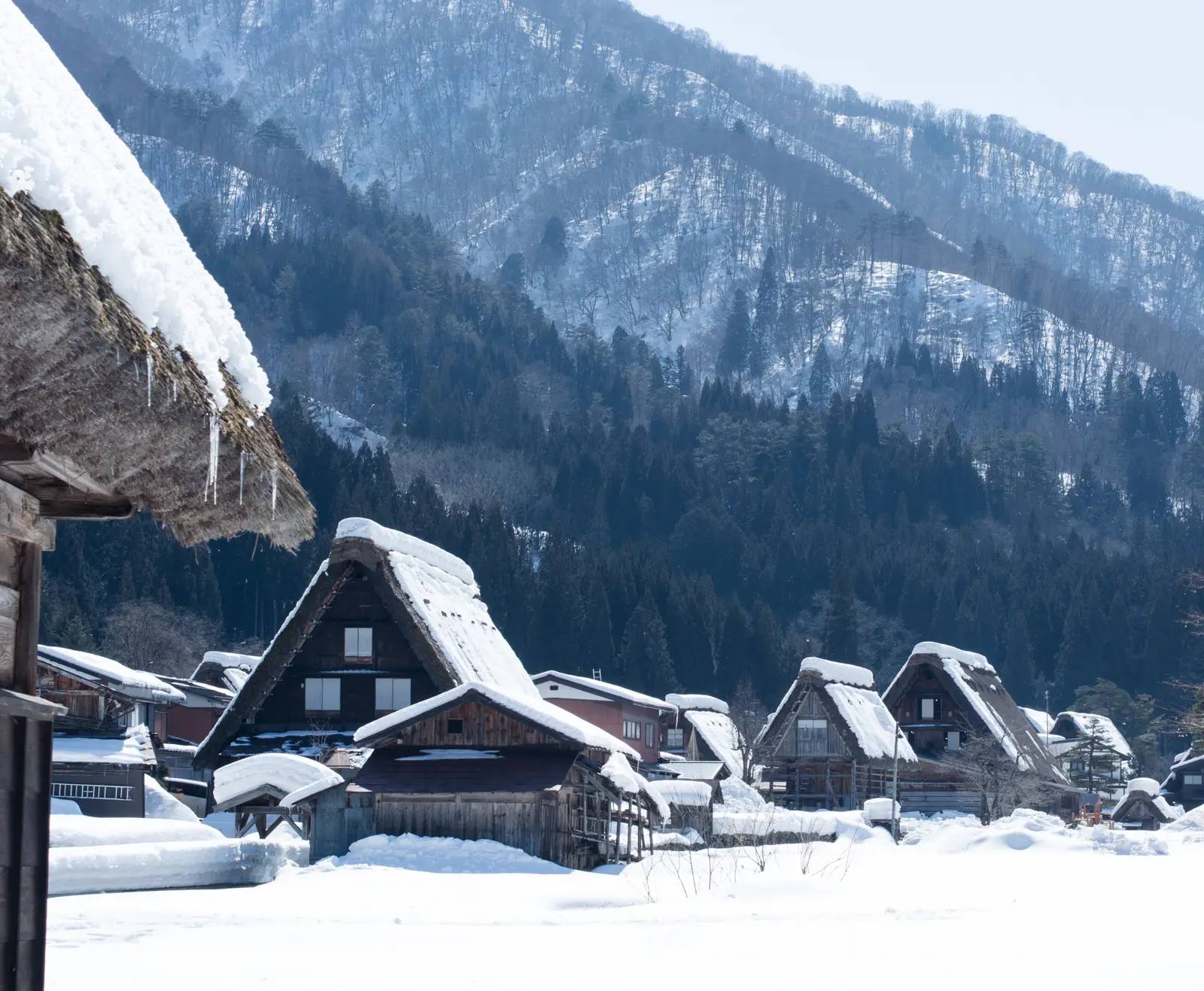
If you would like to experience real snow in Japan, you have to travel deliberately into the snow belt – to the Sea of Japan side or into the mountains. The classic travel axis Tokyo–Kyoto–Osaka, by contrast, remains largely free of snow in winter, dry and sunny. Responsible for this division is the winter north-westerly monsoon, which separates Japan climatically into two very different halves.
The mechanism is simple: cold, dry air from Siberia flows across the comparatively warm Sea of Japan and takes up a great deal of moisture on the way. At the mountain ranges of the west coast it unloads this as heavy snowfall – here lies Yukiguni, the “snow country”, with metre-deep snow and mostly grey skies. Beyond the ridges the now dry air sinks again. On the Pacific side, with Tokyo and Kyoto, it brings clear, dry days and cold north-westerly winds – on the Kantō plain around Tokyo they even have their own name, karakkaze.
For you as a traveller this means: in Tokyo and Kyoto you can expect mostly brilliant blue skies, but noticeable cold and short days – in Tokyo the sun sets as early as around 5 pm, and nights in Kyoto’s basin setting fall close to freezing. The advantage of this dry winter air: it gives the Pacific side the clearest view of Mt. Fuji of the year; in December and January the mountain is visible on around 20 to 25 days. On the Sea of Japan side it is the other way round – not extremely cold, but grey, damp and snow-rich; honestly, not postcard weather, but the stage for deep powder snow and steaming onsen in the snow.
| Place | Avg. temp. January | Avg. daily high | Avg. daily low | Winter character |
|---|---|---|---|---|
| Tokyo (Pacific side) | 5.4 °C | 9.8 °C | 1.2 °C | Dry, sunny, short days – snow is rare |
| Kyoto (basin setting) | 4.8 °C | 9.1 °C | 1.5 °C | Often clear during the day, nights around freezing, rarely light snow |
| Nagano (edge of the Alps) | approx. −0.3 °C | approx. 3.5 °C | approx. −4.1 °C | Cold; snowfall on around 23 days – gateway to skiing and the snow monkeys |
| Kanazawa (Sea of Japan side) | approx. 3.9 °C | approx. 6.8 °C | approx. 0.9 °C | Mild, but grey and damp; snowfall on around 19 days |
| Sapporo (Hokkaidō) | −3.2 °C | −0.4 °C | −6.4 °C | Below freezing all day, little sun, reliably plenty of snow |
The values for Tokyo, Kyoto and Sapporo follow the JMA climatological normals 1991–2020 (January); the figures for Nagano and Kanazawa are rounded guide values for 2026/27.
Rule of thumb: where the snow lies
For snow, skiing and open-air onsen you travel into the snow belt – to Hokkaidō, into the mountains of Nagano or to the Sea of Japan side. For clear views, city culture and an unobstructed view of Mt. Fuji you stay on the Pacific side (Tokyo, Kyoto, Osaka). The finest way to combine the two is a two-week round trip; which month suits which region is something we set out in our overview of the best time to travel.
Sources: Japan Meteorological Agency – climatological normals 1991–2020 (January), Weather Atlas – Nagano in January (guide values), Weather Atlas – Kanazawa in January (guide values), Climate of Japan – winter monsoon and the two-way split (Wikipedia, citing the JMA), Japan Highlights – Mt. Fuji visibility by month
The snow monkeys of Jigokudani (Nagano)
The snow monkeys of Jigokudani are not a zoo experience but free-living Japanese macaques (nihonzaru) without fences, which enter the hot spring only when it is genuinely cold. They bathe most reliably in January and February, when temperatures fall regularly below −5 °C; on mild winter days they often do not go into the water at all. The iconic scene is therefore never guaranteed. Check the park’s official live webcam before you set out, to see whether the animals are bathing at all that day – that will spare you a long, fruitless journey on a day that is too mild.
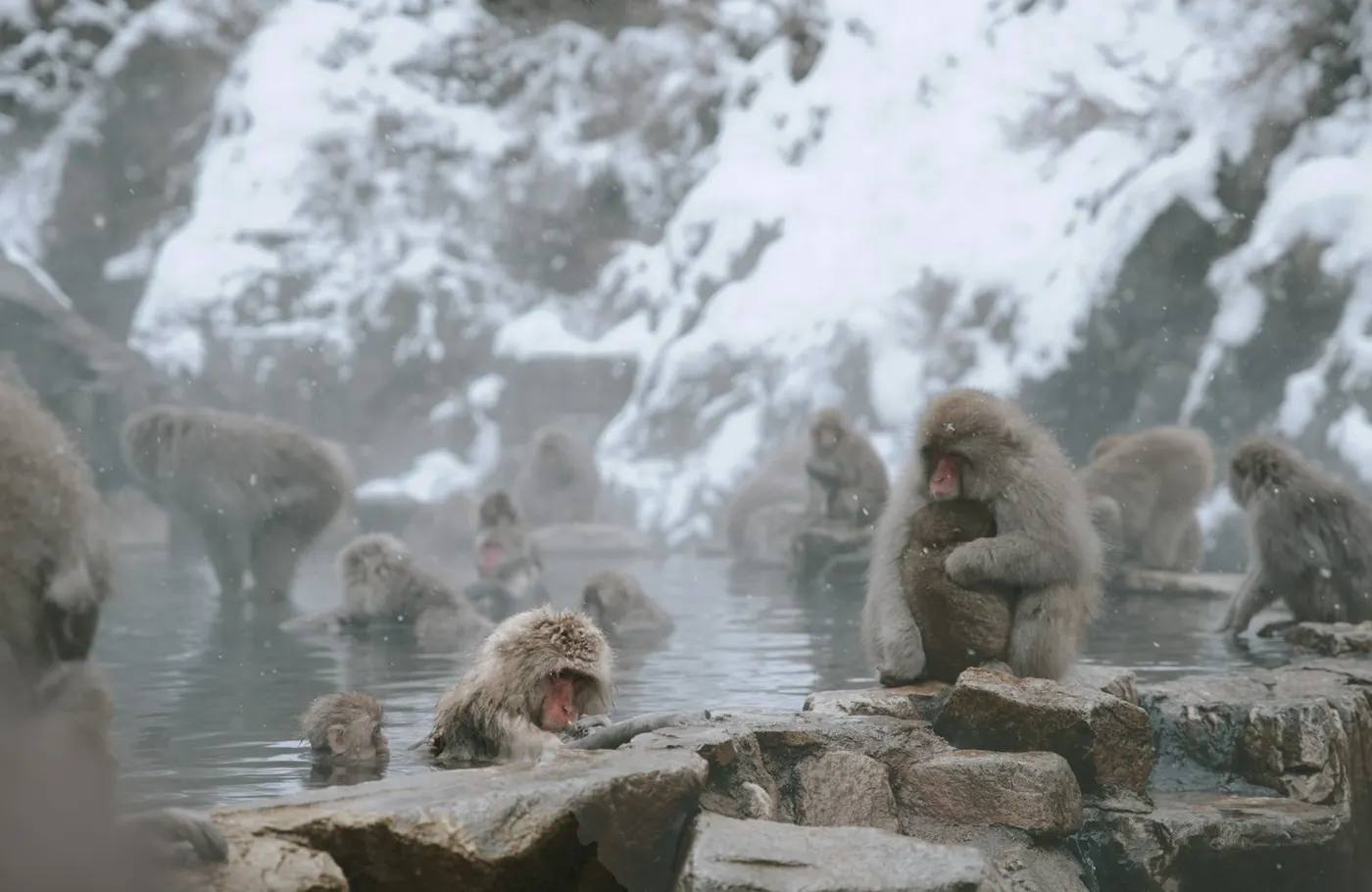
That is also the heart of the matter: the same cold that drives the macaques into the warm water also makes the visit demanding. The city of Nagano at the foot of the Alps is one of the coldest areas of the main island – in January the average daily high is around 3.5 °C, the daily low about −4.1 °C, and snow falls on a good 23 days of the month (guide values). Anyone who wants to see the bathing monkeys therefore has to reckon precisely with the weather that makes the scene possible in the first place.
The park does not lie beside a road but at the end of a footpath. From Tokyo the Hokuriku Shinkansen brings you to Nagano in around 79 minutes at best; from there you continue by the Nagano Dentetsu railway (about 45 minutes to Yudanaka with the Limited Express Snow Monkey) and by bus, or you take the direct bus from Nagano. At the end there is a walk of around 30 to 40 minutes along an unpaved forest path that is often icy in winter. Sturdy winter boots – with crampons in icy conditions – are not a recommendation here but a necessity; the path is not suitable for wheelchairs or pushchairs. Come early: in winter (November to March) the park is open from 9 am to 4 pm, and the morning is noticeably quieter.
New for the winter of 2026/27: the park has switched admission to online tickets with a fixed visiting date – a response to the long queues at the ticket counter, which regularly exceeded capacity in winter. Since August 2026 the park has been selling the tickets via its official website; they can be booked up to three months before the day of your visit. According to the park, anyone arriving without an online ticket should expect to wait and, depending on crowds, may be refused entry. For your planning this means: the visit is a fixed appointment in the itinerary, not a spontaneous detour. We book the tickets as part of planning your journey.
| Point | Guide value 2026/27 |
|---|---|
| Admission | Adults (18 and over) 800 yen, children 6–17 years 400 yen; from 1 Dec 2026: 1,000 and 500 yen (online 880 and 440 yen); under 6 free |
| Opening hours in winter | November to March, 9:00 am – 4:00 pm (come early) |
| Getting there from Tokyo | Hokuriku Shinkansen to Nagano (~79 min.), then train + bus or direct bus |
| Walk to the park | ~30–40 min. along an unpaved, often icy forest path; sturdy winter boots required |
| Accessibility | Not accessible – no wheelchairs or pushchairs; Jigokudani car park 500 yen |
| Best time | January/February at temperatures below −5 °C; check the live webcam beforehand |
Because the journey there and back takes half a day anyway, we prefer to combine Jigokudani into a small winter route of its own rather than a rushed day trip: with the venerable Zenkō-ji temple in Nagano and then a night in the nearby onsen village of Shibu or Yudanaka. There, in the evening, in the steaming rotenburo (outdoor bath) while snow is falling, you experience precisely the onsen culture that also draws the monkeys into the warm water during the day – the finest contrast to the cold. How to choose the right house is something you can read in our ryokan guide; when the winter low season is worthwhile overall is something we set out in our overview of the best time to visit Japan.
Sources: Jigokudani Yaen-kōen – admission and opening hours (official guide), Jigokudani Yaen-kōen – getting there (official access page), Jigokudani Yaen-kōen – bathing behaviour (first-time visitor guide), Jigokudani Yaen-kōen – introduction of online ticket sales (official announcement, 30 April 2026), Jigokudani Yaen-kōen – launch of online ticketing (official announcement, 6 August 2026), Weather Atlas – Nagano in January
Skiing and powder snow (Japow): Niseko, Hakuba and others
Japan’s legendary powder snow – known in marketing simply as “Japow” – is among the driest and lightest in the world, and the best, most consistent deep snow falls in what is called “Japanuary”, roughly from mid-January to mid-February. Responsible for it is the Sea of Japan effect: cold, dry air from Siberia takes up moisture over the comparatively warm Sea of Japan and unloads it again on the mountains of the Sea of Japan side as fine, low-moisture snow. In this core phase temperatures in many places stay permanently below −5 °C – and that is exactly what keeps the snow powdery rather than heavy.
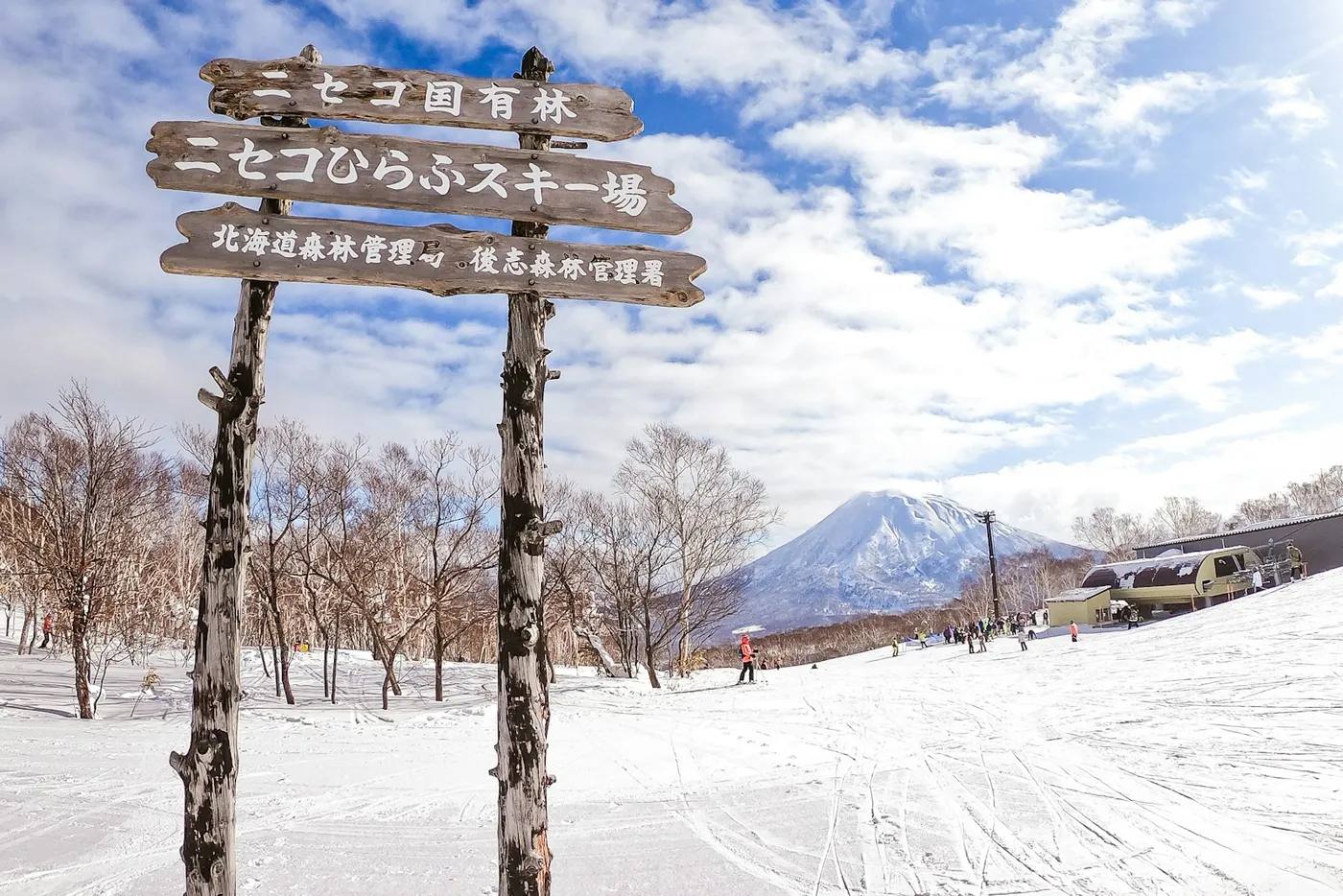
Three areas stand for the Japanese winter, each with its own character. Niseko on Hokkaidō is the international classic with around 14–15 m of snowfall per winter, but at the same time the most expensive and most crowded destination – in the evening you often hear more English there than Japanese. Hakuba Happō-One and Nozawa Onsen in the Nagano Alps feel noticeably more Japanese; Nozawa is on top of that a tradition-rich onsen village in which skiing and hot springs come together directly.
| Area | Region | Season 2026/27 (guide value) | Snow | Character |
|---|---|---|---|---|
| Niseko | Hokkaidō | Start 28 Nov 2026; peak 24 Dec 2026 – 28 Feb 2027 (official) | ~14–15 m per winter | Dry “Japow”, international crowd, night skiing – expensive and busy |
| Hakuba Happō-One | Nagano (Alps) | approx. 1 Dec 2026 – early May (guide value from the previous season) | Plentiful; best in Jan/Feb | Olympic area of 1998, demanding slopes, alpine panorama |
| Nozawa Onsen | Nagano | Opening at the end of November (guide value from the previous season) | Plentiful; best in Jan/Feb | Traditional onsen village, skiing and hot springs combined |
The season dates for Niseko 2026/27 have already been officially published; for Hakuba and Nozawa the exact dates were not yet available at the time of writing, which is why we give the established framework of the previous season as a guide value. Worth knowing: in many places the lifts run into the spring, but the best powder snow remains reserved for January and February. If you prefer things a little quieter, March is often still a snow-sure and considerably more relaxed alternative.
Clever on the ground: takkyūbin for skis and luggage
One lever many travellers do not know about: with takkyūbin, Japan’s reliable courier service, ski equipment and suitcases can conveniently be sent ahead from city to city – for example from the hotel in Tokyo directly to the accommodation in Niseko. That way you sit on the shinkansen without heavy luggage and can get going straight away on the mountain. We organise the shipment for you and coordinate dates and addresses.
For us, snow is rarely the whole reason for a journey, but one building block. Instead of a rigid ski package or a group tour, we combine a few days of city and culture – Tokyo or Kyoto, for example – with a snow experience in the north and quiet evenings in the hot bath. How that comes together into a coherent route is something we show in our guide to individual journeys through Japan in 2026; if you would like to enjoy the onsen after a day on the slopes, you will find the right accommodation in the ryokan guide.
Sources: Niseko United – official lift pass page, season 2026/27 (accessed July 2026), Japan Activity – Niseko Snow Season Guide (Japow/“Japanuary”), Japan Ski Experience – Opening Dates 2025/26 (Hakuba, Nozawa as a guide value)
Onsen in the snow: rotenburo and yukimi-buro
The steaming outdoor bath while snow is falling – in Japanese yukimi-buro, the “snow-viewing bath” – is for us the sensory highlight of the Japanese winter. Outside lies fresh snow, steam rises around you, and the rotenburo (outdoor bath) keeps you effortlessly warm in the hot thermal water while only your head and shoulders feel the icy air. It is the same cold that draws you into the hot water in the evening and that during the day drives the famous snow monkeys of Jigokudani into their hot spring – most reliably when the thermometer falls regularly below −5 °C (guide value for January/February 2026/27).
Frankly, communal bathing has two hurdles that you should know about in advance. First, the tattoo rules: many public onsen and ryokan still turn away visible tattoos. Small motifs can often be covered with a plaster; otherwise you can switch to a bath that can be booked privately. That is exactly what the kashikiri-buro is for – a bath that you reserve exclusively for yourself, as a couple or as a family, for about 45 to 60 minutes, entirely without other people’s eyes. As a rule that settles the tattoo question as well; a few houses, however, apply their rule in the private bath too, which is why we clarify this in writing before booking. Which houses offer this, and what matters when booking, is something we have gathered in the ryokan guide.
Health: the jump from cold to hot
The rapid change from icy air into water of more than 40 °C puts a strain on the circulation – in Japan people speak of “heat shock”. It affects older guests and people with cardiovascular complaints most of all. Enter the water slowly, stay in for no more than 10 to 15 minutes, drink something before and afterwards, and avoid the bath directly after alcohol. With this care, the winter bath is a pure pleasure for the vast majority.
The winter bath in a ryokan only unfolds its full appeal in combination with the food. After the bath a winter kaiseki awaits, and winter is the season of crab (kani) – the king of winter seafood, above all from the Hokkaidō coast and from the San’in and Hokuriku coasts on the Sea of Japan, raw as sashimi, boiled or in the pot. Alongside it comes the nabe, the warming hotpot cooked at the table and shared. It is precisely this combination of hot water, snow outside the window and regional winter cuisine that is the reason why, for an individual winter journey, we almost always plan in at least one ryokan night with an onsen – not as ticking off a sight, but as the quiet, warming centre of your journey.
Sources: Japan Web Magazine – Jigokudani Snow Monkey Park (onsen context), Coto Academy – Must-Try Winter Foods (kani/crab), Japan Rail Club – 8 Winter Foods (nabe)
Winter illuminations and the Sapporo Snow Festival (Yuki Matsuri)
If you would like to experience the famous winter lights and snow sculptures, a simple rhythm helps with planning: December and January are the time of the illuminations, February is the peak of the great snow festivals. Winter illuminations such as the Sapporo White Illumination or the flower paradise Nabana no Sato in Kuwana (Mie Prefecture, a good half hour from Nagoya) bathe the cities in light from as early as the end of November, while the spectacular snow sculptures only appear in the depth of winter. One exception is the Kobe Luminarie: for some years now it has no longer taken place in December but from the end of January to the beginning of February – in 2026 from 30 January to 8 February; the dates for 2027 will be announced by the city in the autumn. If you want to see both, it is best to combine a December trip for the lights with a second winter window in February – or to place the whole journey in February.
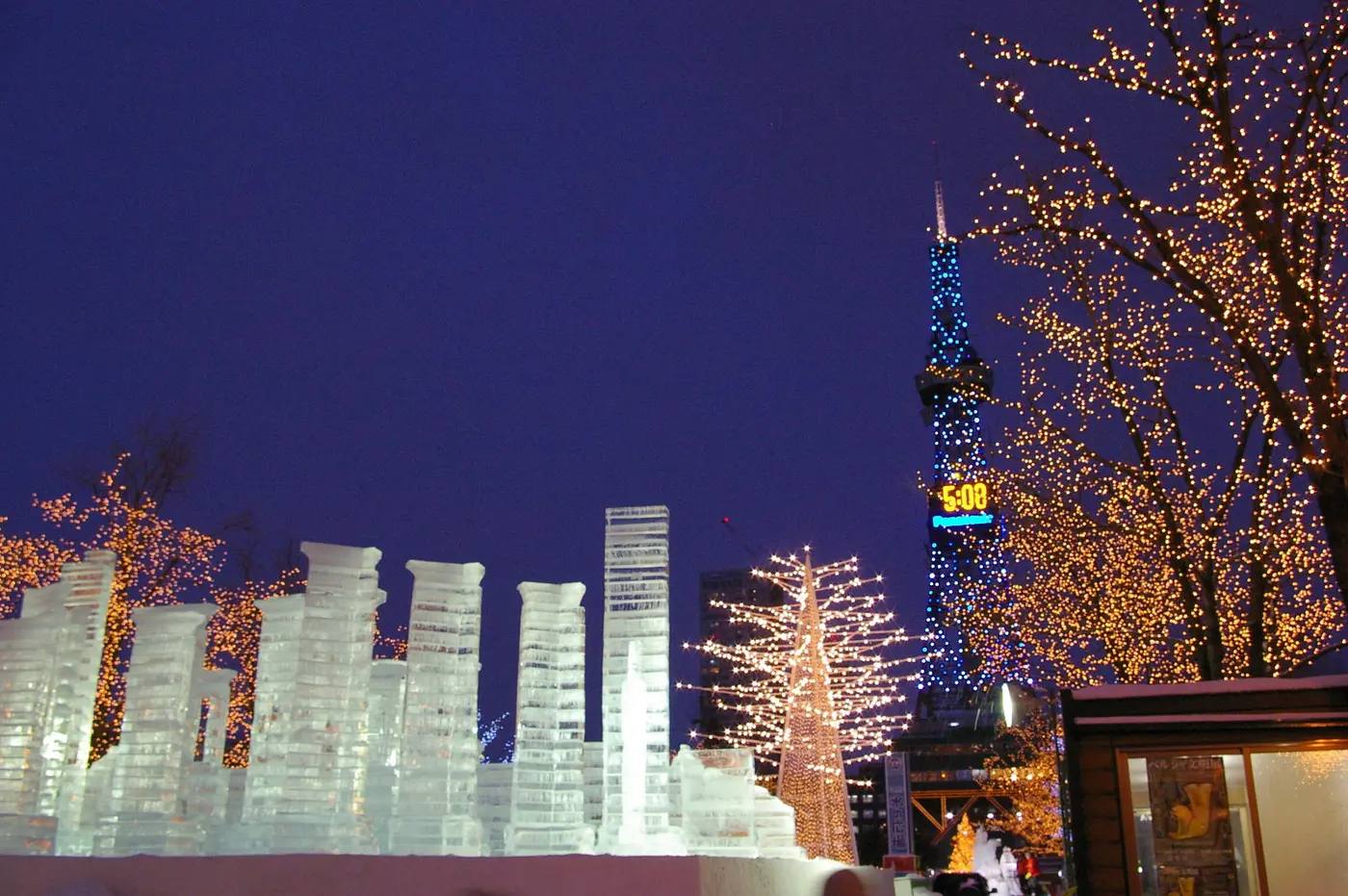
The Sapporo White Illumination shines, as a guide value for 2026/27, from around 20/21 November 2026 to 14 March 2027, with free admission. Important for planning: the atmospheric part in Odori Park usually runs only until the end of December, while the street sections on Minami-Ichijo-dori stay lit until mid-March and the one on Ekimae-dori by the station only until mid-February. So if you would like to see the lights in the park, you should rather travel in December – in February the sculptures are the great attraction, and the Odori Park part of the illumination is over by then.
The real star of the Japanese winter is the Sapporo Snow Festival (Yuki Matsuri). The 77th edition has already been announced on the official site as planned (開催予定, kaisai yotei); as a guide value for 2026/27, it is expected to run from Thursday 4 to Thursday 11 February 2027. The main venue is Odori Park, which extends over around 1.5 km and shows snow sculptures of more than 15 m in height; added to this are the Susukino site with delicate ice sculptures and Tsudome as the family area. With more than two million visitors a year this is anything but an insider tip: accommodation in Sapporo is booked out early at this time and considerably more expensive. With individual trip planning we therefore reserve in good time and place your visits deliberately in the quieter morning or late evening hours.
Quieter, and for many of our guests the real favourite, is the Otaru Snow Light Path (Yuki Akari no Michi) in the port town of Otaru, around 40 minutes from Sapporo. For about eight days – as a circulating guide value, 5 to 12 February 2027, officially still unconfirmed – countless candle lanterns line the historic canal and the former Temiya railway line; the lighting begins at around 5:00 pm and the candles go out between 8:30 and 9:00 pm. As Otaru takes place at the same time as the Snow Festival, the two can be combined well. Away from Hokkaidō, the illuminated Zaō juhyō (“snow monsters”) in Yamagata Prefecture are also worthwhile – firs encrusted with snow and ice that are floodlit in the evening – as is the Yokote Kamakura Festival in Akita, at which hundreds of small snow huts (kamakura) are lit with candles in mid-February. We are happy to build these settings into an individual winter round trip through the north.
| Event | Place | Period (guide value 2026/27) | Note |
|---|---|---|---|
| Sapporo White Illumination | Sapporo (Odori Park, Ekimae-dori) | approx. 20 Nov 2026 – 14 Mar 2027 | Odori part usually only until the end of December; admission free |
| Sapporo Yuki Matsuri | Odori Park, Susukino, Tsudome | expected 4 – 11 February 2027 | officially listed as “planned”; more than 2 million visitors |
| Otaru Snow Light Path | Otaru (canal, Temiya line) | expected ~5 – 12 February 2027 | officially unconfirmed; candles from 5:00 pm until around 9:00 pm |
| Zaō juhyō (“snow monsters”) | Zaō, Yamagata Prefecture | Deep winter, evening illumination | weather-dependent; reachable by ropeway |
| Yokote Kamakura Festival | Yokote, Akita Prefecture | Mid-February | illuminated snow huts (kamakura) |
Our planning note
The February dates for 2027 given here are still guide values – Sapporo is officially confirmed only as “planned”, and Otaru is officially unconfirmed. We therefore book accommodation in Sapporo and Otaru early and adjust the exact itinerary as soon as the organisers publish the final dates.
Sources: Official website of the Sapporo Snow Festival, snowfes.com (accessed July 2026), Welcome to Sapporo – White Illumination, city portal (accessed July 2026), Japan National Tourism Organization – Otaru Snow Light Path (accessed July 2026), Kobe Luminarie – official website, dates of the 31st edition (30 Jan – 8 Feb 2026)
Japan’s quiet season – planned individually for you
Whether onsen in the snow, a single day on the slopes or snow-covered temples away from the crowds – we put your route together individually, without a group and without sales pressure. Tell us what you are dreaming of.
Make a no-obligation enquiryNew Year’s Eve and New Year (Ōshōgatsu): well planned
If you are in Japan over the turn of the year, plan the days from 29 December to 3 January deliberately: during this time many small shops, restaurants, banks including their cash machines, and museums close – on 1 January most of all. Reliably open, by contrast, are konbini (around the clock, with cash machines that accept foreign cards), larger chains, hotels and railway stations. Our honest advice: arrange the active part of your journey so that you really get going only from 4 or 5 January – by then almost everything is open again, and prices fall noticeably back into the low season.
On top of this comes the kisei, the great travel wave when millions of Japanese travel to their home towns over the holidays. The shinkansen is then booked out early, a seat reservation is practically essential (you should not rely on the non-reserved carriages on these days), and good ryokan charge their highest prices of the year. If you are flexible, avoid long train journeys around 30/31 December and 2/3 January, and book seats and New Year accommodation early.
Instead of being annoyed by closed doors, it is worth experiencing shōgatsu for what it is: Japan’s most important family festival. On New Year’s Eve people eat toshikoshi soba, the “year-crossing noodles”, whose length symbolises a long life. On New Year’s morning osechi ryōri comes to the table – symbolic dishes in stacked lacquer boxes (jūbako), such as kuromame (black soybeans for diligence) or kazunoko (herring roe for numerous descendants) – along with ozōni, a mochi soup (in the Kantō region square mochi in a clear soy broth, in Kansai round mochi in white miso). You will hardly see this festive cuisine in ordinary restaurants; you are most likely to experience it in a ryokan or at a privately arranged meal – more on that in our culinary journey through Japan.
The most visible tradition is hatsumōde, the first shrine or temple visit of the year, above all on the first three days of January, known as san-ga-nichi. The Meiji Shrine in Tokyo draws more than 3 million people; on 1 January reckon with 1 to 3 hours of queuing, and on 2/3 January rather 30 to 60 minutes (many railway lines run through the night on New Year’s Eve). At the stalls, hot amazake, a sweet, warm rice drink, provides warmth (in two versions – with and without alcohol; see below). From 2 January the department stores open again as well – with hatsuuri, the first sales of the year, and the popular fukubukuro, lucky bags with surprise contents at a fixed price.
| Stays open | Mostly closed (approx. 29 Dec – 3 Jan) |
|---|---|
| Konbini – around the clock, with cash machines for foreign cards | Small, owner-run shops and restaurants |
| Hotels and larger chains (and their restaurants) | Many banks and bank cash machines |
| Railway stations and local transport (kisei = full, reserve early) | Numerous museums, above all on 1 January |
| Shrines and temples (hatsumōde, often around the clock) | Department stores on 1 January |
| Department stores from 2 January (hatsuuri, fukubukuro) | Public offices, doctors’ surgeries, many small cafés |
Our advice for the holidays
Withdraw cash in good time on 30/31 December at a konbini cash machine, because many bank machines pause over New Year. Spend the turn of the year calmly in one place – ideally in a ryokan with an onsen – and start the actual round trip from 4 or 5 January, when shops open again and low-season prices return (guide value 2026/27).
Sources: japan-guide.com – Visiting Japan during New Year, Nippon.com – Shōgatsu: Japanese New Year, Agate Travel – Cheapest Month to Visit Japan
Winter cuisine: nabe, kani and hot sake
The Japanese winter is above all the season of warming comfort food – and from our point of view one of the finest reasons to travel precisely now. When it is freezing outside, the steaming pot moves to the centre of the table in Japan: nabe (鍋), a hotpot that everyone cooks together at the table and shares. It is a sociable meal that pleasantly cushions the short, cold days and that you will hardly find in this form in summer.
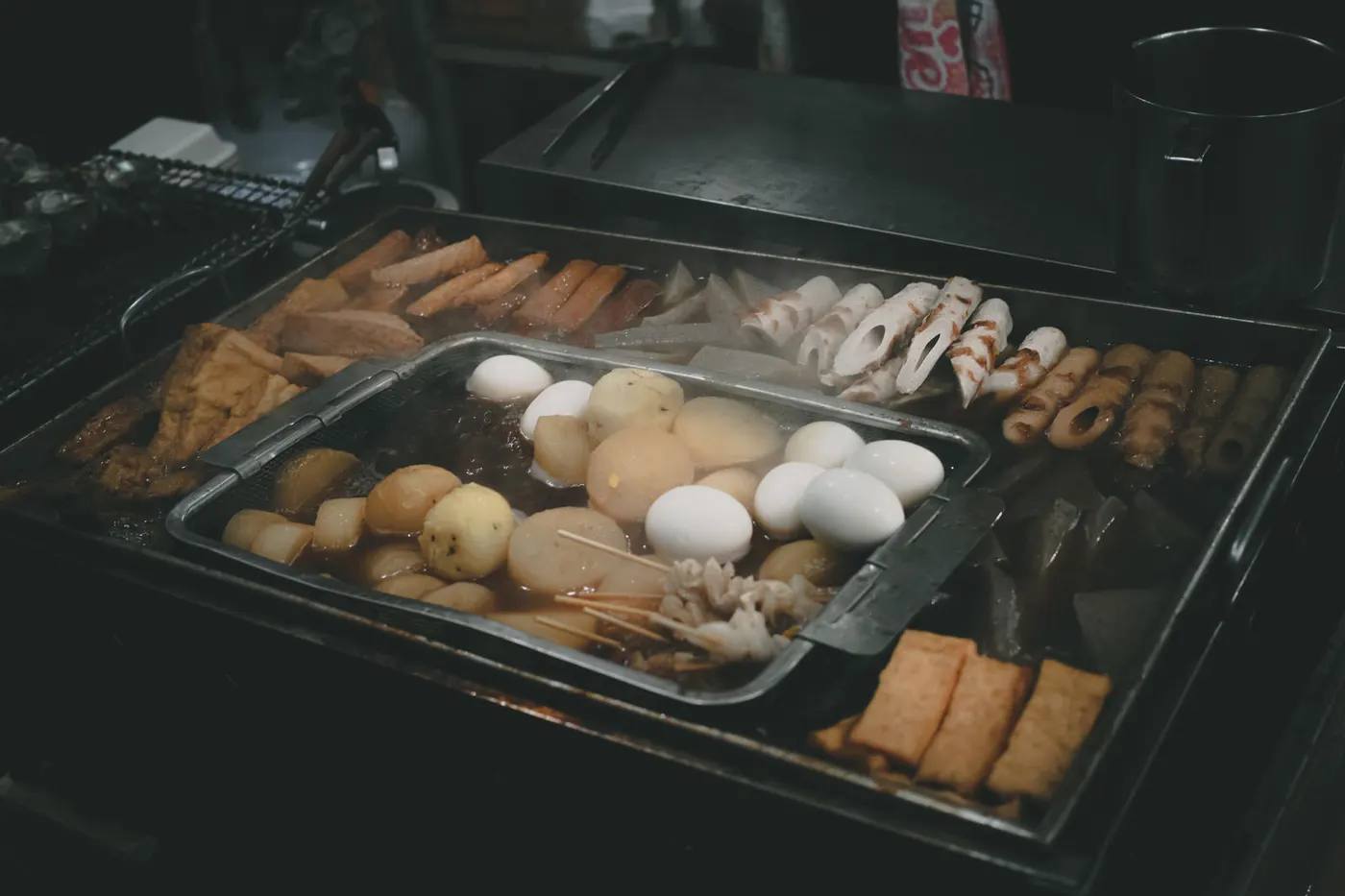
Behind the word nabe lies a whole family of dishes. With sukiyaki, thinly sliced beef is braised with vegetables in a sweet-savoury soy sauce and swirled through raw egg; with shabu-shabu, the meat is only briefly drawn through simmering broth. Oden – radish (daikon), egg, fish cakes and konjac, slowly braised in a light soy broth – is the inexpensive, ubiquitous variant that you can even get at the konbini counter. On Hokkaidō, try ishikari nabe with salmon and miso, and anyone who likes sumo will know chanko nabe, the hearty wrestlers’ dish. However different the recipes are, the principle stays the same: cook together, eat together.
Winter is also high season for seafood. Crab (kani) is regarded as the king of the cold months: the best quality comes from Hokkaidō as well as from the San’in and Hokuriku coasts on the Sea of Japan, where matsuba and zuwai-gani come to the table as sashimi, boiled or in the nabe. A delicacy to be treated with respect is the pufferfish fugu, which only specially licensed chefs are permitted to prepare – lean, finely umami and at the height of its season in winter. And anyone travelling to Hokkaidō should not miss the hearty miso ramen and the warming soup curry in Sapporo; both were created there in the snow.
Finally, the drinks are part of warming up. Atsukan, sake served warm, goes excellently with a wintry izakaya evening, while amazake – a sweet, warm drink made from fermented rice – is served hot at many shrines at New Year. There are two versions of amazake: the one made from rice kōji is alcohol-free and also suitable for children, whereas the one made from sake lees (sakekasu) does contain small amounts of alcohol (usually under 1 %) – if you want to be sure, simply ask at the stall for the kōji version. At street stalls there is the scent of yaki-imo, oven-warm sweet potato. How deep Japanese food culture reaches is shown by our culinary journey through Japan; if you prefer to do without alcohol, you will find the warm, ceremonial side of the Japanese winter in matcha and tea.
Our tip on the ground
Nabe tastes best in a small group – many restaurants serve it only from two people upwards. If you travel as a couple or in a small group, we are happy to reserve a table with its own tabletop cooker for you. For fugu or a good crab address, a reservation is worthwhile in any case, especially in the high season between December and February.
Sources: Japan Rail Club – 8 Winter Foods to Enjoy in Japan, Coto Academy – Must-Try Winter Foods in Japan
December, January or February – the months compared
In short: all three winter months are worthwhile – only for different travellers. December offers illuminations, the clearest view of Mt. Fuji and the mildest cold, but has the New Year logistics on its hands towards the end of the month. January delivers the most reliable snow and – after the holidays – the quietest places at the lowest prices. February is the peak for skiing and snow festivals and brings the first blossoms in the mild south. Which month suits you therefore depends less on the calendar than on what you are looking for in winter.
December – lights and clear views of Mt. Fuji. The Pacific side with Tokyo and Kyoto stays dry and often sunny, although the days are short (sunset already around 5 pm, guide value 2026/27). It is precisely this dry winter air that gives you the most reliable view of Mt. Fuji of the year: December and January bring a clear view of the mountain on around 20 to 25 days. In addition, winter illuminations shine in many cities. The catch: from around 29 December the New Year break begins, during which many small shops, restaurants and museums close until 3 January – anyone travelling at the end of December should plan for that firmly.
January – reliable snow, quiet prices. If you want real winter, January is the safest choice: in Hokkaidō and the Northern Alps there is reliable snow, and the period from mid-January to mid-February – called “Japanuary” by skiers – is considered the best phase for dry powder snow at temperatures permanently below −5 °C. After the New Year holidays, so from around 5 January, flight and hotel prices away from the ski regions fall noticeably, and popular places become considerably quieter (guide value 2026/27). What that means concretely for your budget is something we set out in our overview of travel costs.
February – snow festivals and the first blossoms. February is the peak of the cold and therefore the height of the season for skiing and snow festivals – above all the Sapporo Yuki Matsuri, which in 2027 is expected to take place at the beginning of February (guide value: 4–11 February, officially listed as “planned”). At the same time the mild south is already showing the first signs of early spring: the plum blossom (ume) and the early Kawazu cherry blossom on the Izu peninsula. If you would like to combine deep snow in the north with the first blossoms in the south in a single journey, February offers the widest range – on the cherry blossom itself you can read more in our sakura guide.
| Month | Weather (guide value) | Highlights | Ideal for whom |
|---|---|---|---|
| December | Pacific side dry, sunny, cool; shortest days (sunset ~5 pm) | Winter illuminations, clearest view of Mt. Fuji, mild start to winter | First-time visitors, couples, photographers – anyone who prefers light and clear views to deep cold |
| January | Reliable snow in the north and in the Alps, permanent frost in Hokkaidō; Pacific side clear | Best powder snow (“Japanuary”), quiet New Year traditions, low prices from 5 January | Skiers, onsen fans, price-conscious travellers – anyone looking for real winter and calm |
| February | Peak of the cold and the best snow depths; in the south the first signs of early spring | Snow festivals (Sapporo at the beginning of February), peak of the ski season, first plum and early Kawazu cherry blossom | Ski and festival travellers, nature lovers – anyone who wants to combine snow and the first blossoms |
Sources: Japan Highlights – Mt. Fuji Visibility by Month, Sapporo Snow Festival – official website (season 2026/27), Agate Travel – Cheapest Month to Visit Japan
Packing, transport and your tailor-made winter journey
What you pack and how you travel depends in the Japanese winter almost entirely on the region – not on the calendar date. For a pure city trip to Tokyo, Kyoto or the mild island of Kyūshū you do not need extreme equipment; the layering principle, several thin layers that you put on and take off depending on the indoor temperature, is entirely sufficient there. Thin functional or Heat Tech underwear (available on every corner in Japan) has also proved its worth, as have kairo – small, self-warming heat patches available in every konbini and drugstore, which you slip into jacket or trouser pockets.
- Hokkaidō and the snow regions: here the temperature stays below freezing all day (Sapporo in January averages −3.2 °C, JMA normal value). What matters most is non-slip, waterproof winter boots for icy pavements, plus a warm hat, gloves and a proper winter jacket.
- Tokyo, Kyoto and the Pacific side: cool outdoors, but mostly dry and sunny (Tokyo in January around 9.8 °C during the day, JMA); shops, trains and restaurants, by contrast, are often strongly overheated. This is exactly where the quickly removable layering principle pays off.
- Kyūshū and the south: considerably milder – for a city trip, sturdier autumn clothing with one warm layer is enough. You can safely leave winter boots and a down jacket at home.
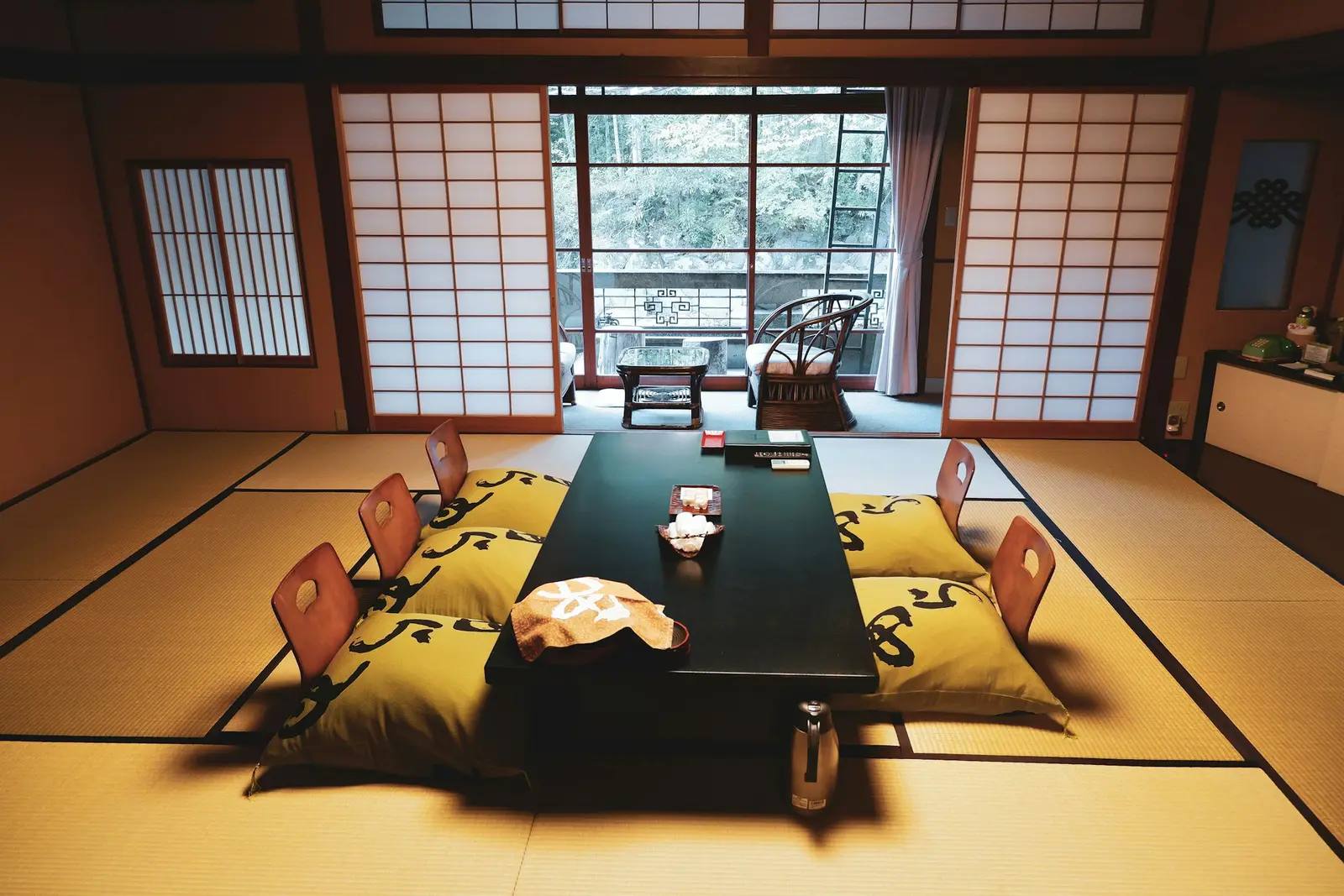
- A note on interiors: many ryokan, old temples and traditional houses are only weakly heated; warmth often comes from a single spot, the kotatsu, a heated table with a blanket. Warm socks and a thick sleeping layer are more comfortable there than you may be used to from central heating in much of Europe.
On transport our recommendation is clear: in winter, rely on the train, not on a hire car. Very practical is the takkyūbin luggage forwarding service – you send your suitcase ahead from the hotel to your next lodging and travel with light hand luggage through narrow, snow-covered stations and connecting passages. Reckon with one to several days depending on the route (to Hokkaidō and Okinawa usually two); what you need for the first night belongs in your hand luggage. From a hire car in the Hokkaidō winter we generally advise against, on the other hand: snow drifts, mirror-smooth roads and whiteout conditions make driving there demanding even for experienced drivers; trains and organised transfers are the safer choice.
Two things you should plan for firmly in terms of timing. In the New Year week (roughly 29 December to 3 January) the shinkansen and popular connections are booked out early – reserved seats are then obligatory, not optional. And anyone flying to Hokkaidō should know that snow storms at New Chitose airport (Sapporo) repeatedly lead to delays and cancellations. So do not put the departure on the last day before your flight home, and allow a buffer for connections.
This is exactly where our work begins. As a tour operator living in Japan and guiding you in English, we combine snow, culture and onsen into a journey made to your measure – instead of a ski package or a group tour. We coordinate regions, indoor temperatures, New Year closures and connections so that you experience the real Japanese winter without getting caught on its pitfalls. For a sound winter plan – especially with sought-after ryokan, ski accommodation and train seats over New Year – we recommend six to nine months of lead time. How we build such a journey in principle is something you can read under independent travel; if you would like to be out in the snow with the family, you will find practical guidance under Japan with children.
Sources: Japan Meteorological Agency – Climatological Normals (1991–2020), japan-guide.com – Visiting Japan during New Year
Frequently asked questions about a winter journey in Japan
Is winter a good time to visit Japan?
Yes – away from the New Year week, winter is one of the quietest and often least expensive times of the year. On the Pacific side (Tokyo, Kyoto) it is mostly dry and sunny, with clear air and the most reliable view of Mt. Fuji of the year. You do have to reckon with cold and short days – in Tokyo the sun sets as early as around 5 pm. The exceptions are Hokkaidō and the ski regions, where winter is high season and prices rise accordingly.
How cold is Japan in winter (Tokyo, Kyoto, Hokkaidō)?
In January the daily mean in Tokyo is around 5 °C, with highs near 10 °C and lows close to freezing; Kyoto is similar at about 5 °C, but becomes noticeably colder at night in its basin setting. Sapporo on Hokkaidō, by contrast, stays below freezing all day, with a daily mean of −3 °C and highs around the freezing point, and it is far snowier. In short: Tokyo and Kyoto are wintry but quite bearable, while Hokkaidō is real, snow-rich winter (JMA climatological normals 1991–2020).
When is the Sapporo Snow Festival 2027 and is it worth visiting?
The 77th Sapporo Yuki Matsuri is officially planned for early February 2027 – expected to run from Thursday 4 to Thursday 11 February 2027 (listed as “planned” on snowfes.com). The main venue is the 1.5 km long Odori Park with snow and ice sculptures, some of them more than 15 m high, plus the Susukino and Tsudome sites. With more than two million visitors a year it is a highlight – but book accommodation early, because Sapporo is fully booked and expensive during that week. A lovely addition: at the same time, Otaru holds its Snow Light Path with candle lanterns along the canal, which you can easily combine with it.
Where and when can you watch the snow monkeys in the onsen, and are they certain to bathe?
You can see the bathing snow monkeys at Jigokudani Yaen-kōen near Nagano, most reliably in the depth of winter (January and February), when temperatures regularly fall below −5 °C. The bathing is never guaranteed, however: these are wild Japanese macaques, which on mild days barely enter the hot water – check the park’s live webcam before you set out. Allow for a walk of 30 to 40 minutes along an unpaved forest path that is often icy in winter; sturdy winter boots are necessary, and the path is not accessible for wheelchairs. Admission is 800 yen for adults and 400 yen for children aged 6 to 17; from 1 December 2026 it rises to 1,000 and 500 yen respectively (online ticket: 880 and 440 yen).
Should you travel to Japan over Christmas and New Year, and what is closed then?
Christmas is not a public holiday in Japan but a cheerful time with illuminations – almost everything stays open. The real festival is New Year (Shōgatsu): from around 29 December to 3 January many small shops, restaurants, banks and museums close, with 1 January the quietest day of all. Konbini remain open (around the clock, with cash machines that accept foreign cards), as do chains, hotels and railway stations; department stores start their “hatsuuri” sales from 2 January, with fukubukuro lucky bags. The visit is worthwhile for the unique experience of hatsumōde (the first shrine visit of the year) – but plan the closing days in firmly instead of relying on spontaneous restaurant visits.
Can you see Mt. Fuji in winter, and where is the view best?
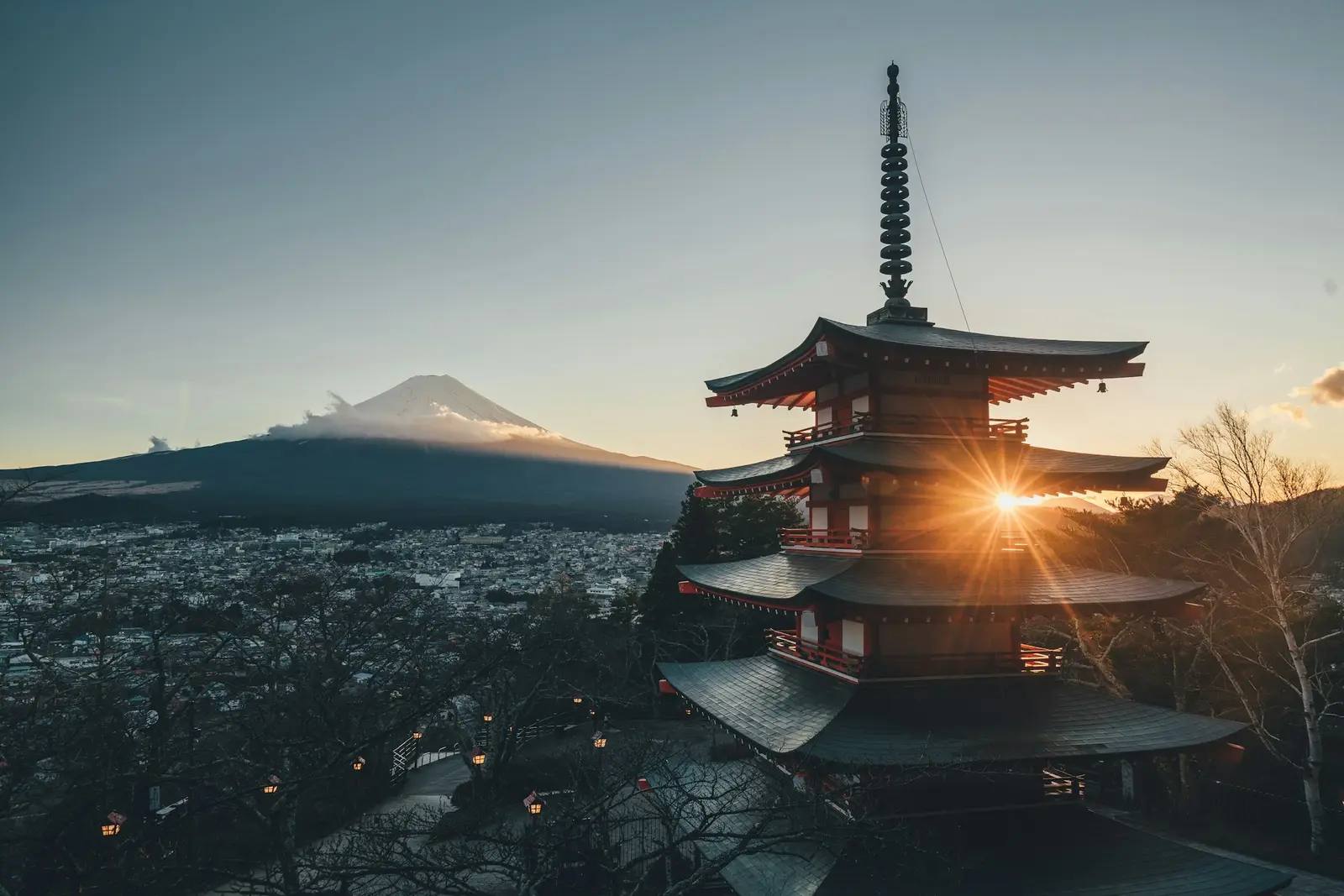
Yes – winter in fact offers the most reliable view of Mt. Fuji of the entire year. December and January in particular deliver a clear view on around 20 to 25 days per month thanks to the dry north-westerly winds – far more than in summer, when the mountain often disappears into haze for weeks. Good viewpoints lie on the Pacific side, for example in the region of the Fuji Five Lakes (Fujigoko), in Hakone or – on clear days – from the Tōkaidō Shinkansen and from Tokyo. The snow-covered summit against a deep blue sky is one of the finest winter moments of a journey through Japan.
Your winter journey through Japan, entirely at your own pace
As Japan specialists on the ground who guide you in English, we plan your individual winter journey – from the best time to travel through ryokan with onsen to well-considered New Year logistics. Write to us; we will listen carefully.
Enquire about a journeyAbout the author

Kentaro Asakura
Founder of Japan Privat · A Japan specialist who guides you in English
Kentaro Asakura was born and raised in Japan. His student years took him first to the UK, where English became second nature to him, and later to Munich, where he met his wife, who is German – together they returned to Japan. With Japan Privat, he has been designing individual journeys for European travellers for more than ten years – in English, with the eyes of a local and a genuine feel for what guests from Europe are looking for.