Cherry Blossom in Japan 2027: Best Time to Travel, Places and Realistic Planning
Contents
- Cherry blossom in Japan 2027: when does it bloom, and where? (The short answer)
- What is hanami? Sakura, mono no aware and the fascination of transience
- Understanding the cherry blossom front (sakura zensen) – the south-to-north principle
- Average blossom dates by region (long-term averages for orientation)
- Current status: what is already known today about the 2027 blossom
- When will the official blossom forecasts for 2027 appear?
- Places with character – the famous stages, soberly considered
- Quiet places with depth – alternatives for connoisseurs, away from the crowds
- Hanami in practice: picnic, yozakura and etiquette
- The moving target: booking and timing in the absolute peak season
- Important to know: the blossom tends to arrive earlier
- In retrospect: how did the 2026 season actually unfold?
- The last kilometre: why the cherry blossom calls for individual planning
- Frequently asked questions about the cherry blossom in Japan 2027
If you would like to experience the cherry blossom in Japan in 2027, the rough orientation is this: on the classic Golden Route – Tokyo, Kyoto, Osaka – the blossom falls, in the long-term average, into the window from late March to early April. It moves in stages from south to north: Kyushu usually blooms from mid to late March, the Tohoku region from early to late April, and Hokkaido only from late April to early May. One early-flowering variety, the Kawazu-zakura on the Izu Peninsula, already appears in February.
The key points in brief
- Best time to travel: On the Golden Route – Tokyo, Kyoto, Osaka – the blossom falls, in the long-term average, into the window from late March to early April.
- South to north: The blossom moves across the country as a wave (sakura zensen) – Kyushu mid to late March, Tohoku early to late April, Hokkaido late April to early May.
- Dates for 2027: Concrete dates do not exist today – the first official forecasts appear from mid to late December 2026 (JMC) and late January 2027 (JWA) respectively.
- A short window: Full bloom in one place often lasts only about a week and can vary by up to two weeks from year to year – plan with buffer days.
One thing first, and it matters: concrete blossom dates for 2027 do not exist today – and no serious source can provide them. The first official blossom forecasts will not appear until around mid to late December 2026 (Japan Meteorological Corporation) and late January 2027 (Japan Weather Association) respectively. Until then, the long-term averages are the only reliable basis – and you will find exactly those further below as a table. The actual full-bloom window in one place is short, often only about a week, and it can vary by up to two weeks from one year to the next. Practically everything that makes up this article follows from that one fact. If you would like to keep the larger seasonal calendar in view, you will find it in our overview of the best time to visit Japan.
It is shortly after seven on a morning in early April, and for barely an hour Maruyama Park in Kyoto belongs almost entirely to you. The great weeping cherry at its centre – surrounded by hundreds of people the evening before – now stands still in the cool light. Anyone who has experienced Japan’s cherry blossom once in this window understands two things at the same time: why it is regarded as the country’s most beautiful natural spectacle – and why it is the most difficult travel season of all to plan. Instead of invented forecast dates, you will find here sound average values, the principle behind the famous wave of blossom and clear guidance on crowds, booking and timing.
What is hanami? Sakura, mono no aware and the fascination of transience
Hanami (花見, “blossom viewing”) describes the shared contemplation of the cherry blossom – a tradition more than a thousand years old that is far more than a pretty natural spectacle. There is a reason, deep in Japanese culture, why this short window of blossom is worth so much effort. In the Nara period (710–794) admiration was still directed at the plum blossom (ume); in the Heian period (794–1185) the court nobility shifted its attention to the cherry blossom, and in the Edo period (1603–1868) the courtly viewing became a popular festival in which all social classes took part.
The aesthetic core lies in transience. The blossom is precious precisely because it drifts away again so quickly – a sensibility captured in the Japanese term mono no aware (物の哀れ, roughly “the wistful awareness of the transience of things”). It is exactly this fleetingness that creates the appeal, and it is at the same time the whole difficulty of planning a journey: you are planning an experience that eludes any fixed date. It is the same sensitivity to the right moment that gives the autumn leaves (kōyō), the autumn counterpart, their appeal – the other great, fleeting season of the Japanese year, only moving across the country in the opposite direction.
Four terms will come up again and again:
- Sakura (桜) – the cherry blossom itself, usually the standard variety Somei-Yoshino.
- Hanami (花見) – the blossom viewing, the shared contemplation.
- Kaika (開花) – the beginning of the bloom.
- Mankai (満開) – full bloom.
For connoisseurs, one fine but relevant distinction: the quiet, private picnic or the silent stroll beneath the trees is hanami proper. To be distinguished from it is the more commercial Sakura-Matsuri, a festival with stalls, loudspeakers and bustle. Both have their appeal – but for a calm, refined travel experience they are not the same thing.
Understanding the cherry blossom front (sakura zensen) – the south-to-north principle
The most important point first: the cherry blossom in Japan is not a date, it is a wave. In Japanese it is called sakura zensen (桜前線), the “cherry blossom front” – the imaginary line of trees coming into bloom that moves across the archipelago from south-west to north-east as spring temperatures rise.
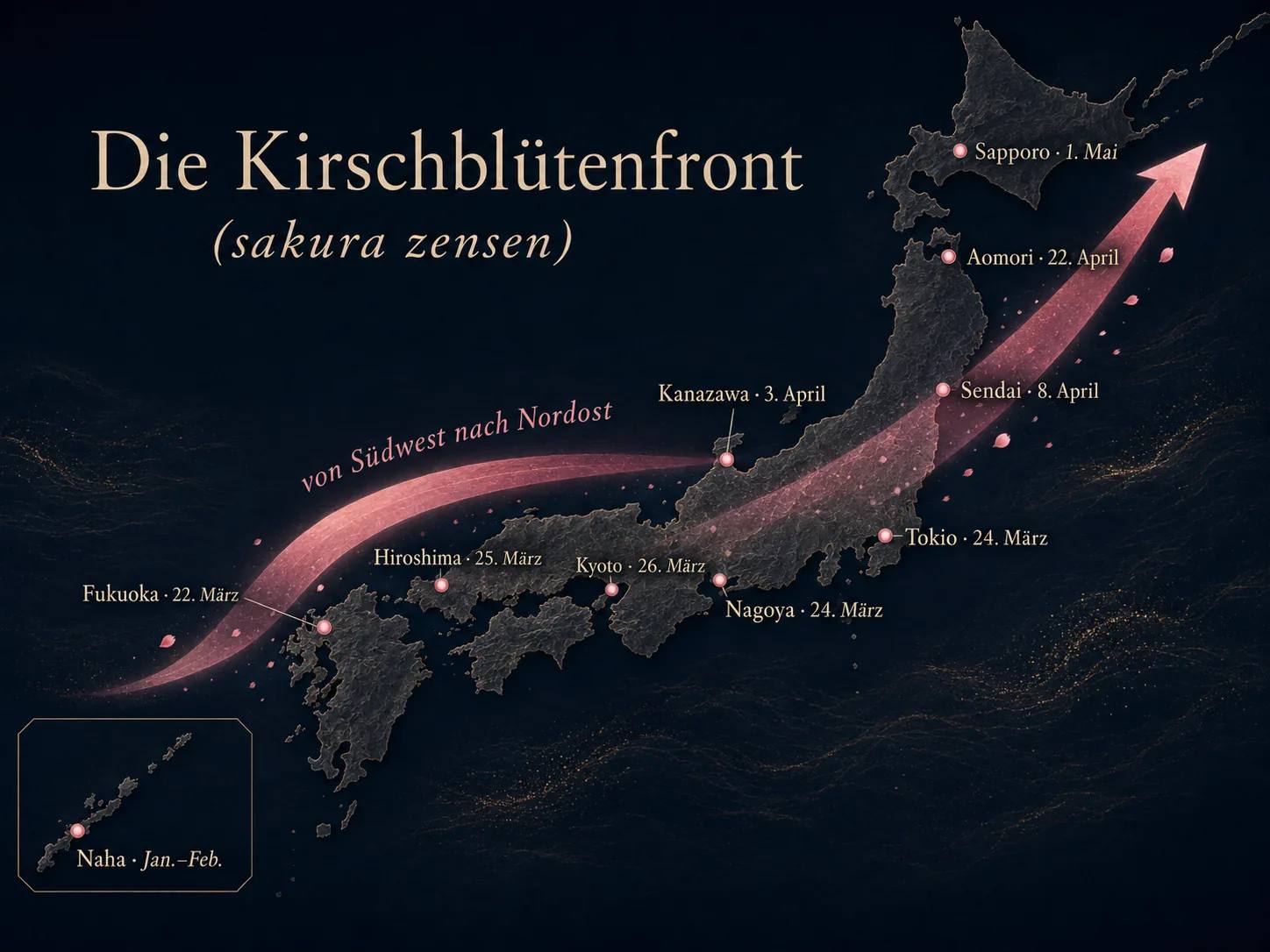
How the blossom moves across the country
The front moves in a surprisingly reliable rhythm, even though the exact days vary each year: Okinawa begins as early as January and February, Kyushu and Shikoku follow from mid to late March, Honshu with the Golden Route from late March to early April, Tohoku from early to late April, and Hokkaido brings up the rear from late April to early May.
In addition to the north–south movement there is a second axis: from the plain to the heights. Places at higher altitude bloom later than the surrounding lowlands. This is not a marginal detail but a practical tool – on Mount Yoshino in Nara, for example, the trees stand in four altitude tiers, so that the blossom there extends over considerably more days than at a single point, while mountain towns such as Takayama lag behind the lowlands by days.
A note on accuracy that separates serious sources from superficial ones: the early blossom on Okinawa and the Amami Islands belongs botanically to the Hikan-zakura, or Kanhi-zakura, and not to the nationwide standard variety Somei-Yoshino that shapes the rest of the front. That is why the far south is reported separately in the official bulletins – the February dates there are not simply a “brought-forward” Tokyo and cannot be transferred one to one.
The practical consequence is the loveliest feature of the whole thing: if you travel flexibly, you can literally travel after the blossom. Begin in the south or in the lowlands and plan places further north or higher up as later stages – in this way you extend your own hanami window from one week to several. The strategies further below are built on exactly this.
kaika and mankai: what the official terms mean
So that you can read later forecasts and reports correctly, it helps to know the definitions used by the Japanese weather agency JMA (気象庁). The beginning of the bloom (kaika) is officially the day on which five to six blossoms have opened on a designated reference tree – in Tokyo this tree stands at the Yasukuni Shrine. Full bloom (mankai) is regarded as reached when more than 80 percent of the buds have opened. Nationwide, the JMA maintains around 58 such official reference trees.
Between kaika and mankai about a week typically passes, in the north often only four to five days. That is the span within which your travel window moves – and the reason why a few days of buffer time can decide between success and a narrow miss. When the forecast providers name a date in winter, they always mean one of these two defined moments – and the finest sight usually lies in the days after the reported full bloom.
Average blossom dates by region (long-term averages for orientation)
Now to the concrete figures – with one important preliminary remark: the following table shows long-term averages (平年, the mean of the years 1991–2020 from the JMA). These are not forecasts for 2027. They give you a realistic sense of when a region “usually” blooms – no more, but no less either.
| City | Region | Avg. start of bloom (kaika) | Avg. full bloom (mankai) |
|---|---|---|---|
| Fukuoka | Kyushu | 22 March | 31 March |
| Hiroshima | Chugoku | 25 March | 3 April |
| Nagoya | Tokai | 24 March | 2 April |
| Tokyo | Kanto | 24 March | 31 March |
| Kyoto | Kansai | 26 March | 4 April |
| Osaka | Kansai | 27 March | 4 April |
| Kanazawa | Hokuriku | 3 April | 8 April |
| Sendai | Tohoku | 8 April | 13 April |
| Aomori | Tohoku | 22 April | 26 April |
| Sapporo | Hokkaido | 1 May | 6 May |
Source: Japan Meteorological Agency / 気象庁, long-term average 1991–2020 (column 平年日). Values rounded.
And once again, because it is so easily misunderstood: these are average values for orientation, not a forecast. The actual date in 2027 can deviate from them by several days to a good week – in both directions.
This table represents the heart of the Golden Route well, but it has two edges you should know about. At the lower end, that is earlier: the Kawazu-zakura on the Izu Peninsula blooms as early as February – a different, early-flowering variety that officially does not belong in the same series, but which marks the de facto start of the season. At the upper end, that is later: in the far east of Hokkaido the blossom continues until around mid-May. Anyone who makes use of the whole span has cherry trees blooming somewhere in Japan for around three months.
As a rule of thumb, keep to the roughly one week between the beginning of the bloom and full bloom – in the north this interval tends to be shorter: in Kanazawa, Sendai, Aomori and Sapporo only four to five days lie between them on average. How the cherry blossom fits into the larger seasonal calendar – spring, summer, autumn and winter compared – is something we explore in our overview of the best time to visit Japan.
Current status: what is already known today about the 2027 blossom – 23 September 2026
There is no blossom forecast for 2027 yet, and no one can seriously name one today. What does already exist is the weather that prepares the bloom – and it is running at this very moment. The buds for 2027 were formed in the summer of 2026 and are now entering their dormant phase. Whether they open early or late in spring is decided over the coming months, not once March arrives.
Autumn 2026 is turning out warm – and El Niño continues into the winter
The weather agency’s three-month forecast of 18 September 2026 considers above-average temperatures nationwide the most likely outcome from October to December; the edition of 25 August had already expressly noted that the season is only advancing slowly. Behind this lies an El Niño event that has been under way since the spring of 2026 and which the agency sees continuing with a probability of 100 per cent into the winter. In August the sea temperature in the monitoring area was 3.4 °C above the reference value – more than in August 1997 (+3.0 °C), until then the highest August value since 1949; for the peak in winter the agency expects a value that comes close to the previous record of December 1997 (+3.6 °C). For Japan, however, El Niño does not automatically mean “mild”: the same agency notes that the patterns typical of El Niño were not clearly discernible over Japan in the recent past. The effect runs more indirectly – global warming and El Niño together raise the temperature of the entire atmosphere in the tropics, so that warm air settles over Japan more readily.
Why a mild winter does not simply mean “early blossom”
This is the point at which most travel reports fall short. The Somei-Yoshino cherry needs two opposing things. First cold: the bud only awakens once it has been exposed to low temperatures for long enough in autumn and winter – in Japan this process is called kyūmin-daha, the breaking of dormancy. Second warmth: after that, the accumulated warmth of the late winter and the spring decides how quickly things progress to the bloom.
A consistently mild winter therefore works in both directions at once. If the cold is lacking, the breaking of dormancy is delayed and becomes irregular – in the south of Japan this sometimes shows itself as an uneven, drawn-out bloom rather than as an early date. This is not theory: in the 2026 season Weathernews expressly noted in its first forecast that the breaking of dormancy in western Japan may have been delayed because the cold air had not persisted for long enough. If the late winter is warm, on the other hand, things will move quickly once dormancy has been broken. Which of the two effects prevails is not yet settled in September. That is precisely why the first forecasts in December are less certain than those in February – and why we hold back with figures at this point for as long as there are none. This has to be kept apart from the long-term trend: over the decades the blossom is moving forward – more on that further below – but a single mild winter does not automatically follow that line.
The winter outlook of 18 September – and what it does not say
Since 18 September 2026 the first official statement about precisely the winter that determines the breaking of dormancy for 2027 has been available. The weather agency’s outlook for the cold season considers above-average temperatures likely (60 per cent) for December to February in eastern and western Japan – that is, from Tokyo via Kyoto and Osaka to Kyushu – and 70 per cent on Okinawa and the Amami Islands. For the north, “normal” and “warmer than normal” are equally likely (40 per cent each).
No blossom date can be read from this. The outlook says that a mild winter is more likely than a cold one – not how much cold the buds will receive, and not how warm March will be. Both together decide the date, and a mild winter, as described above, works in both directions at once. The first blossom forecast for the 2026 season appeared on 18 December 2025 from the Japan Meteorological Corporation – unusually early; the other two services followed in January. The agency itself will re-examine its winter outlook with the next three-month forecast on 20 October. For your planning, that changes nothing about the order: the good houses in Kyoto and Tokyo are taken for the blossom period long before the first forecast appears. If you would like to travel for the cherry blossom in 2027, you book the accommodation according to the long-term average and adjust the route afterwards – not the other way round.
Sources for this section: the temperature outlook for September to November follows the three-month forecast of the weather agency of 25 August 2026 in the analysis of tenki.jp; the state of El Niño, its continuation into the winter and the comparison with 1997 follow the El Niño report of the weather agency of 9 September 2026; the outlook for the cold season (December to February) and the three-month forecast for October to December, both published on 18 September 2026 at 14:00, together with the probabilities by region and the date of the re-examination on 20 October, follow the seasonal forecasts of the weather agency in the analysis of tenki.jp of 18 September 2026; the delayed breaking of dormancy in western Japan in the 2026 season follows the first blossom forecast from Weathernews of 8 January 2026.
When will the official blossom forecasts for 2027 appear?
The first sound blossom forecasts for 2027 are likely to appear from mid to late December 2026 from the Japan Meteorological Corporation (JMC) and from late January 2027 from the Japan Weather Association (JWA, tenki.jp); experience shows that the forecast only becomes truly precise about six weeks before the respective bloom. When a reliable forecast for the coming year becomes available is one of the most frequently asked and at the same time most rarely clearly answered questions – what follows is the sound answer with its sources: instead of invented figures, the whether and the when.
First, a fact that is often overlooked: the state weather agency JMA (Japan Meteorological Agency, Japan’s national weather service) has not issued a cherry blossom forecast of its own since 2010. It continues to observe and, from the beginning of March, reports daily the first and full blooms that have actually occurred at its reference trees – but the forecasts themselves come today from private weather companies.
Three of them shape the season:
- Japan Meteorological Corporation (JMC): a private weather company from Osaka (known in Japan as n-kishou) – not to be confused with the state JMA. For the 2026 season it published its first forecast as early as 18 December 2025 – unusually early, made possible by a newly introduced AI-supported long-range model. The company forecasts around 1,000 locations and updates its data continuously.
- Japan Weather Association (JWA, tenki.jp): it issued its first instalment (Part 1) for 2026 on 29 January 2026 and then supplemented it with rolling updates into April.
- Weathernews: the third major provider, with its own dense observation network and its own forecasts. Its first forecast for 2026 appeared on 8 January 2026 – that is, between the other two.
What does that mean for 2027? Put as a well-founded expectation, not as a fact: the first sound forecasts are likely to appear from mid to late December 2026 (JMC) and late January 2027 (JWA) respectively. Experience shows, however, that the blossom forecast only becomes truly precise and reliable about six weeks before the respective bloom.
And this belongs to the picture as well: early forecasts remain subject to uncertainty. They are based on models of accumulated warmth and of what is known as the breaking of bud dormancy – both react sensitively to every mild or cold spell in winter. Our advice is therefore unspectacular, but effective: follow the official updates from winter onwards. We do that continuously on the ground in any case, and compare the figures with what we actually see on our walks.
Places with character – the famous stages, soberly considered
The great names are famous for good reason. We do not keep quiet about them – but we tell you plainly what they are really like at peak time, and where the quieter variant lies just next door.
Tokyo: from the overrun park to the quiet alternative
Ueno Park is Tokyo’s classic hanami stage and attracts around two million visitors in spring; on peak days you literally stand shoulder to shoulder there. The Meguro River, whose trees leaning over the water adorn every travel magazine, is barely passable in the evening during the illumination. It remains beautiful nonetheless – but not quiet.
The connoisseur’s tip lies immediately next door: right beside the much-photographed Chidorigafuchi moat with its rowing boats beneath the branches lies the adjoining Kitanomaru Park. Five minutes on foot, the same historic waterside setting around the Imperial Palace – and a fraction of the people. If you prefer a well-tended, curated setting, go to Shinjuku Gyoen – a wonderfully maintained garden with an admission charge, which filters the crowds somewhat; on the peak weekends, however, an advance reservation is required, which you have to know about and make in good time.
Kyoto and Kansai: the Philosopher’s Path, Maruyama, Yoshino
In Kyoto the Philosopher’s Path (Tetsugaku-no-michi) is among the loveliest walks in the country: around two kilometres along a canal, lined with some five hundred trees – in the early morning, before the tour groups, one of the most peaceful places in the city. In Maruyama Park stands that great shidare-zakura with which this article began, its hanging branches lit up in the evening. Arashiyama in the west and the Daigo-ji temple in the south-east round off the picture – the latter still carries the echo of a famous hanami that the warlord Toyotomi Hideyoshi held here in the year 1598. It should be noted: Kyoto struggles with visitor numbers generally, and the cherry blossom season is the peak of that – one more reason to get up early.
Things are one step more relaxed in the extensive park of Osaka Castle, which lends itself well to a picnic. And for everyone who would like to experience the staggered blooming, Yoshino in Nara Prefecture is the epitome of it – for many the cherry blossom place in Japan: around 30,000 trees are spread over four altitude tiers, so that the blossom there moves from bottom to top over several days.
Castles and higher ground: Himeji, Hirosaki, Takato
Hardly any setting carries the cherry blossom more beautifully than a Japanese castle. The brilliant white Himeji Castle in Hyogo, a World Heritage Site, forms an almost painted contrast with the pink blossoms. In the north, in Aomori, Hirosaki Castle is regarded as one of the most magnificent destinations of all: when the blossom is late, the famous hanaikada forms on the castle moat, the “blossom raft” of fallen petals that colours the water pink. And Takato in Nagano Prefecture traditionally counts among the country’s “three best” cherry blossom places.
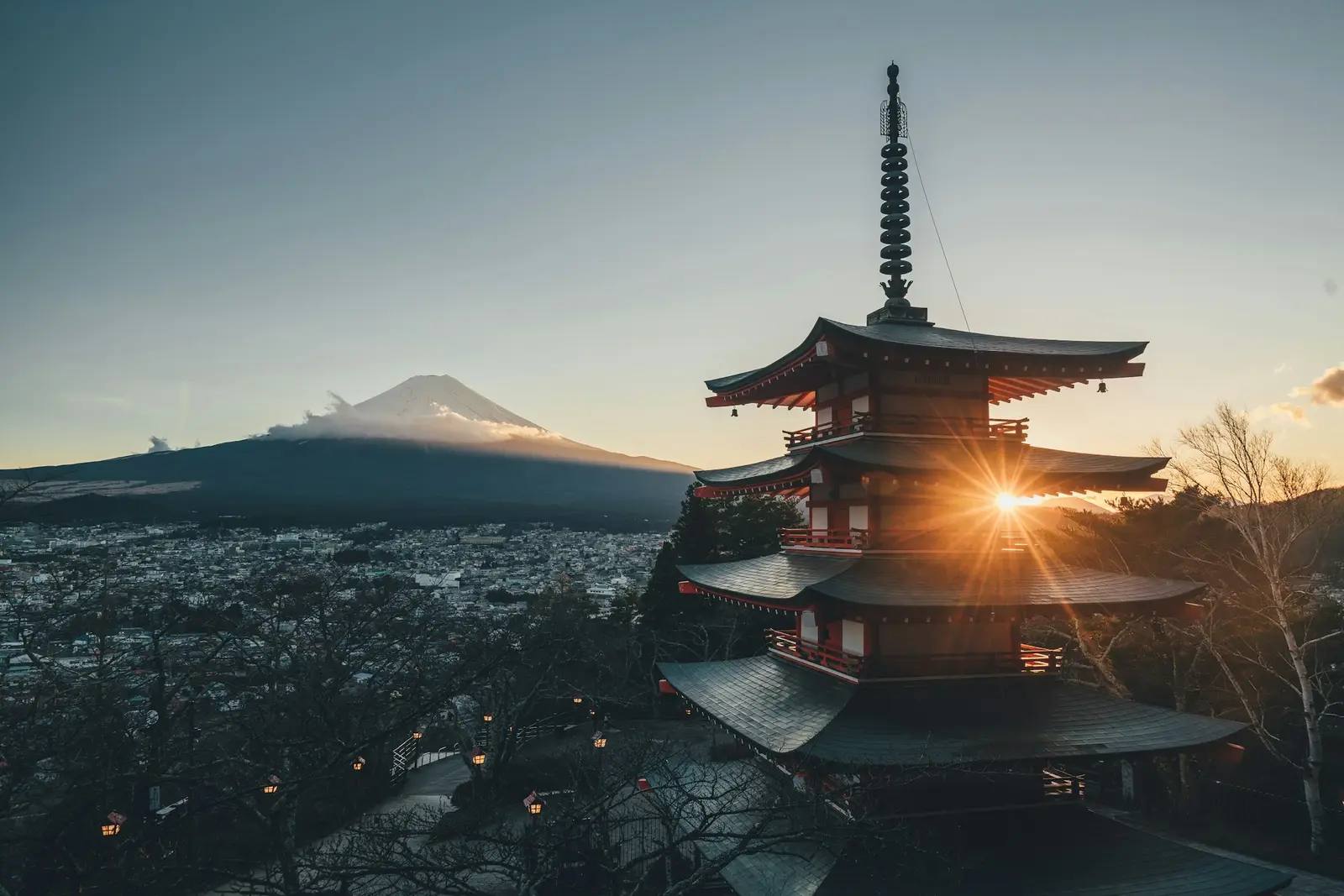
The Fuji region is home to the iconic image of the Chureito Pagoda with snow-covered Mount Fuji and the blossoms in the foreground – perhaps the most photographed Japanese motif of all, and for exactly that reason a focal point of overtourism. Fujiyoshida, the town below Fuji and the Chureito Pagoda, announced as early as February 2026 that it would not hold its cherry blossom festival that spring – to protect residents from overtourism. It nevertheless kept stewards, traffic control and visitor management in place during the blossom season. The scale of the crowds nationwide was then shown by March 2026: with more than 3.6 million arrivals, it was the busiest March in Japan’s history.
One consistent tip that applies to all these places: the only time window in which these stages are genuinely quiet is the early morning on weekdays, roughly between seven and nine o’clock. This one habit changes the experience more than any choice of location. We sketch a sensible spring route through these places in our 14-day route along the Golden Route; if you have three weeks and would like to follow the blossom as far as Hirosaki, you will find the wider framework in our 21-day route through Japan.
Quiet places with depth – alternatives for connoisseurs, away from the crowds
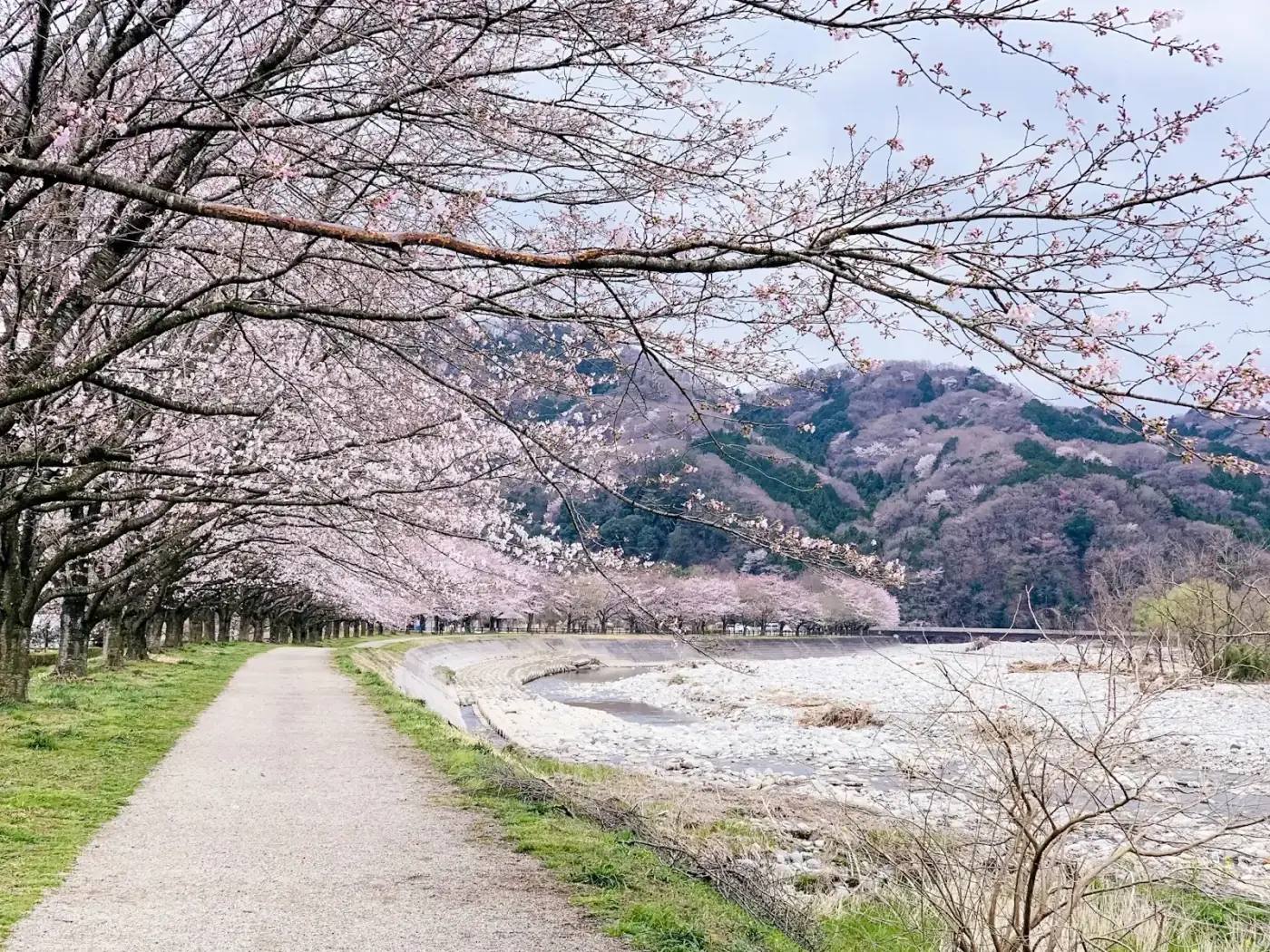
This is where the real added value of someone who lives here lies: not the list of top-ten spots, but the places with genuine depth that a standard guidebook either does not know or mentions only in passing – not because they are less beautiful, but because they are further away.
Kakunodate (Akita), the “Little Kyoto of the north”, is a preserved samurai town with more than 400 weeping cherries, 162 of which are protected as a natural monument. The first saplings came to the far north in 1664 as part of the dowry of a nobleman’s daughter from Kyoto – a fine historical bridge that can still be seen in the trees today. Along the Hinokinai River they form a tunnel of blossom around two kilometres long. Because the north is late (the blossom usually from mid to late April), Kakunodate is at the same time a perfect “second chance” should you narrowly miss the blossom in the south.
The Miharu Takizakura in Fukushima is a chapter of its own: the Takizakura (“waterfall cherry”) is a beni-shidare more than a thousand years old and 13.5 metres tall, declared in 1922 the very first tree in Japan to become a National Natural Monument and one of the “three great cherry trees of Japan”. On an early weekday morning you stand almost alone before this tree. Fukushima lends itself well as a quieter base in general – with Aizuwakamatsu Castle and quiet onsen towns nearby.
If you like things contemplative, travel to Minobusan Kuonji (Yamanashi), the 750-year-old head temple of the Nichiren school, in whose grounds a famous weeping cherry more than 400 years old blossoms. Here a temple stay (shukubo) is even possible – an experience that goes far beyond mere blossom viewing.
And for everyone who arrives early, there are quiet options before the main wave: the Kawazu-zakura on Izu, which blooms as early as February (the associated festival does attract close to two million visitors, but it marks precisely the start of the season); the quiet Yodo Suiro in the south of Kyoto with around 200 Kawazu cherries from mid-February to mid-March; or Kawagoe, the “Little Edo” north of Tokyo, as an easily reachable day trip. The message behind all these places is the same: character instead of crowds – and the later blossom in the north is your natural second chance should the timing in the south not work out. If you would like to pursue this thought beyond the cherry blossom, our Japan hidden gems away from the tourist trails will show you the country’s quiet regions – with current figures on where the crowds are currently shifting and which “hidden gems” are no longer hidden.
Hanami in practice: picnic, yozakura and etiquette
As beautiful as the postcard images are – hanami is also a lived everyday practice with rules of its own and small pleasures of its own. A few practical things that make the difference between a tourist and a guest.
The classic hanami picnic takes place on a blue plastic sheet (Japanese rejā-shīto), which at popular places is often laid out as a placeholder the evening before or early in the morning. You take off your shoes before sitting down on it. In principle there are two variants: the seated picnic hanami and the strolling hanami beneath the trees. For discerning guests the quiet morning window is usually the more elegant choice – the blossom in the soft spring sun, before the crowd arrives, beats the crush of the afternoon.
Yozakura: the cherry blossom at night
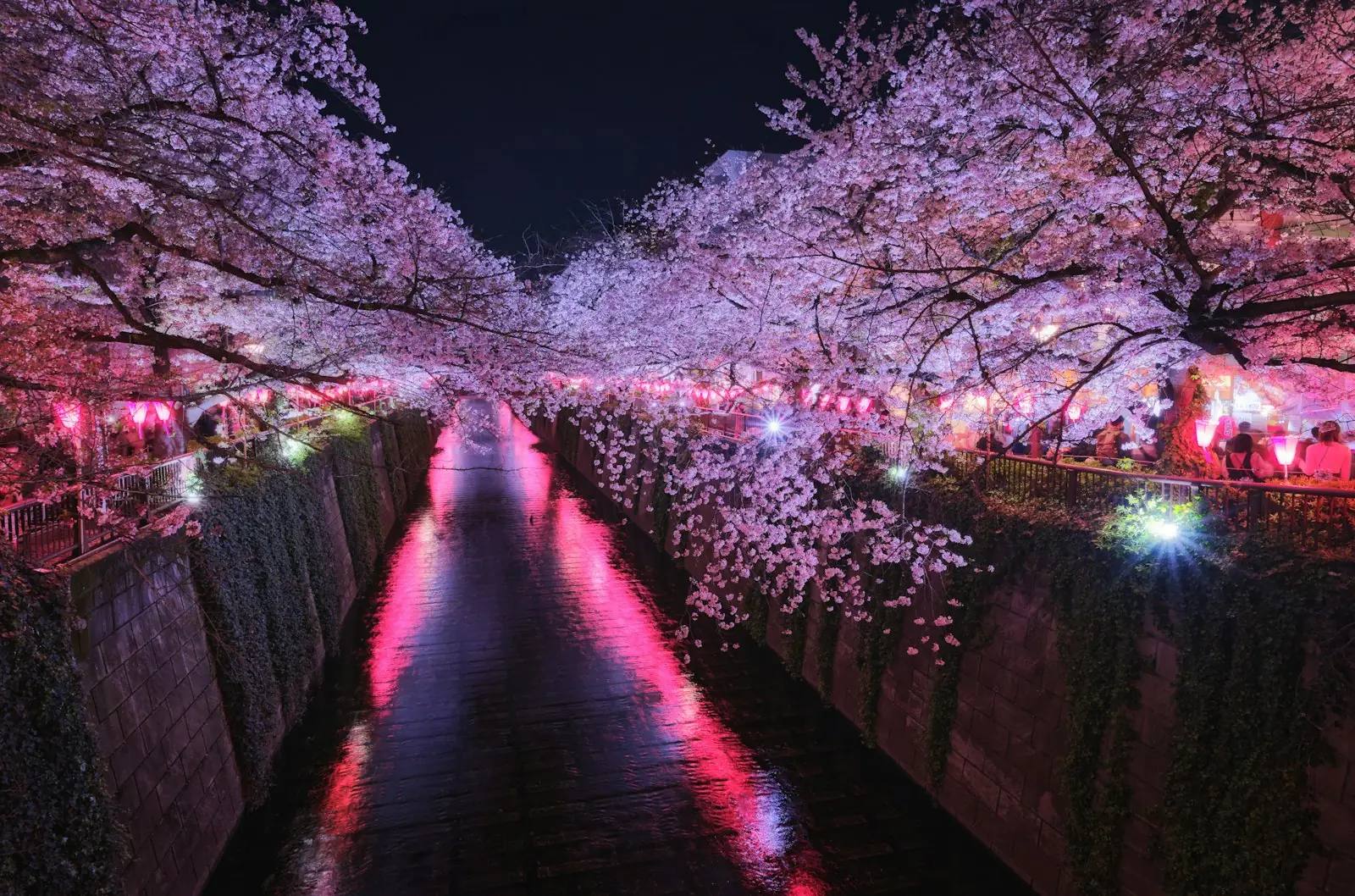
A completely different character reveals itself after nightfall. Yozakura (夜桜), the nocturnal blossom under illumination, lives on contrast and shadow – illuminated blossoms against a dark sky appear richer in contrast and are often quieter than by day. In Ueno Park paper lanterns hang between the trees; in Hirosaki and Takato the castles and cherries are atmospherically lit in the evening. A few practical notes: dress warmly, spring evenings in Japan are cool; check the closing times of the parks; and do without glaring flashes that spoil the moment for others.
What to do and what to leave alone – hanami etiquette
Hanami works through quiet agreement, and a little consideration makes the difference. Clarify in advance whether picnicking is permitted at a place at all – in many classic gardens such as Shinjuku Gyoen or Kyoto’s temple gardens it expressly is not; there you stroll and look, rather than sitting down on the ground. Take all of your rubbish away with you. And be considerate of those who wish to enjoy the moment in silence.
Equally important is what one refrains from: never shake the branches to make petals fall – that harms the trees. Do not step on the roots, do not block paths, and do not reserve places for hours with a sheet that goes unused.
Small companions: sakura-mochi, hanami-dango, hanami-bento
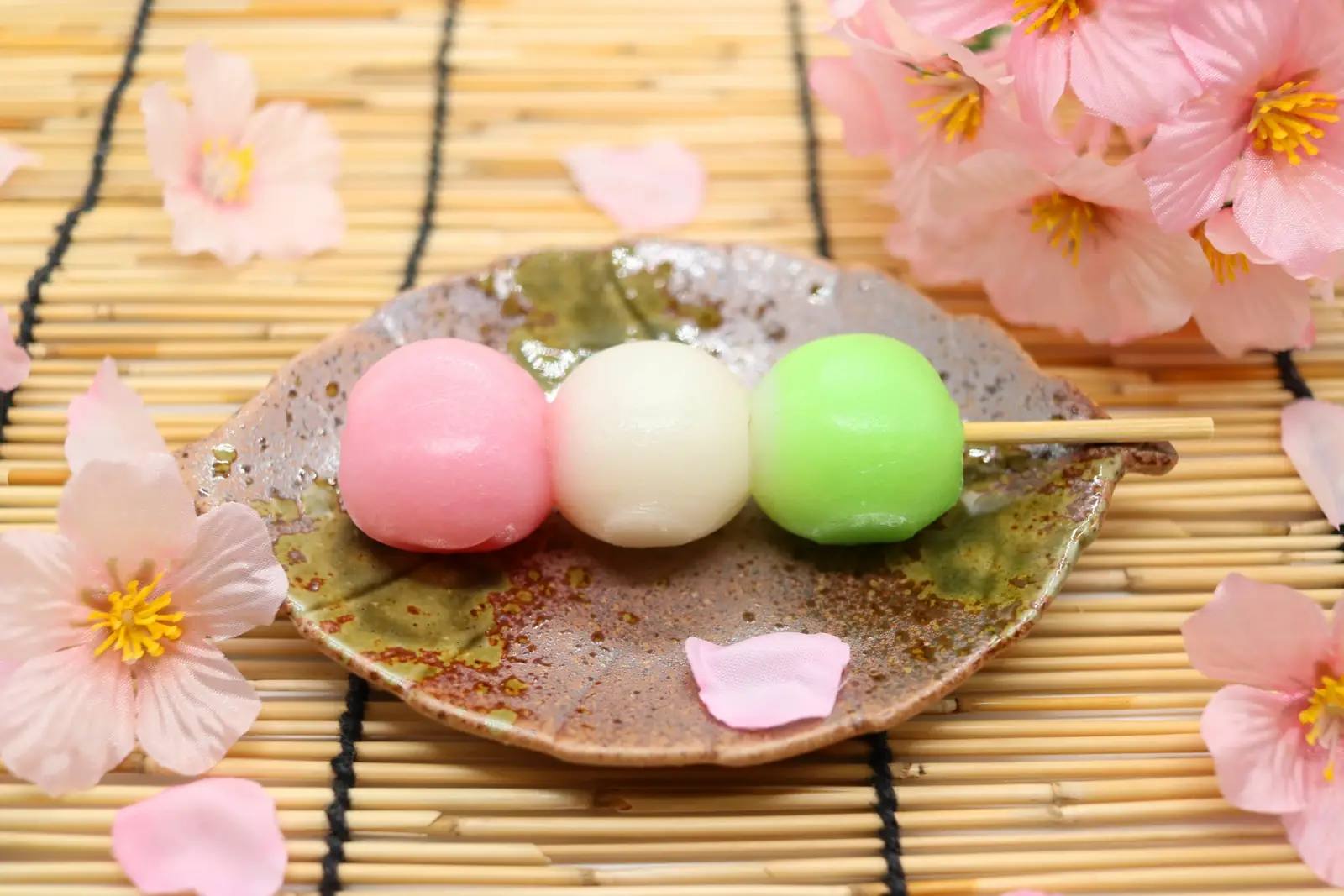
Food is part of hanami, and it is lovingly matched to the occasion. The hanami-bento, the spring lunch box, typically combines makizushi (sushi rolls), inarizushi (rice wrapped in sweetened tofu), tamagoyaki (Japanese omelette), onigiri (rice balls) and karaage (fried chicken). Things turn sweet with sakura-mochi – pink-coloured glutinous rice around a filling of anko, the sweet red bean paste, wrapped in a salted cherry leaf that you eat as well. And the secret star is the hanami-dango: three small rice dumplings on a skewer, pink, white and green – the colours of spring. You will find all of this excellently in the depachika, the delicatessen floor of the large department stores, or, quite simply, in the konbini around the corner.
One practical note to close this section: spring in Japan is also hay fever season, triggered above all by the pollen of cedar and cypress. If you are prone to allergies, you should pack the appropriate medication – the pollen load can be considerable at this time.
The moving target: booking and timing in the absolute peak season
This is where it is decided whether your journey truly succeeds. Because the cherry blossom is not only the most beautiful but also the most difficult travel season in Japan to time.
Why the cherry blossom is the most difficult travel season to time
Keep the four factors in view at the same time. First: a reliable forecast is only available about six weeks before the bloom. Second: full bloom in one place lasts only five to seven beautiful days. Third: a single spell of heavy rain or wind can end it abruptly. And fourth, the actual conflict: your rooms have to be firmly booked months in advance. So you are planning an immovable framework around a moving target. That is exactly what makes the cherry blossom in Japan 2027 the country’s most demanding travel season – solvable, but only with method.
How far in advance you should book
April is Japan’s most expensive travel month – that is not a marketing phrase but market reality. At full bloom the good houses in Tokyo, Kyoto and Osaka are quickly booked out, and prices lie noticeably above the annual average; as a rough order of magnitude you should reckon with surcharges of around 50 to 100 percent, and at the most sought-after ryokan sometimes with two to three times the usual rate. Flights, too, lie well above average. What a journey to Japan costs overall is something we set out in this piece on the cost of a trip to Japan.
As for lead time: top ryokan and refined houses should be approached nine to twelve months, in some cases a full year, in advance. Good hotels in Tokyo and Kyoto should be booked at least four to six months beforehand, in the premium segment rather six to eight. The mechanism behind this is simple: ryokan are tiny, often only eight to twenty rooms, and regular guests secure the same date for the following year as they check out. What is worth it and what to look out for is explored in our ryokan guide.
There is a paradox here that leads many travellers astray: numerous traditional houses only release their allocations three to six months before check-in. “Fully booked” can therefore simply mean that the rooms have not yet gone on sale. Conversely, the most sought-after top ryokan open their peak weeks as much as nine to twelve months ahead. The decisive advantage therefore lies in knowing when which house opens its doors – not in merely searching early.
Strategies for a moving target: follow the blossom, combine early and late
Against a moving target a fixed date does not help; a clever safeguard does. Five strategies have proved themselves:
1. Book cancellable rates. Wherever possible, choose flexibly cancellable rates (often shown as “free cancellation”). In this way you can react as soon as the forecast becomes more precise from winter onwards, without losing money – you are not at the mercy of the sharpening forecast, you can follow it.
2. Follow the front. Plan two to three nights per city, travel along the south-to-north wave and arrive at each place slightly before the expected peak, with one to two buffer days for rearranging things.
3. Combine early and late. An early variety (Kawazu in February) and a late place in the north (Tohoku, Hokkaido) on the same trip work like an insurance policy: even if the Golden Route just misses, you will experience full bloom somewhere. That is the best safeguard against an unfavourable year. It does cost time, however: several weeks lie between the early blossom in the south and the late one in Tohoku. With fourteen days you are effectively deciding on one blossom window; only with around three weeks can two windows be placed in the same journey. We show what such a route can look like in our 21-day route through Japan.
4. Avoid Golden Week. The chain of public holidays from roughly late April to early May (in Japanese Golden Week) is Japan’s largest domestic travel period; prices and scarcity shoot up. On a late-blossom journey to Tohoku or Hokkaido in particular, you should plan to be there before it if at all possible.
5. A base plus day trips. Instead of changing location every night, a well-connected fixed base with day trips can be the cleverer option – Osaka, for example, as a quieter and often less expensive place to stay than the more expensive Kyoto, exploring from there. And reserve your shinkansen seats early – even with a Japan Rail Pass, because reserved seats are quickly taken in the high season.
Important to know: the blossom tends to arrive earlier
One point that serious planning should not conceal: over the decades the cherry blossom is tending to shift forward.
The evidence is unusually good, because Kyoto’s full bloom is documented back to the year 812 thanks to historical court records – one of the longest phenological data sets in the world, known as the Aono series. Since around 1800 this series has shown a clear shift of full bloom towards the beginning of the month; in 2021 Kyoto reached its earliest full bloom in more than 1,200 years, on 26 March.
Tokyo’s normal value has moved as well: from 29 March (mean 1961–1990) to 24 March (mean 1991–2020), that is around five days earlier. Across all JMA stations the trend is about 1.2 days per decade since 1953. As the cause, research points to the interplay of anthropogenic warming and urbanisation – the additional urban heat amplifies the effect in the large cities; attribution studies conclude that extremely early blooms such as that of 2021 have become considerably more likely through human influence.
For you as a traveller, one clear consequence follows from this: do not rely on the exact calendar date of past decades. Plan buffers, and wait for the current forecasts. Nobody can seriously guarantee a particular day – and anyone who promises one should make you rather suspicious.
In retrospect: how did the 2026 season actually unfold?
The 2026 season was on the whole “earlier than average, but not extreme”: the north was furthest ahead, Tokyo and Kyoto bloomed a few days before the mean – in Tokyo, for instance, full bloom on 28 March – while other cities stayed exactly on the long-term average or were even later. That also shows how strongly the blossom varies from year to year – and it is important to note: these are observed data from the past, not a conclusion for 2027.
In Tokyo and Kyoto the blossom in 2026 lay noticeably ahead of the mean. In Tokyo the JMA reported the beginning of the bloom on 19 March and full bloom on 28 March; in Kyoto the beginning of the bloom on 23 March and full bloom on 30 March – both therefore a few days earlier than the long-term average.
But this is precisely where the important nuance against any hasty generalisation lies: early it was not everywhere. Osaka, with full bloom on 3 April, was practically on the mean (only one day earlier); Yokohama, Kobe and Kagoshima hit the long-term average exactly, and Fukuoka was even three days later. Furthest ahead was the north: Sapporo reached full bloom as early as 24 April, around twelve days before the mean, and stations such as Akita and Obihiro up to thirteen days earlier. The character of the season can be summed up as “earlier than average, but not extreme”, carried by a mild late winter and a warm March.
The lesson for everyone planning for 2027 is unambiguous: a single early indicator – the much-quoted Tokyo report, for example – does not represent the whole country. That is exactly the strongest argument for individual, flexible planning that looks at each region separately, rather than a fixed, pre-booked standard programme.
The last kilometre: why the cherry blossom calls for individual planning
The picture is clear: a full-bloom window of five to seven days, an annual variation of up to two weeks, reliable forecasts only late – and a peak season in which the best houses are allocated months in advance. This combination makes the cherry blossom Japan’s most demanding travel season. It can be planned for, but it does not forgive rigid planning.
The concrete added value lies precisely in the adjustments we have described in this article: a flexible route along the front, from south to north and from the lowlands to higher ground; the right reservations at the right time, from the time slot at Shinjuku Gyoen to the shinkansen seat; places with character rather than crowds; the early morning window on weekdays; and, if the risk becomes too great, a second base in the late north – Tohoku or Hokkaido – as a safety net.
Above all, though, it means knowing when a particular small house opens its allocation – often before it appears on the large platforms at all – and using cancellable rates in such a way that you can react to the sharpening forecast rather than being at its mercy. “The last kilometre” is exactly this fine adjustment: those few decisive changes that lie between “narrowly missed the blossom” and “perfect timing”. It is the same care that we describe elsewhere when we explain why a Japan specialist is worthwhile precisely here – not because you could not travel Japan on your own, but because with such a moving target it is the knowledge of detail that tips the balance.
If you are seriously considering a journey for the cherry blossom in 2027, it is worth starting the conversation early – not in order to invent dates that do not yet exist, but to set the framework up flexibly enough that you can react as soon as the forecasts appear in winter. You will find a broader framework for this in our large guide to independent travel in Japan; and the seasonal calendar around the blossom in our overview of the best time to visit Japan. There is only this one week in the year; it deserves to be well planned – and we are glad to accompany you the whole way, to the last kilometre.
This article is based on long-term observational data from the Japanese weather agency (JMA / 気象庁) as well as the forecast providers Japan Meteorological Corporation and Japan Weather Association, and on our own experience on the ground. Concrete blossom dates for 2027 will not be published until the winter of 2026/27 – we will update this guide accordingly.
Frequently asked questions about the cherry blossom in Japan 2027
When does the cherry blossom bloom in Japan in 2027?
Concrete dates for 2027 do not exist today – the first official blossom forecasts appear from around mid to late December 2026 (JMC) and late January 2027 (JWA) respectively. The long-term average serves as orientation: on the Golden Route (Tokyo, Kyoto, Osaka) the blossom usually falls between late March and early April. Staggered by region that means: Kyushu mid to late March, Tohoku early to late April, Hokkaido late April to early May; the earliest variety (Kawazu on Izu) already appears in February.
When does the cherry blossom bloom in Tokyo and Kyoto on average?
In Tokyo the long-term mean for the beginning of the bloom is around 24 March and for full bloom around 31 March. In Kyoto the blossom begins on average around 26 March, with full bloom following around 4 April. These are JMA averages for the years 1991 to 2020, given for orientation – not a fixed date for a particular year, because the blossom varies by up to two weeks from one year to the next.
What is the cherry blossom front (sakura zensen)?
The cherry blossom front (Japanese sakura zensen) is the line, moving from south to north, along which the nationwide standard variety Somei-Yoshino comes into bloom. Because Japan extends over around 3,000 kilometres, the blossom stretches over weeks: from Kyushu (mid to late March) via the Golden Route (late March to early April) to Tohoku (early to late April) and Hokkaido (late April to early May). The far south (Okinawa, Amami) belongs botanically to a different variety and is reported separately. It is precisely this staggering that makes it possible to follow the blossom deliberately from south to north.
When will the blossom forecasts for 2027 appear?
The first sound cherry blossom forecasts for 2027 are likely to appear from mid to late December 2026 from the Japan Meteorological Corporation (JMC) and from late January 2027 from the Japan Weather Association (JWA, tenki.jp). Experience shows, however, that the blossom forecast only becomes truly precise and reliable about six weeks before the respective bloom. The state weather agency JMA has not issued a forecast of its own since 2010; from the beginning of March it only reports the blooms that have actually occurred at its reference trees.
How long does the cherry blossom last in one place?
A single tree typically stands in blossom for about ten to fourteen days. From the beginning of the bloom (kaika) to full bloom (mankai) around a week passes. The truly beautiful window after full bloom is short, however – about five to seven days; rain and wind can end it abruptly. That is exactly why flexible planning with one to two buffer days per stage is worthwhile.
How early should I book for the cherry blossom season?
Top ryokan and refined houses are best booked nine to twelve months, in some cases a year, in advance. Good hotels in Tokyo and Kyoto should be secured at least four to six months beforehand, and six to eight months in the premium segment. One tip: where possible, book flexibly cancellable rates so that you can react later to the sharpening forecast – and bear in mind that some houses only release their allocations three to six months before check-in, so “fully booked” can be deceptive.
About the author

Kentaro Asakura
Founder of Japan Privat · A Japan specialist who guides you in English
Kentaro Asakura was born and raised in Japan. His student years took him first to the UK, where English became second nature to him, and later to Munich, where he met his wife, who is German – together they returned to Japan. With Japan Privat, he has been designing individual journeys for European travellers for more than ten years – in English, with the eyes of a local and a genuine feel for what guests from Europe are looking for.