Summer in Japan 2026 – Festivals, Fireworks and Practical Advice for the Hot Season
Contents
- Why the heat is worth it
- Japan’s summer at a glance
- Matsuri – the summer festivals
- Hanabi – the art of fireworks
- Obon – the time of the ancestors
- Mt. Fuji and the cool side of summer
- Managing the heat – practical advice from us
- What comes to the table in summer
- How we plan your summer journey
- Frequently asked questions
- Our conclusion
When guests from Europe think of a summer in Japan, many hesitate: “Isn’t it far too hot there?” The short answer is: yes, it is hot and humid. And yet summer is culturally the most intense time of the year. While the heat shimmers above the cities, people in yukata walk to the festivals every evening, hundreds of paper lanterns glow, some of the largest fireworks in the world rise into the sky – and in mid-August, so the belief goes, the ancestors return for a few days. In our article on the rainy season and typhoon season we described the difficult side of the Japanese summer openly. This piece is about the opposite: about the festivals, the fireworks and the atmosphere that make the heat worth it.
The key points in brief
- Best festival period: The matsuri and hanabi high season runs from mid-July to the end of August – if you would like to experience several highlights, the first half of August is the best time to plan for.
- Weather: Hot and humid, mostly 30 – 35 °C at 70 – 80 per cent humidity, and often muggy at night as well. Quite manageable with the right daily rhythm.
- Obon (13 – 16 August): Culturally fascinating, but the largest travel wave of the year – extended by the public holiday on 11 August. During that week it is better to stay in one place than to travel long stages.
- Mt. Fuji: The climb is only possible during the short season from early July to early September.
- Our advice: Secure dates and good seats early – the finest festivals and fireworks are often sold out weeks in advance.
Are you planning an individual journey through Japan? This article is part of our large overview. You will find the complete guide – with travel seasons, routes, costs and planning – here: Japan Independent Travel 2026 – the complete guide.
Japan’s summer at a glance
The “real” Japanese summer begins with the end of the rainy season – on the main island of Honshū usually mid to late July – and lasts into early September. During these weeks the country shifts into a different rhythm: school holidays, festivals almost every weekend, long bright evenings.
What awaits you in terms of climate is worth knowing before you book:
- Temperatures in the cities are mostly between 30 and 35 °C during the day, occasionally higher. Kyoto and the inland regions are particularly hot because they lie in a basin.
- Humidity of 70 to 80 per cent makes the perceived heat considerably stronger than the plain number of degrees.
- Tropical nights (nettaiya) – nights in which the temperature does not fall below 25 °C – are frequent; in summer, air conditioning in the room is not a question of comfort but of rest.
- Heatstroke warnings: On particularly hot days the weather agency issues an official warning (necchūshō alert). It is taken seriously – and travellers should do the same. As early as the end of June 2026, at the start of summer, such warnings were in force for several regions on individual days.
- The new term kokusho-bi: How seriously the heat is now taken is shown by a new word: in 2026 the weather service officially introduced the term kokusho-bi (酷暑日) for days above 40 °C – the first new heat term since mōshobi (35 °C) in 2007.
Summer 2026 is also above average hot across the country – and what the three-month forecast of the Japan Meteorological Agency (as of 23 June 2026) had announced has come to pass: the Pacific high pressure system expanded strongly over Honshū, and the number of particularly hot days rose sharply. The end of the rainy season came even earlier than the weather service had expected: for Kansai, the region around Hiroshima and northern Kyūshū it declared the end as early as 8 July – around eleven days earlier than usual – with Shikoku following on the 12th and southern Kyūshū on 13 July.
In mid-July Japan then experienced the hottest days of the year so far. On 14 July, 170 measuring stations reported more than 35 °C, with the peak value recorded in Hamamatsu at 38.3 °C; in the wards of Tokyo, Nerima recorded the first mōshobi of the year at 36.6 °C. On 16 July the official heatstroke warning applied in 26 prefectures; after the end of the rainy season in the east, on 21 July it was already 42 prefectures – the highest figure of the year so far. Anyone travelling during these days quickly notices how everyday life shifts: you start early in the morning and move the midday hours indoors. In the east, the announcement of the end of the rainy season expected for mid-July took longer: for Tōkai and Kantō the weather service declared the tsuyu over only on 20 July – one day later than the long-term average. Since then it has remained open only in Hokuriku and Tōhoku; there the end is being delayed further – it is now expected only around 31 July. For July and August the weather service continues to expect above-average temperatures, and normal values again for September. It does not forecast quite as extreme a course as in the record summer of 2025 – nevertheless the summer is above average hot, so heat protection remains important.
Added to this is the typhoon season, which reaches its peak in August and September. If you travel in late summer, you should plan for it; we have devoted a separate chapter to it in our article on the rainy and typhoon season. The good news: the warning time amounts to several days, and with support on the ground routes can be adjusted at short notice.
So why travel in summer at all? Because it is the only time when you do not merely visit Japan but celebrate along with it. The festivals are not tourist attractions but living community events, into which you are invited as a guest. That is precisely what the next three chapters are about.
Matsuri – the summer festivals
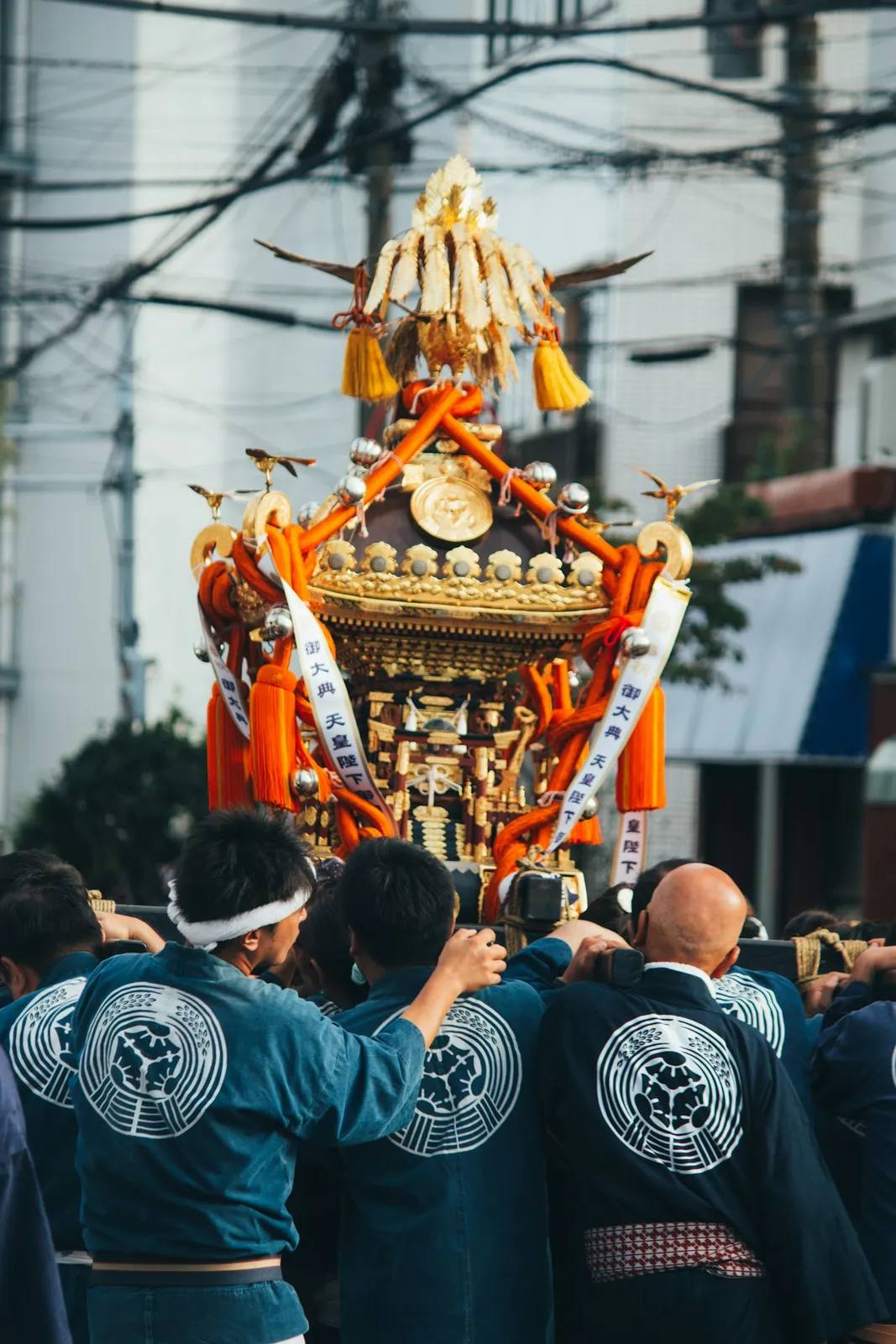
Matsuri (祭り) are Japanese festivals with mostly religious origins – many go back to Shintō shrines or Buddhist temples and reach back centuries. At their core they are about the connection between community, gods and season. The most visible symbol is the mikoshi, a portable shrine that dozens of people carry through the streets, calling out and swaying. Added to this are drums (taiko), dances, yatai stalls with food – and the feeling that an entire town breathes together for a few days.
Here are the most important summer festivals, ordered by date – with the confirmed dates for 2026.
As of 28 July 2026: The July festivals are over for this year – the Gion Matsuri in Kyoto (processions on 17 and 24 July), the Tenjin Matsuri in Osaka and the Sumidagawa fireworks in Tokyo. Ahead of you now lies the second half of the season, which for many is the finer one: the great festivals in Tōhoku in early August, the Awa Odori in mid-August and the national fireworks competition of Ōmagari at the end of August. If you are planning only now, you should concentrate on the first half of August; in our experience, accommodation in Aomori, Akita and Sendai is the first to sell out around these dates.
| Festival | Place | Date 2026 | Highlight |
|---|---|---|---|
| Gion Matsuri (祇園祭) | Kyoto | 1–31 July (over for 2026) | Yamaboko processions on 17 July (Fri) and 24 July (Fri), Yoiyama evenings beforehand |
| Tenjin Matsuri (天神祭) | Osaka | 24–25 July (over for 2026) | Boat procession (Funa-Togyo) with fireworks on the evening of the 25th |
| Nebuta Matsuri (ねぶた祭) | Aomori | 2–7 August | Huge illuminated figure floats, Haneto dancers |
| Kantō Matsuri (竿燈まつり) | Akita | 3–6 August | Balancing long bamboo poles covered in lanterns |
| Sendai Tanabata (仙台七夕) | Sendai | 6–8 August | Magnificent decorations of paper streamers throughout the city |
| Yosakoi (よさこい祭り) | Kōchi | 9–12 August | Rousing dance groups with naruko clappers (main days 10 and 11) |
| Awa Odori (阿波踊り) | Tokushima | 11–15 August | Dance groups (ren) on the stages of the city centre – the street stages run from 12 to 15 August |
As of July 2026. The dates are confirmed through the official organiser websites; times and seating arrangements are added shortly before the festivals.
Gion Matsuri – the most famous festival in the country
The Gion Matsuri of the Yasaka Shrine runs through the whole of July and is part of the UNESCO intangible cultural heritage. Its highlights are the two Yamaboko processions (Yamaboko Junkō) – in 2026 on Friday 17 July (Saki Matsuri) and on Friday 24 July (Ato Matsuri) – in which floats weighing tonnes and decorated with great artistry are pulled through the city centre. At least as beautiful are the Yoiyama evenings beforehand: the floats stand illuminated in the lanes, families display old treasures, and the streets fill with yatai stalls. There are paid grandstand seats for the processions, which sell out early – if you prefer things quieter, you will often experience the Yoiyama evenings as the true heart of the festival.
Tenjin Matsuri – fire and water in Osaka
On 24 and 25 July – in 2026 a Friday and a Saturday – Osaka celebrates the Tenjin Matsuri, one of the three great festivals of Japan. Its highlight on the evening of the 25th is the Funa-Togyo, a procession of illuminated boats on the river – accompanied by around 3,000 fireworks that are mirrored in the water. The combination of flames, lanterns and pyrotechnics above the water is one of the most striking summer images in Japan.
The great festivals of the north – Tōhoku in early August
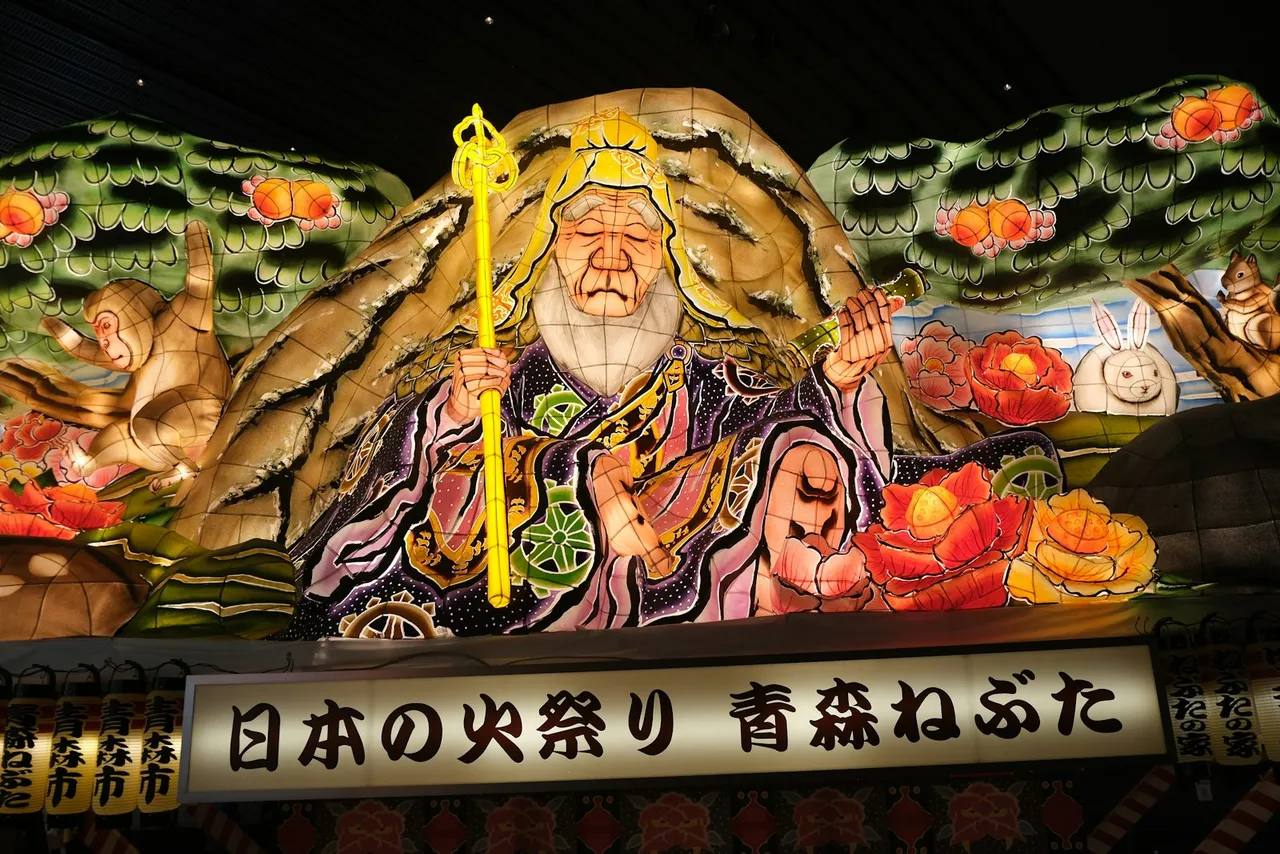
In the first week of August the Tōhoku region (northern Honshū) celebrates its famous festivals almost simultaneously – a journey can be arranged so that you experience several of them. There is the Nebuta Matsuri in Aomori with its huge figure floats lit from within, the Kantō Matsuri in Akita, where men balance poles several metres long with dozens of lanterns on forehead, shoulder and hip, and the colourful Tanabata in Sendai. These festivals are visited by fewer international guests than those in Kyoto and Osaka – and are all the more impressive for it.
In practice: yukata, yatai and crowds
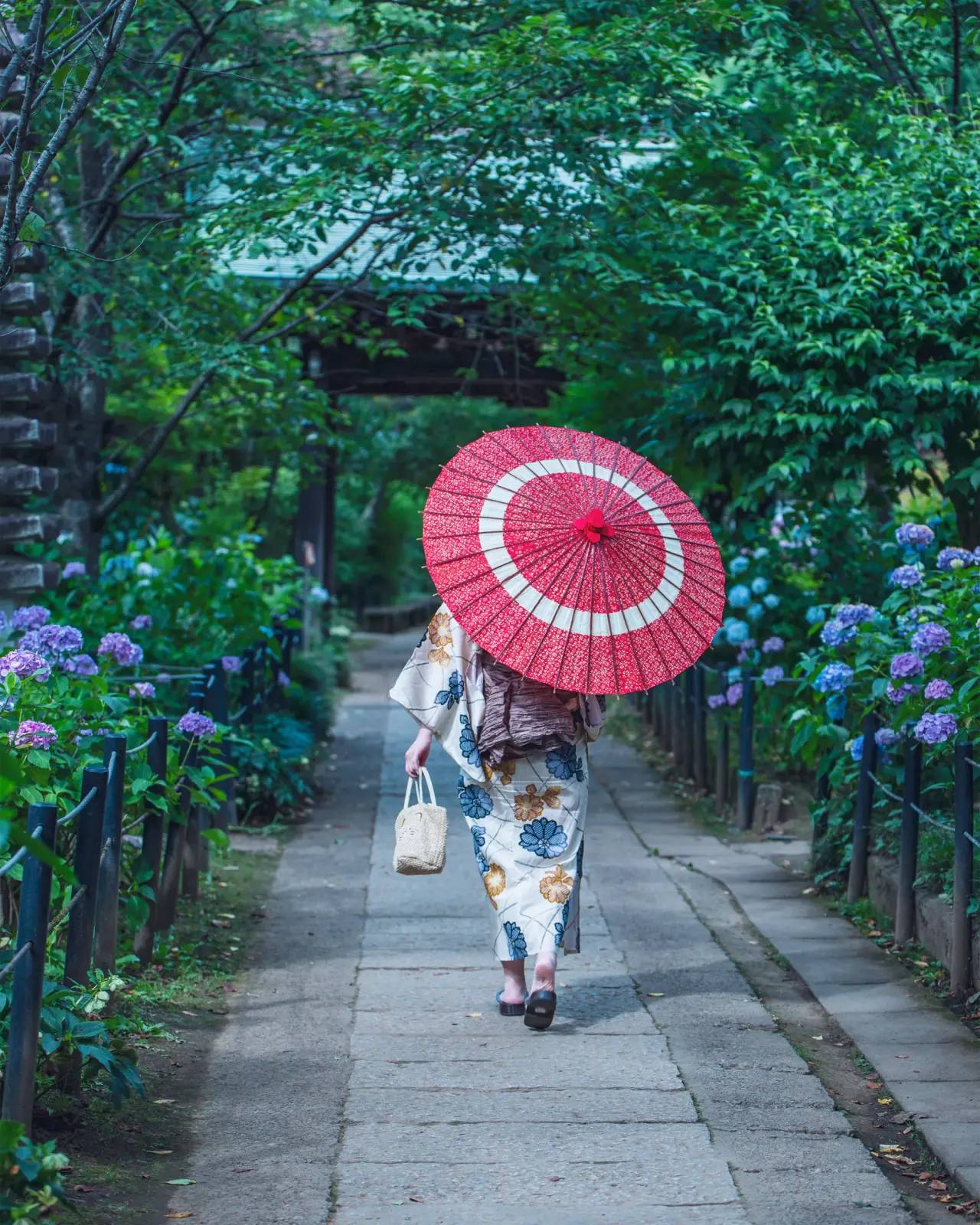
- Wearing yukata: The light summer kimono is welcome at festivals – for guests as well. In many cities there are rental stations that take care of the dressing. It is a lovely way to move from spectator to participant.
- Enjoying yatai: The food stalls are part of the festival. Yakisoba, takoyaki, grilled corn, kakigōri (shaved ice) – a world of their own. If you would like to travel further in pursuit of the food, our article on the culinary journey through Japan offers the continuation: regional cuisine, auberges and how to build a route from them. A note for travellers on a plant-based diet follows in the chapter on summer cuisine.
- Crowds: The large festivals are busy. Arriving early, sturdy shoes and an agreed meeting point for the group all help. The way home after the festival is often the biggest bottleneck – allow a little patience.
Experiencing a matsuri from the front row
We reserve grandstand seats for the great processions, arrange yukata rental and plan your route so that you experience several festivals in one journey.
Request a no-obligation consultationHanabi – the art of fireworks
Hanabi (花火, literally “fire flowers”) are not an accessory in Japan but an art form in their own right. The great hanabi taikai (fireworks festivals) are summer institutions with a long history, their own workshops and an audience that knows exactly how to read the work of the pyrotechnicians. A Japanese firework shell – the perfectly circular unfolding, the multicoloured concentric layers – is craftsmanship of the highest order.
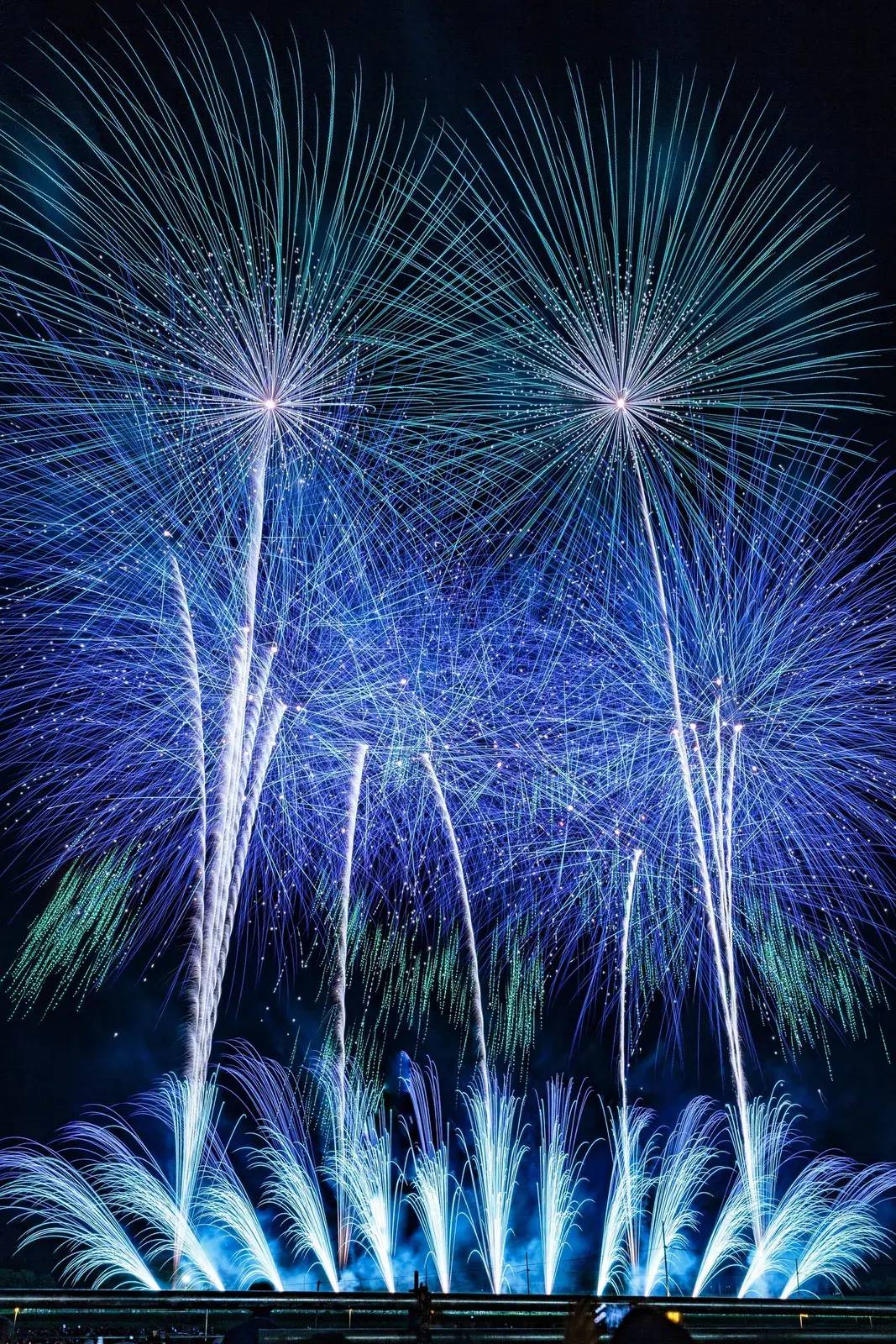
A selection of the best-known fireworks – the exact dates change every year and should be confirmed before booking:
| Fireworks | Place | Date 2026 | Special feature |
|---|---|---|---|
| Sumidagawa (隅田川) | Tokyo | 25 July (over for 2026) | One of the oldest fireworks displays in Japan, in the middle of the city |
| Edogawa (江戸川区) | Tokyo / Chiba | 1 August | Celebrated on both sides of the river (Edogawa and Ichikawa), famous opening sequence |
| Nagaoka (長岡まつり) | Niigata | 2–3 August | Huge “Phoenix” shells in remembrance of the reconstruction |
| Jingū Gaien (神宮外苑) | Tokyo | 8 August | Fireworks and live music in the heart of the city |
| Suwako (諏訪湖) | Nagano | 15 August | Spectacular water starmines above Lake Suwa |
| Ōmagari (大曲) | Akita | 29 August | National competition of the best pyrotechnicians |
As of July 2026, according to official organiser information. For Nagaoka and Suwako the number of shells is not officially stated – these festivals convince less through quantity than through scale and choreography (such as the “Sanshakudama” giant shells in Nagaoka).
How to experience a hanabi properly
- Secure paid seats early: For the large fireworks there are reserved seating areas with a clear view. They are popular and often sold out weeks in advance – booking in good time is worthwhile.
- Come in yukata: A summer evening by the river in a light kimono, with a cold drink and yatai food – for many Japanese this is the essence of summer.
- Plan the way back: After the finale, tens of thousands stream towards the stations at the same time. If you are not in a hurry, let the first wave pass and enjoy another half hour by the water.
Obon – the time of the ancestors
Obon (お盆) is one of the most important festivals of the Japanese year – a Buddhist-influenced period in which, according to belief, the souls of the departed return to their families for a few days. In most regions Obon is observed around 13 to 16 August – in 2026 therefore from 13 to 16 August; in parts of Tokyo and some other areas already in mid-July. Families clean the graves, put up lanterns to show the ancestors the way, and gather together.
For travellers, three expressions of it are above all visible and accessible:
- Bon Odori (盆踊り): The Bon dance takes place in almost every neighbourhood – people of all ages dance in a circle around a raised wooden tower (yagura), to which drums are played and songs are sung. Guests are welcome to join in; the steps are simple and are demonstrated first. It is the most accessible way to take part in Obon.
- Gozan no Okuribi (五山送り火): On the evening of 16 August – in 2026 a Sunday – huge characters and shapes made of fire are lit on the mountains around Kyoto, the best known being the character Dai (大, “large”) on Mount Daimonji. It is the ceremonial farewell fire that guides the ancestors back. A profoundly quiet, dignified mood lies over the city.
- Tōrō Nagashi (灯籠流し): In many places illuminated paper lanterns are set adrift on the water – a quiet, moving image of farewell.
Important note: Obon is the largest travel wave of the year
During Obon, millions of Japanese return to their home towns. In 2026 the public holiday “Mountain Day” (Yama no Hi) falls on Tuesday 11 August – with a single bridging day this results in a long holiday week up to 16 August, which is why even more travellers than usual are to be expected during this period. Shinkansen, domestic flights, rental cars and popular accommodation are then fully booked and considerably more expensive, and the main traffic arteries are congested. Experience shows that the peak of the outward journey falls around 12 and 13 August, and that of the return journey around 15 and 16 August. Our advice: do not plan any long changes of location for the Obon week. Stay in one place, experience the local Bon festivals – and place longer travel stages before or after Obon. With early booking the period is wonderful; spontaneous replanning, however, is then barely possible.
Mt. Fuji and the cool side of summer
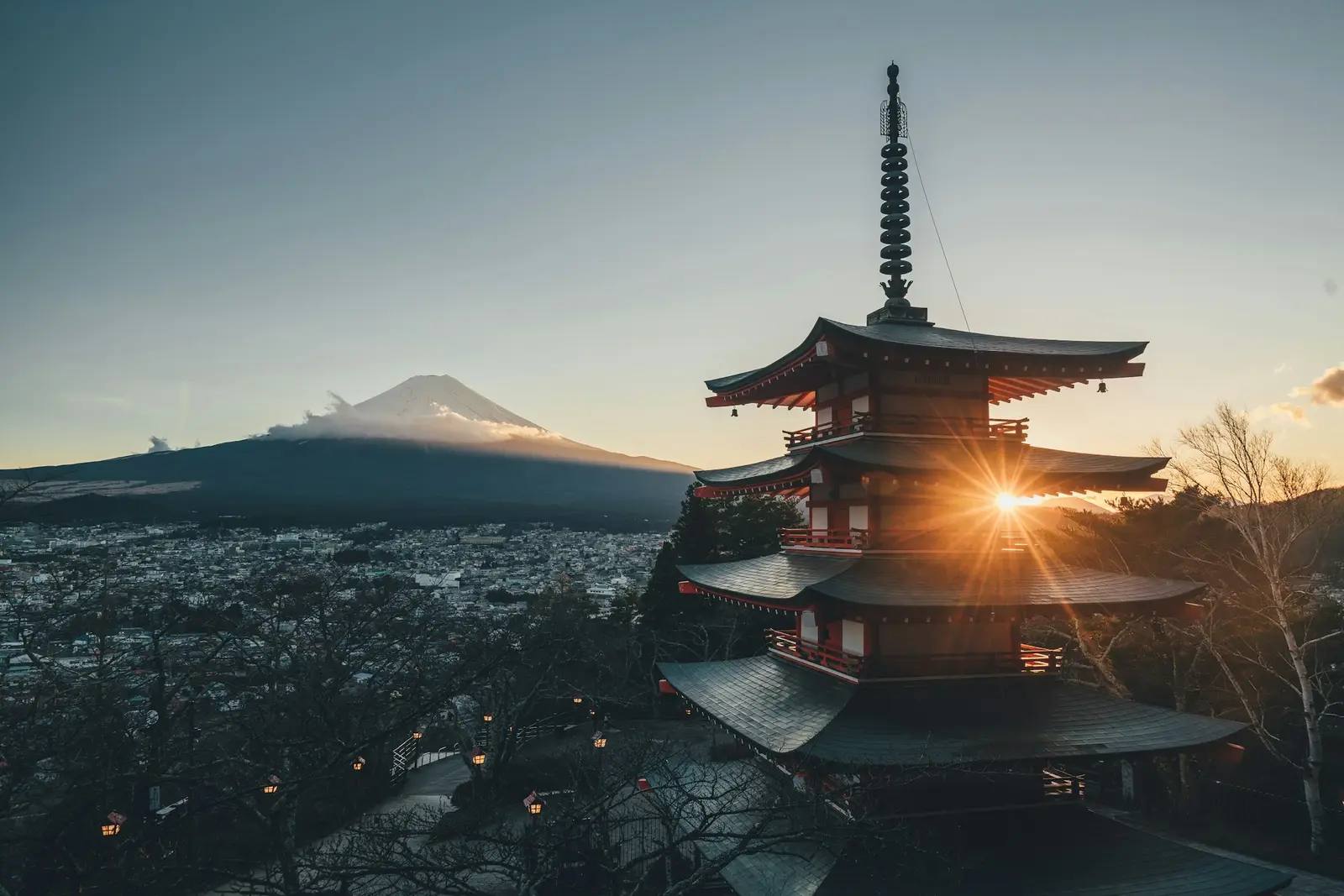
Summer is the only time when you can climb Mt. Fuji. The official season is short and runs roughly from early July to early September – only then are the mountain huts open and the paths supervised. The ascent usually takes place overnight, in order to experience the sunrise from the summit (goraikō). Since 2024 a fee and a daily limit on climbers have applied on the popular Yoshida route, in order to contain the crowds and the dangerous “bullet climbing” without an overnight stay. The exact rules change every year – anyone who would like to climb Fuji should check them beforehand.
And if you want to escape the heat, you will find surprisingly cool retreats in the same country:
- Hokkaidō: The northern island knows no oppressive humidity. Lavender fields in Furano, hiking in the national parks, a pleasant 25 °C – the ideal summer destination for those sensitive to heat.
- The Japanese Alps: High valleys such as Kamikōchi, or the highlands around Karuizawa and Hakuba, offer fresh mountain air only a few hours by train from Tokyo.
- Onsen at altitude: Mountain springs in Tōhoku or Nagano combine cooling by day with a bath in the evening.
Managing the heat – practical advice from us
The most important trick against the summer heat is the rhythm of the day: morning and evening outdoors, the midday heat indoors. The Japanese summer heat is real, but it can be handled well – over centuries the Japanese have developed an entire culture of dealing with it. What we recommend to our guests beyond that:
Planning the day
- Morning and evening outdoors, midday heat indoors. Temples and gardens in the early morning, the midday hours in museums, department stores or air-conditioned cafés, the festivals in the evening – in this way the day follows the natural rhythm of the heat.
- Depachika as a refuge: The food basements of the large department stores (depachika) are cool, fascinating and a culinary experience in themselves.
Clothing and equipment
- Light, breathable fabrics – linen and thin cotton. A parasol is increasingly a matter of course in Japan, among men as well, and is more effective than any cap.
- A small handheld fan and a cooling towel: available in every convenience store, worth their weight in gold in daily life.
- Drinking and salt: Plenty of water, together with the salt sweets or electrolyte drinks common in Japan (for example Pocari Sweat). Against heatstroke, prevention helps more than reaction.
Information
The weather app Tenki.jp shows not only the temperature but also the heat index and the heatstroke warning level for every region. On days with a declared necchūshō alert it is worth deliberately slowing the programme down.
What comes to the table in summer
Japanese cuisine has its own answer to the heat: cool, light dishes that make the summer seem almost bearable.
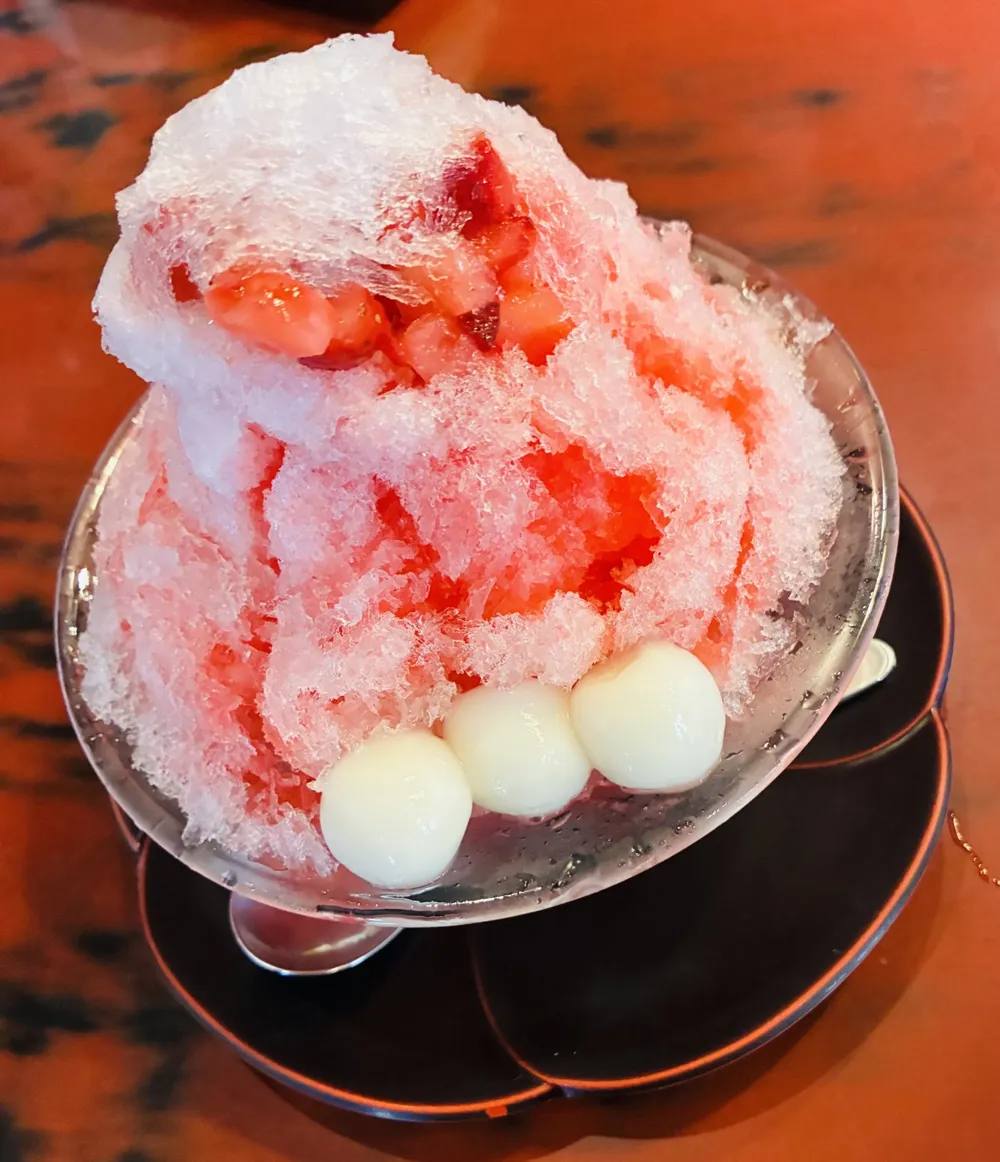
- Kakigōri (かき氷): Finely shaved ice (not ice cream, but shaved flakes of ice) with syrup, often with matcha or fruit – the summer dessert par excellence, to be found on every festival evening.
- Hiyashi Chūka (冷やし中華): Cold ramen noodles with colourful toppings, a classic of the hot months.
- Nagashi Sōmen (流しそうめん): Thin noodles that are sent through a bamboo channel with flowing water and caught as they glide past – more an experience than a meal.
- Unagi (うなぎ): Grilled eel is traditionally regarded as a strengthening food against summer fatigue, particularly on the “Day of the Ox” (Doyō no Ushi no Hi) at the end of July.
A practical note for guests on a plant-based diet: many yatai and summer dishes contain fish stock (dashi), bonito flakes or egg. How to avoid this reliably is explained in detail in our article Vegetarian & Vegan in Japan 2026.
A summer journey with festivals, planned properly
We build your route around the festivals you would like to see, secure seats and accommodation in good time and avoid the Obon bottlenecks – so that the hot season becomes a highlight.
Plan an individual summer journeyHow we plan your summer journey
In concrete terms, we reserve grandstand and seated places for you in good time, build the route around the festivals so that you experience several highlights without the Obon bottlenecks, arrange yukata rental on request and take care of rebookings in real time when typhoon warnings are issued – in English. Summer festivals in particular are hard to get hold of without local knowledge: dates vary, good seats are allocated early, and much of it takes place in Japanese. This is where we come in – as a Japan-based tour operator advising you in English:
- Grandstand and seated places for the great processions and fireworks we reserve in good time – including where booking is only possible in Japanese.
- The route around the festivals we build so that you experience several highlights without travelling through the Obon bottlenecks.
- Yukata rental and festival evenings we arrange on request, including accompaniment on the ground.
- When typhoon warnings are issued we take care of rebookings and alternative connections in real time – in English.
You can read more about when a specialist is worthwhile in our article Why a Japan Specialist? – 5 Advantages Over Booking Online.
Frequently asked questions
When is the best time for summer festivals in Japan?
The matsuri high season runs from mid-July to the end of August. The Gion Matsuri in Kyoto fills the whole of July in 2026 (processions on 17 and 24 July), the great festivals in Tōhoku (Nebuta in Aomori from 2 to 7 August, Kantō in Akita from 3 to 6 August) take place in early August, and the Awa Odori in Tokushima from 11 to 15 August. If you would like to experience several highlights, it is best to plan the journey for the first half of August – the exact dates are confirmed early every year.
How hot does it get in Japan in summer?
From mid-July to the end of August, daytime temperatures in the cities are mostly between 30 and 35 °C, with humidity often between 70 and 80 per cent. Tropical nights (nights that do not cool below 25 °C) are frequent. The perceived strain is high, which is why the weather agency issues a heatstroke warning (necchūshō alert) on hot days. With the right daily planning – morning and evening outdoors, the midday heat indoors – summer is nevertheless quite manageable.
Should you travel to Japan during Obon?
Obon falls on 13 to 16 August in 2026 and is culturally fascinating, but it coincides with the largest domestic travel wave of the year in Japan – reinforced by the public holiday Yama no Hi on 11 August, which extends the holiday week. Shinkansen, domestic flights and popular accommodation are then fully booked and more expensive. Anyone travelling at this time should avoid longer changes of location and instead stay in one place in order to experience the Bon festivals locally. With early planning, Obon can certainly be enjoyed – spontaneous rebookings, however, are difficult during this week.
Which fireworks displays in Japan are the most famous?
Among the best known are the Sumidagawa fireworks in Tokyo (in 2026 on 25 July, one of the oldest in Japan), the Nagaoka fireworks in Niigata (in 2026 on 2 and 3 August, famous for the huge Phoenix shells) and the national fireworks competition of Ōmagari in Akita (in 2026 on 29 August), where the best pyrotechnicians in the country compete against one another. The exact dates vary from year to year and should be checked before booking.
Can you climb Mt. Fuji in summer?
Yes – the official climbing season on Mt. Fuji is very short and runs roughly from early July to early September. Only during these weeks are the mountain huts open and the paths supervised. Since 2024 a fee and access restrictions have applied on the popular Yoshida route, in order to limit the crowds and the dangerous night-time bullet climbing. The exact rules change every year and should be checked for the current state before the journey.
Further reading
Our conclusion
The Japanese summer asks for an entrance ticket – and that ticket is called heat. Anyone prepared to pay it receives in return the most intense time of the Japanese year: matsuri into which you are invited as a guest, fireworks as a living art form, and in Obon a rare, dignified glimpse into the soul of the country. Added to that are the short Fuji season and cool retreats in the north and in the mountains.
Our advice remains the same as always: build your journey around what you are looking for. If you are looking for festivals, life and atmosphere, summer is your season – provided you plan carefully for the heat, the typhoon risk and the Obon week. If you want flawless weather and empty temples, you will be better served in May, in October with the beginning of the autumn leaves, or in the Japanese winter, when snow and onsen take the leading role. Both are legitimate. Both are Japan.
We are Japan Privat: a Japan-based tour operator for individual journeys through Japan, advising you in English. If you are considering whether a summer of festivals and fireworks is the right thing for you, do get in touch with us without obligation.
A first conversation of 30 minutes – free and without obligation
Tell us which festivals or experiences appeal to you. We listen, we ask questions – and together we decide whether summer or a different travel season suits you.
Request a consultationAbout the author

Kentaro Asakura
Founder of Japan Privat · A Japan specialist who guides you in English
Kentaro Asakura was born and raised in Japan. His student years took him first to the UK, where English became second nature to him, and later to Munich, where he met his wife, who is German – together they returned to Japan. With Japan Privat, he has been designing individual journeys for European travellers for more than ten years – in English, with the eyes of a local and a genuine feel for what guests from Europe are looking for.